Bismuth borate glasses were shown outperformance while compared with the commercial ones
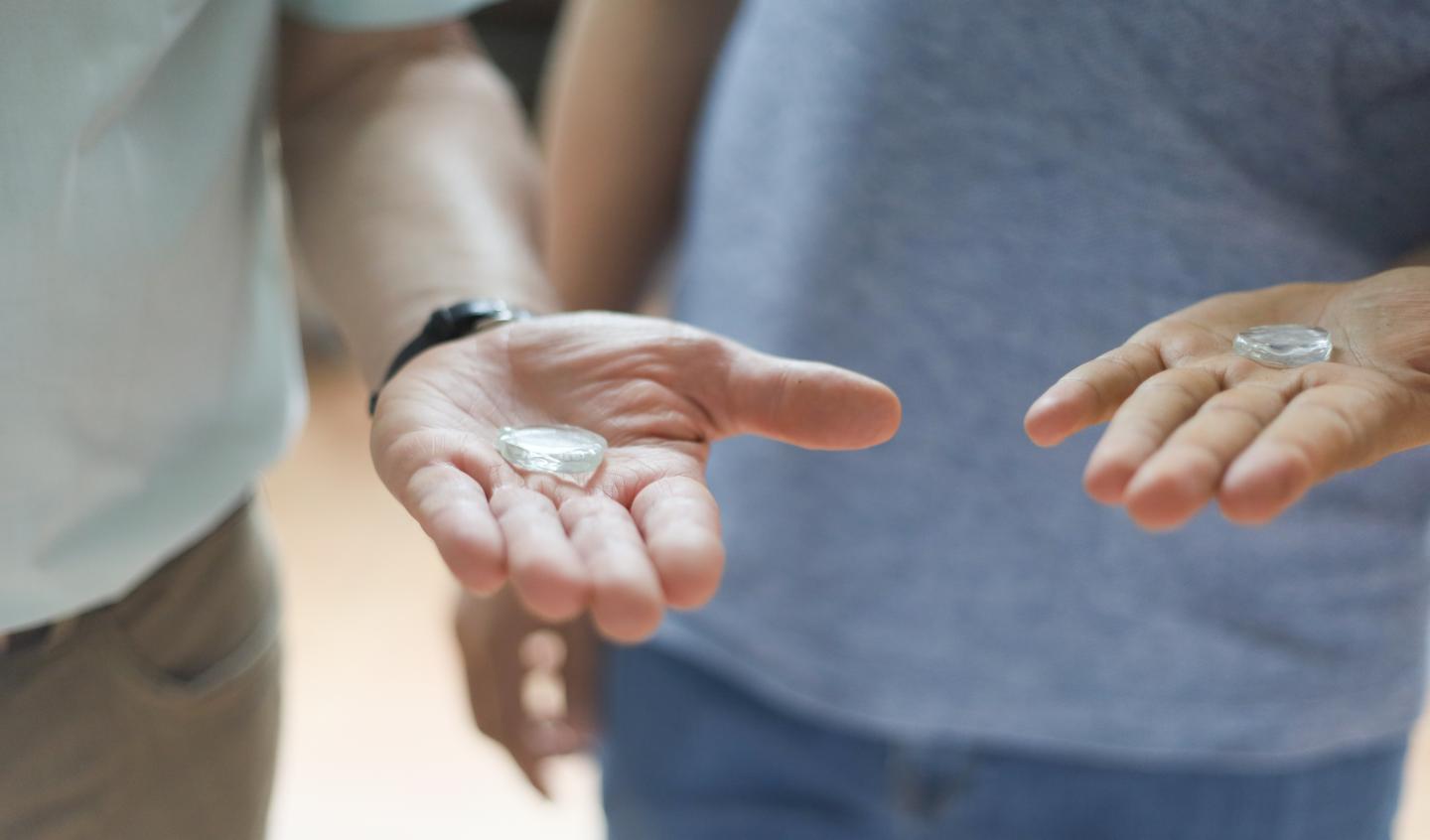
Credit: Image: UrFU / Anastasia Farafontova.
An international research team, including physics from Russia, has created new glasses for protection against X-ray and gamma radiation. Scientists could select new components that improved the characteristics of the samples and allowed to reduce the amount of lead in the glass composition. Physicists engineered several samples of glasses. One of the latest results – glasses based on barium fluoride – was described by the team in the Optic magazine. But the best results have bismuth borate glasses. Its radiation protection characteristics (mean-free-path, half-value layer) are better than commercial analogs. The features of these samples are described in the Scientific Reports.
“Gamma-ray is using in many fields like industrial (to detect defects in metal casting), medical (to treat malignant and cancerous tumors), agriculture (to control the degree of ripeness and extend the shelf life of fruits and vegetables) and space applications, etc,” says Karem Abdelazim Gaber Mahmud, co-author of the research articles, research engineer at the Ural Federal University (Russia), an employee of the Nuclear Material Authority (Egypt). “Gamma radiation has significant penetrating depths, so we are faced with the task of creating a material that could provide maximum protection and the necessary safety for workers.”
Commercial radiation shielded glasses contain predominantly lead and phosphate. Due to its high density, lead is one of the most effective protection against gamma-ra?. But this is a heavy toxic metal. Lead glass can weigh up to several hundred kilograms. Therefore, scientists worldwide try to find the optimal composition, components that would help lighten the weight of the glass, reduce the thickness, and lower cost price. Another problem is that after exceeding a certain percentage of additive materials, the glasses lose their clarity, just as after absorbing a certain dose of radiation. Therefore, on the one hand, it is necessary to minimize the amount of lead in the glass composition, while maintaining the protective properties, and on the other hand, it is necessary to extend the shelf life of the end-product, its clarity. Scientists from Jordan, Saudi Arabia, Turkey, Malaysia, China, Egypt are working most actively in this direction.
“Scientists began to create protective glasses in the late 1940s, in the early 1950s, during the formation of nuclear power,” says Oleg Tashlykov, research co-author, associate professor at Ural Federal University. “That time in England, America, Russia they were solving the problem of monitoring radiation-hazardous work. They came up with several options for glasses with different additives, but everywhere the basic components are lead and phosphate. The current trend is to choose such a composition to minimize the volume of lead, or better to replace it with another metal.”
Note that the protective properties of glass researchers have experimentally tested at the Institute of Reactor Materials of the Russian state corporation “Rosatom” (Sverdlovsk region, Russia). The next step is further research of parameters, improvement, and optimization of the composition, commercialization of technology.
###
Media Contact
Anna Marinovich
[email protected]
Original Source
http://urfu.
Related Journal Article
http://dx.