• HOME
  • NEWS
  • EXPLORE
    • CAREER
      • Companies
      • Jobs
    • EVENTS
    • iGEM
      • News
      • Team
    • PHOTOS
    • VIDEO
    • WIKI
  • BLOG
  • COMMUNITY
    • FACEBOOK
    • INSTAGRAM
    • TWITTER
Saturday, February 7, 2026
BIOENGINEER.ORG
No Result
View All Result
  • Login
  • HOME
  • NEWS
  • EXPLORE
    • CAREER
      • Companies
      • Jobs
        • Lecturer
        • PhD Studentship
        • Postdoc
        • Research Assistant
    • EVENTS
    • iGEM
      • News
      • Team
    • PHOTOS
    • VIDEO
    • WIKI
  • BLOG
  • COMMUNITY
    • FACEBOOK
    • INSTAGRAM
    • TWITTER
  • HOME
  • NEWS
  • EXPLORE
    • CAREER
      • Companies
      • Jobs
        • Lecturer
        • PhD Studentship
        • Postdoc
        • Research Assistant
    • EVENTS
    • iGEM
      • News
      • Team
    • PHOTOS
    • VIDEO
    • WIKI
  • BLOG
  • COMMUNITY
    • FACEBOOK
    • INSTAGRAM
    • TWITTER
No Result
View All Result
Bioengineer.org
No Result
View All Result
Home NEWS Science News Chemistry

Theoretical model able to reliably predict low-temperature properties of compounds

Bioengineer by Bioengineer
July 12, 2021
in Chemistry
Reading Time: 2 mins read
0
IMAGE
Share on FacebookShare on TwitterShare on LinkedinShare on RedditShare on Telegram

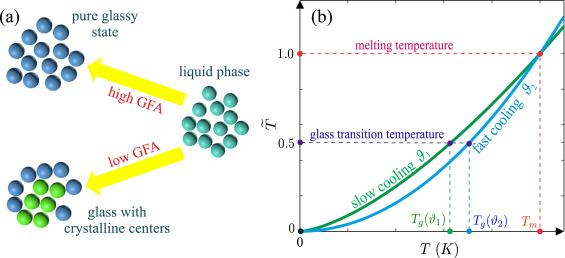
A paper by Kazan Federal University appeared in early access in Journal of Non-Crystalline Solids.
IMAGE

Credit: Kazan Federal University

Co-authors Bulat Galimzyanov and Anatolii Mokshin (Department of Computational Physics) have developed a unique model that allows for a universal interpretation of experimental data on viscosity for systems of different types, while also proposing an alternative method for classifying materials based on a unified temperature scale.

The publication was funded by Russian Science Foundation’s grant ‘Theoretical, simulation and experimental studies of physical and mechanical features of amorphous systems with inhomogeneous local viscoelastic properties’, guided by Professor Mokshin.

Using the developed viscosity model, scientists processed experimental data obtained for thirty different types of systems: from simple quartz glass to complex organic compounds such as salol and propylene carbonate.

“The model reproduces quite accurately the experimental temperature dependences of the viscosity of such materials both near the melting point and near the glass transition temperature, below which the system freezes while still preserving the liquid structure. At the same time, the model uses only two adjustable parameters. In comparison, other existing models use at least three of such parameters. Therefore, this model can be used to more accurately predict the low-temperature physical parameters of materials based on high-temperature characteristics such as thermal conductivity and entropy at the melting point,” comments Associate Professor Galimzyanov.

The results were obtained using an original method of temperature scaling.

“Earlier, we have developed a method to scale the temperature and the phase diagram of various types of systems. This gave a toll to compare the experimental temperature dependences of the viscosity of systems regardless of their preparation conditions. This temperature scale formed the basis of the developed viscosity model, which made it possible to minimize the number of adjustable parameters and improve the accuracy of data approximation,” adds Anatolii Mokshin.

The research contributes to making corrections to the existing methods of classification for glass-forming materials and to establishing a unified viscosity model for various types of compounds.

###

Media Contact
Yury Nurmeev
[email protected]

Original Source

https://eng.kpfu.ru/novosti/theoretical-model-able-to-reliably-predict-low-temperature-properties-of-compounds/

Related Journal Article

http://dx.doi.org/10.1016/j.jnoncrysol.2021.121009

Tags: Chemistry/Physics/Materials SciencesMaterialsMolecular Physics
Share12Tweet8Share2ShareShareShare2

Related Posts

blank

Breakthrough in Environmental Cleanup: Scientists Develop Solar-Activated Biochar for Faster Remediation

February 7, 2026
blank

Cutting Costs: Making Hydrogen Fuel Cells More Affordable

February 6, 2026

Scientists Develop Hand-Held “Levitating” Time Crystals

February 6, 2026

Observing a Key Green-Energy Catalyst Dissolve Atom by Atom

February 6, 2026
Please login to join discussion

POPULAR NEWS

  • Robotic Ureteral Reconstruction: A Novel Approach

    Robotic Ureteral Reconstruction: A Novel Approach

    82 shares
    Share 33 Tweet 21
  • Digital Privacy: Health Data Control in Incarceration

    63 shares
    Share 25 Tweet 16
  • Study Reveals Lipid Accumulation in ME/CFS Cells

    57 shares
    Share 23 Tweet 14
  • Breakthrough in RNA Research Accelerates Medical Innovations Timeline

    53 shares
    Share 21 Tweet 13

About

We bring you the latest biotechnology news from best research centers and universities around the world. Check our website.

Follow us

Recent News

Boosting Remote Healthcare: Stepped-Wedge Trial Insights

Barriers and Boosters of Seniors’ Physical Activity in Karachi

Evaluating Pediatric Emergency Care Quality in Ethiopia

Subscribe to Blog via Email

Enter your email address to subscribe to this blog and receive notifications of new posts by email.

Join 73 other subscribers
  • Contact Us

Bioengineer.org © Copyright 2023 All Rights Reserved.

Welcome Back!

Login to your account below

Forgotten Password?

Retrieve your password

Please enter your username or email address to reset your password.

Log In
No Result
View All Result
  • Homepages
    • Home Page 1
    • Home Page 2
  • News
  • National
  • Business
  • Health
  • Lifestyle
  • Science

Bioengineer.org © Copyright 2023 All Rights Reserved.