• HOME
  • NEWS
  • EXPLORE
    • CAREER
      • Companies
      • Jobs
    • EVENTS
    • iGEM
      • News
      • Team
    • PHOTOS
    • VIDEO
    • WIKI
  • BLOG
  • COMMUNITY
    • FACEBOOK
    • INSTAGRAM
    • TWITTER
Saturday, February 7, 2026
BIOENGINEER.ORG
No Result
View All Result
  • Login
  • HOME
  • NEWS
  • EXPLORE
    • CAREER
      • Companies
      • Jobs
        • Lecturer
        • PhD Studentship
        • Postdoc
        • Research Assistant
    • EVENTS
    • iGEM
      • News
      • Team
    • PHOTOS
    • VIDEO
    • WIKI
  • BLOG
  • COMMUNITY
    • FACEBOOK
    • INSTAGRAM
    • TWITTER
  • HOME
  • NEWS
  • EXPLORE
    • CAREER
      • Companies
      • Jobs
        • Lecturer
        • PhD Studentship
        • Postdoc
        • Research Assistant
    • EVENTS
    • iGEM
      • News
      • Team
    • PHOTOS
    • VIDEO
    • WIKI
  • BLOG
  • COMMUNITY
    • FACEBOOK
    • INSTAGRAM
    • TWITTER
No Result
View All Result
Bioengineer.org
No Result
View All Result
Home NEWS Science News Health

Team find brain mechanism that automatically links objects in our minds

Bioengineer by Bioengineer
July 8, 2021
in Health
Reading Time: 2 mins read
0
IMAGE
Share on FacebookShare on TwitterShare on LinkedinShare on RedditShare on Telegram

IMAGE

Credit: Johns Hopkins University

When people see a toothbrush, a car, a tree — any individual object — their brain automatically associates it with other things it naturally occurs with, allowing humans to build context for their surroundings and set expectations for the world.

By using machine-learning and brain imaging, researchers measured the extent of the “co-occurrence” phenomenon and identified the brain region involved. The findings appear in Nature Communications.

“When we see a refrigerator, we think we’re just looking at a refrigerator, but in our mind, we’re also calling up all the other things in a kitchen that we associate with a refrigerator,” said corresponding author Mick Bonner, a Johns Hopkins University cognitive scientist. “This is the first time anyone has quantified this and identified the brain region where it happens.”

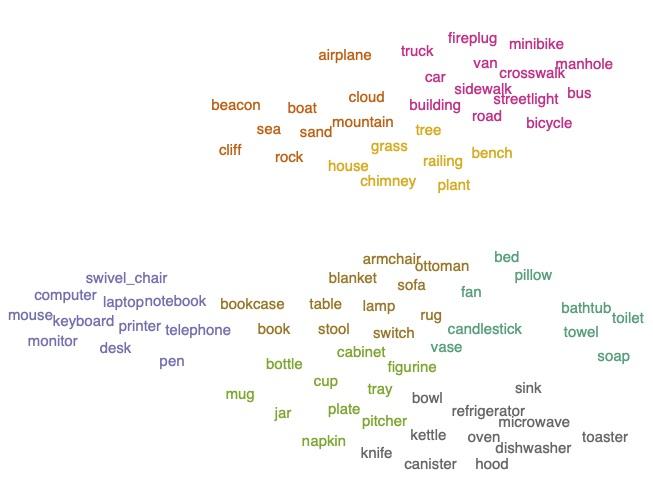
In a two-part study, Bonner and co-author, Russell Epstein, a psychology professor at the University of Pennsylvania, used a database with thousands of scenic photos with every object labeled. There were pictures of household scenes, city life, nature — and the pictures had labels for every mug, car, tree, etc. To quantify object co-occurrences, or how often certain objects appeared with others, they created a statistical model and algorithm that demonstrated the likelihood of seeing a pen if you saw a keyboard, or seeing a boat if you saw a dishwasher.

With these contextual associations quantified, the researchers next attempted to map the brain region that handles the links.

While subjects were having their brain activity monitored with functional magnetic resonance imaging, or fMRI, the team showed them pictures of individual objects and looked for evidence of a region whose responses tracked this co-occurrence information. The spot they identified was a region in the visual cortex commonly associated with the processing of spatial scenes.

“When you look at a plane, this region signals sky and clouds and all the other things,” Bonner said. “This region of the brain long thought to process the spatial environment is also coding information about what things go together in the world.”

Researchers have long-known that people are slower to recognize objects out of context. The team believes this is the first large-scale experiment to quantify the associations between objects in the visual environment as well as the first insight into how this visual context is represented in the brain.

“We show in a fine-grained way that the brain actually seems to represent this rich statistical information,” Bonner said.

###

Media Contact
Jill Rosen
[email protected]

Related Journal Article

http://dx.doi.org/10.1038/s41467-021-24368-2

Tags: Medicine/HealthMemory/Cognitive ProcessesneurobiologyPerception/Awareness
Share12Tweet8Share2ShareShareShare2

Related Posts

Barriers and Boosters of Seniors’ Physical Activity in Karachi

February 7, 2026

Evaluating Pediatric Emergency Care Quality in Ethiopia

February 7, 2026

TPMT Expression Predictions Linked to Azathioprine Side Effects

February 7, 2026

Improving Dementia Care with Enhanced Activity Kits

February 7, 2026
Please login to join discussion

POPULAR NEWS

  • Robotic Ureteral Reconstruction: A Novel Approach

    Robotic Ureteral Reconstruction: A Novel Approach

    82 shares
    Share 33 Tweet 21
  • Digital Privacy: Health Data Control in Incarceration

    63 shares
    Share 25 Tweet 16
  • Study Reveals Lipid Accumulation in ME/CFS Cells

    57 shares
    Share 23 Tweet 14
  • Breakthrough in RNA Research Accelerates Medical Innovations Timeline

    53 shares
    Share 21 Tweet 13

About

We bring you the latest biotechnology news from best research centers and universities around the world. Check our website.

Follow us

Recent News

Barriers and Boosters of Seniors’ Physical Activity in Karachi

Evaluating Pediatric Emergency Care Quality in Ethiopia

TPMT Expression Predictions Linked to Azathioprine Side Effects

Subscribe to Blog via Email

Enter your email address to subscribe to this blog and receive notifications of new posts by email.

Join 73 other subscribers
  • Contact Us

Bioengineer.org © Copyright 2023 All Rights Reserved.

Welcome Back!

Login to your account below

Forgotten Password?

Retrieve your password

Please enter your username or email address to reset your password.

Log In
No Result
View All Result
  • Homepages
    • Home Page 1
    • Home Page 2
  • News
  • National
  • Business
  • Health
  • Lifestyle
  • Science

Bioengineer.org © Copyright 2023 All Rights Reserved.