• HOME
  • NEWS
  • EXPLORE
    • CAREER
      • Companies
      • Jobs
    • EVENTS
    • iGEM
      • News
      • Team
    • PHOTOS
    • VIDEO
    • WIKI
  • BLOG
  • COMMUNITY
    • FACEBOOK
    • INSTAGRAM
    • TWITTER
Wednesday, June 24, 2026
BIOENGINEER.ORG
No Result
View All Result
  • Login
  • HOME
  • NEWS
  • EXPLORE
    • CAREER
      • Companies
      • Jobs
        • Lecturer
        • PhD Studentship
        • Postdoc
        • Research Assistant
    • EVENTS
    • iGEM
      • News
      • Team
    • PHOTOS
    • VIDEO
    • WIKI
  • BLOG
  • COMMUNITY
    • FACEBOOK
    • INSTAGRAM
    • TWITTER
  • HOME
  • NEWS
  • EXPLORE
    • CAREER
      • Companies
      • Jobs
        • Lecturer
        • PhD Studentship
        • Postdoc
        • Research Assistant
    • EVENTS
    • iGEM
      • News
      • Team
    • PHOTOS
    • VIDEO
    • WIKI
  • BLOG
  • COMMUNITY
    • FACEBOOK
    • INSTAGRAM
    • TWITTER
No Result
View All Result
Bioengineer.org
No Result
View All Result
Home NEWS Science News

New broadly applicable tool provides insight into fungicide resistance

Bioengineer by Bioengineer
July 6, 2021
in Science News
Reading Time: 2 mins read
0
IMAGE
Share on FacebookShare on TwitterShare on LinkedinShare on RedditShare on Telegram

IMAGE

Credit: Jingyu Peng, Hyunkyu Sang, Tyre J. Proffer, Jacqueline Gleason, Cory A. Outwater, Geunhwa Jung, and George W. Sundin

Succinate dehydrogenase inhibitors (SDHIs) are a class of fungicides widely used to control many fungal diseases of crops. The relationship between SDHIs and fungi can be compared to finding the right key for the right lock. However, fungi are adaptable and develop resistance to fungicides often by changing the lock so that the SDHI is no longer able to open the door. Because of this adaptability, it is important to understand the biological mechanisms of fungicide resistance.

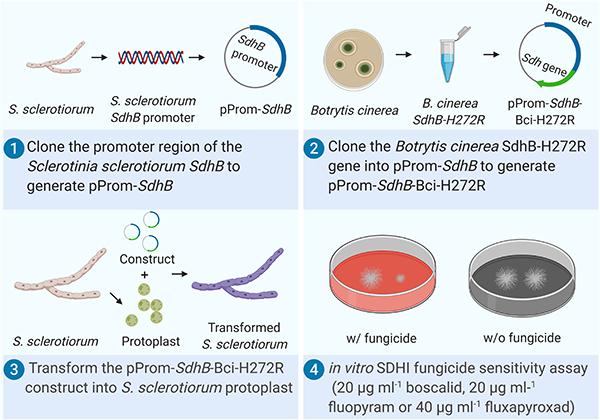
A recent collaboration between scientists in Michigan and Massachusetts as well as South Korea resulted in the development of a novel and broadly applicable molecular assay that used a model fungus to investigate how plant fungal pathogens circumvent the bioactivity of SDHIs. In other words, to study the interactions between different locks and keys. Through this analysis, they were able to successfully validate known mechanisms of fungicide resistance in several agriculturally important fungal pathogens.

Of note, they were also able to provide insights into the question: “Can newer SDHI fungicides overcome existing resistance mutations?” Their answer? Not necessarily! “We showed that the efficacy of fungicides developed in recent years will be heavily dependent on the history of fungicide application in each particular field site,” said Jingyu Peng, one of the researchers involved with this study.

Their assay and resulting study are unique compared to other studies that focus on a specific fungus. “The molecular assay we developed enables a holistic interrogation of fungicide resistance mechanisms in various pathogenic fungi,” Peng explained. “We hope our study will have a positive impact on future fungicide design as our approach is very scalable and can be implemented as a part of the resistance risk assessment protocol for future industrial fungicide discovery.”

###

For a more comprehensive understanding of fungicide resistance mechanisms and the details behind this research, read “A Method for the Examination of SDHI Fungicide Resistance Mechanisms in Phytopathogenic Fungi Using a Heterologous Expression System in Sclerotinia sclerotiorum” published in mid-April in Phytopathology Journal.

Media Contact
Ashley Carlin
[email protected]

Related Journal Article

http://dx.doi.org/10.1094/PHYTO-09-20-0421-R

Tags: Agricultural Production/EconomicsAgricultureBiologyBiotechnologyCell BiologyChemical/Biological WeaponsFood/Food ScienceMolecular BiologyMycologyPlant Sciences
Share13Tweet8Share2ShareShareShare2

Related Posts

Deep Learning Reveals ECG Sudden Death Marker — Medicine

Deep Learning Reveals ECG Sudden Death Marker

June 24, 2026

Antler Stem Cells Relieve Cerebral Ischemic Injury

June 24, 2026

Increase in Adolescent Suicidality Following State-Level Total Abortion Bans

June 24, 2026

Personalized Brain Imaging Offers New Hope for Treatment-Resistant Depression

June 24, 2026
Please login to join discussion

POPULAR NEWS

  • Saying Goodbye to PGY-6: Pediatric Fellowship Realities

    103 shares
    Share 41 Tweet 26
  • Multi-Hospital Study Reveals Long Covid Burden Is Twice as High as Current Estimates

    92 shares
    Share 36 Tweet 23
  • Detection of EDCs in Breast Milk and Infant Urine Up to Six Months Highlights Early Exposure Risks

    77 shares
    Share 31 Tweet 19
  • New Drug Candidate Developed at McMaster Shows Potential for Treating Brain Cancer

    58 shares
    Share 23 Tweet 15

About

We bring you the latest biotechnology news from best research centers and universities around the world. Check our website.

Follow us

Recent News

Deep Learning Reveals ECG Sudden Death Marker

Antler Stem Cells Relieve Cerebral Ischemic Injury

Increase in Adolescent Suicidality Following State-Level Total Abortion Bans

Subscribe to Blog via Email

Enter your email address to subscribe to this blog and receive notifications of new posts by email.

Join 82 other subscribers
  • Contact Us

Bioengineer.org © Copyright 2023 All Rights Reserved.

Welcome Back!

Login to your account below

Forgotten Password?

Retrieve your password

Please enter your username or email address to reset your password.

Log In
No Result
View All Result
  • Homepages
    • Home Page 1
    • Home Page 2
  • News
  • National
  • Business
  • Health
  • Lifestyle
  • Science

Bioengineer.org © Copyright 2023 All Rights Reserved.