• HOME
  • NEWS
  • EXPLORE
    • CAREER
      • Companies
      • Jobs
    • EVENTS
    • iGEM
      • News
      • Team
    • PHOTOS
    • VIDEO
    • WIKI
  • BLOG
  • COMMUNITY
    • FACEBOOK
    • INSTAGRAM
    • TWITTER
Saturday, February 7, 2026
BIOENGINEER.ORG
No Result
View All Result
  • Login
  • HOME
  • NEWS
  • EXPLORE
    • CAREER
      • Companies
      • Jobs
        • Lecturer
        • PhD Studentship
        • Postdoc
        • Research Assistant
    • EVENTS
    • iGEM
      • News
      • Team
    • PHOTOS
    • VIDEO
    • WIKI
  • BLOG
  • COMMUNITY
    • FACEBOOK
    • INSTAGRAM
    • TWITTER
  • HOME
  • NEWS
  • EXPLORE
    • CAREER
      • Companies
      • Jobs
        • Lecturer
        • PhD Studentship
        • Postdoc
        • Research Assistant
    • EVENTS
    • iGEM
      • News
      • Team
    • PHOTOS
    • VIDEO
    • WIKI
  • BLOG
  • COMMUNITY
    • FACEBOOK
    • INSTAGRAM
    • TWITTER
No Result
View All Result
Bioengineer.org
No Result
View All Result
Home NEWS Science News Chemistry

Scientists synthesize 3D graphene films with high-energy E-beam

Bioengineer by Bioengineer
July 6, 2021
in Chemistry
Reading Time: 2 mins read
0
IMAGE
Share on FacebookShare on TwitterShare on LinkedinShare on RedditShare on Telegram

IMAGE

Credit: LI Nian

Recently, Prof. WANG Zhenyang’s research group from the Hefei Institutes of Physical Science (HFIPS) of the Chinese Academy of Sciences (CAS) has prepared macroscopic thick three-dimensional (3D) porous graphene films.

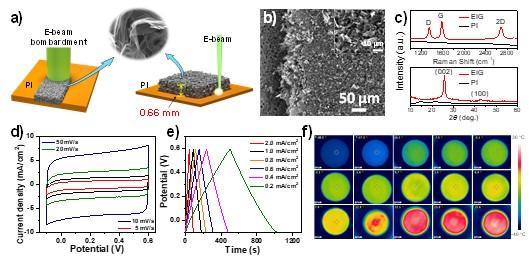
Using high-energy electron beam as the energy source and taking advantages of high kinetic energy and low reflection characteristics of e-beam, the researchers directly induced polyimide precursor into a 3D porous graphene crystal film with a thickness of up to 0.66 mm. Related research results were published in the journal Carbon.

Graphene has been proved to be a new strategic material owing to its numerous exceptional chemical and physical properties. Integrating dimensional (3D) porous graphene network can prevent restacking of graphene sheets and enables easy access and diffusion of ions. However, efficient synthesis of macroscopic thick 3D porous graphene films is still a challenge.

The high instantaneous energy of laser can induce the direct carbonization of the carbon-containing matrix to form high crystalline quality graphene. But the penetration depth of the laser into the carbon-containing matrix is quite low, resulting in insufficient thickness of the prepared graphene film, which limits its application in actual devices. Therefore, exploring a more effective energy source is a key problem that needs to be solved urgently for the industrial application of high-energy beam induced graphene.

In this research, the researchers used high-energy e-beam as a new energy source to realize efficient preparation of macroscopic thick 3D porous graphene crystal films on the polyimide precursor.

Compared with lasers, high-energy e-beam possessed lots of advantages including zero reflection, high kinetic energy, injection effect, and simple focus control, making the e-beam to be a possible better energy source than laser, which could quickly induce carbonization of polyimide precursors to produce graphene.

Hydrogen, oxygen and some other components in polyimide can rapidly escape in the form of gas, resulting in abundant 3D pore structure of graphene.

This study exhibits that the thickness of e-beam-induced graphene (EIG) film is as high as 0.66 mm, and the synthesis rate is 84 cm2/min, which is significantly larger than laser. Furthermore, EIG has been successfully applied to the field of supercapacitor electrodes, which shows excellent electrochemical storage capacity.

With prominent photothermal performance, EIG can also be applied to the field of solar photothermal anti-icing and deicing. The temperatures can be -40 °C, which is ultra-low.

###

This work was supported by the National Key Research and Development Project of China, the National Natural Science Foundation of China, and the Anhui Key Research and Development Program.

Media Contact
ZHAO Weiwei
[email protected]

Original Source

http://english.hf.cas.cn/new/news/rn/202107/t20210702_273352.html

Related Journal Article

http://dx.doi.org/10.1016/j.carbon.2021.06.035

Tags: Chemistry/Physics/Materials SciencesMaterialsMolecular Physics
Share12Tweet8Share2ShareShareShare2

Related Posts

blank

Breakthrough in Environmental Cleanup: Scientists Develop Solar-Activated Biochar for Faster Remediation

February 7, 2026
blank

Cutting Costs: Making Hydrogen Fuel Cells More Affordable

February 6, 2026

Scientists Develop Hand-Held “Levitating” Time Crystals

February 6, 2026

Observing a Key Green-Energy Catalyst Dissolve Atom by Atom

February 6, 2026
Please login to join discussion

POPULAR NEWS

  • Robotic Ureteral Reconstruction: A Novel Approach

    Robotic Ureteral Reconstruction: A Novel Approach

    82 shares
    Share 33 Tweet 21
  • Digital Privacy: Health Data Control in Incarceration

    63 shares
    Share 25 Tweet 16
  • Study Reveals Lipid Accumulation in ME/CFS Cells

    57 shares
    Share 23 Tweet 14
  • Breakthrough in RNA Research Accelerates Medical Innovations Timeline

    53 shares
    Share 21 Tweet 13

About

We bring you the latest biotechnology news from best research centers and universities around the world. Check our website.

Follow us

Recent News

Phage-Antibiotic Combo Beats Resistant Peritoneal Infection

Boosting Remote Healthcare: Stepped-Wedge Trial Insights

Barriers and Boosters of Seniors’ Physical Activity in Karachi

Subscribe to Blog via Email

Enter your email address to subscribe to this blog and receive notifications of new posts by email.

Join 73 other subscribers
  • Contact Us

Bioengineer.org © Copyright 2023 All Rights Reserved.

Welcome Back!

Login to your account below

Forgotten Password?

Retrieve your password

Please enter your username or email address to reset your password.

Log In
No Result
View All Result
  • Homepages
    • Home Page 1
    • Home Page 2
  • News
  • National
  • Business
  • Health
  • Lifestyle
  • Science

Bioengineer.org © Copyright 2023 All Rights Reserved.