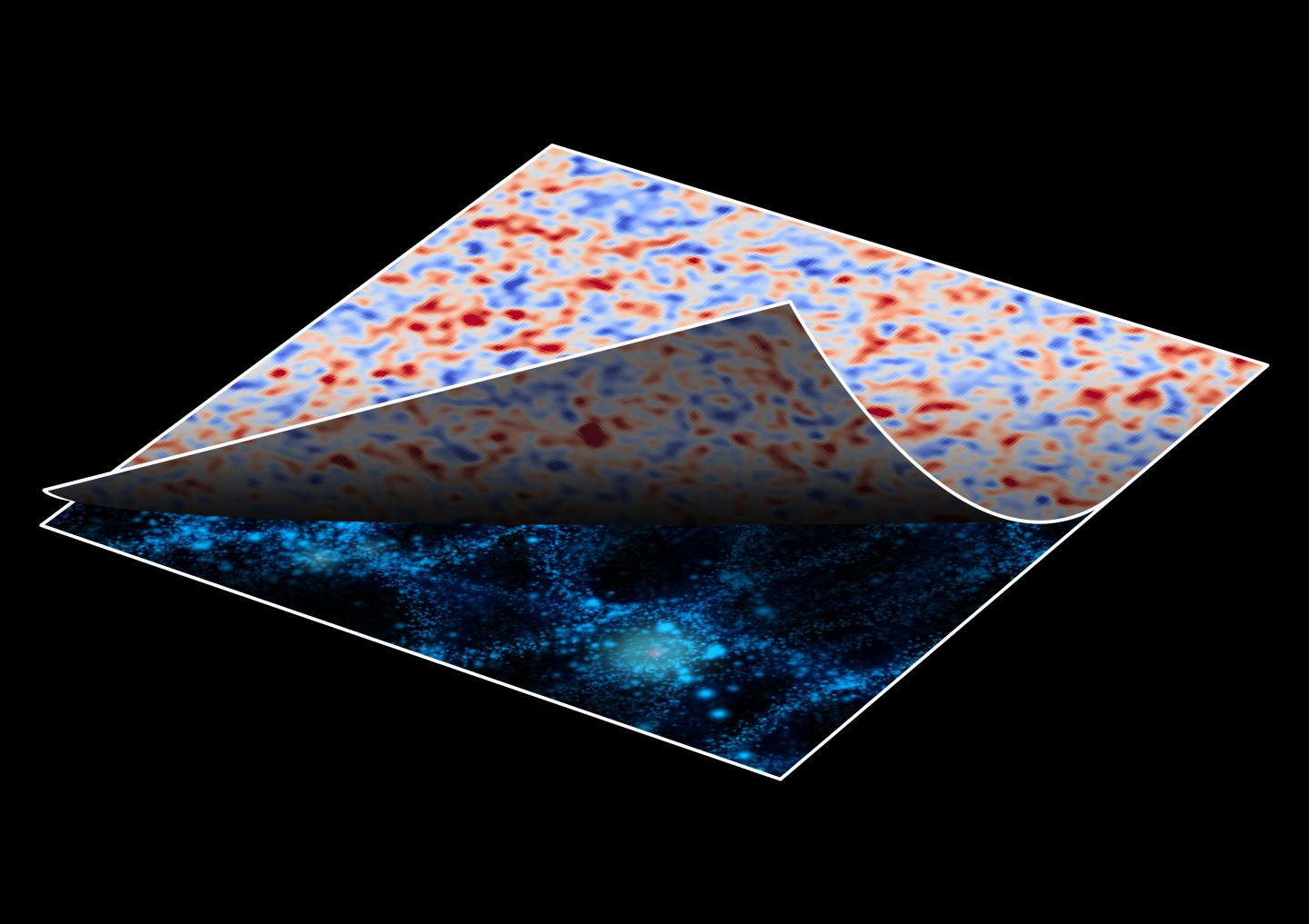
Credit: @ The Institute of Statistical Mathematics
Japanese astronomers have developed a new artificial intelligence (AI) technique to remove noise in astronomical data due to random variations in galaxy shapes. After extensive training and testing on large mock data created by supercomputer simulations, they then applied this new tool to actual data from Japan’s Subaru Telescope and found that the mass distribution derived from using this method is consistent with the currently accepted models of the Universe. This is a powerful new tool for analyzing big data from current and planned astronomy surveys.
Wide area survey data can be used to study the large-scale structure of the Universe through measurements of gravitational lensing patterns. In gravitational lensing, the gravity of a foreground object, like a cluster of galaxies, can distort the image of a background object, such as a more distant galaxy. Some examples of gravitational lensing are obvious, such as the “Eye of Horus” (https:/
But this technique of looking at many galaxy images runs into a problem; some galaxies are just innately a little funny looking. It is difficult to distinguish between a galaxy image distorted by gravitational lensing and a galaxy that is actually distorted. This is referred to as shape noise and is one of the limiting factors in research studying the large-scale structure of the Universe.
To compensate for shape noise, a team of Japanese astronomers first used ATERUI II, the world’s most powerful supercomputer dedicated to astronomy, to generate 25,000 mock galaxy catalogs based on real data from the Subaru Telescope. They then added realist noise to these perfectly known artificial data sets, and trained an AI to statistically recover the lensing dark matter from the mock data.
After training, the AI was able to recover previously unobservable fine details, helping to improve our understanding of the cosmic dark matter. Then using this AI on real data covering 21 square degrees of the sky, the team found a distribution of foreground mass consistent with the standard cosmological model.
“This research shows the benefits of combining different types of research: observations, simulations, and AI data analysis.” comments Masato Shirasaki, the leader of the team, “In this era of big data, we need to step across traditional boundaries between specialties and use all available tools to understand the data. If we can do this, it will open new fields in astronomy and other sciences.”
###
These results appeared as Shirasaki et al. “Noise reduction for weak lensing mass mapping: an application of generative adversarial networks to Subaru Hyper Suprime-Cam first-year data” in the June 2021 issue of Monthly Notices of the Royal Astronomical Society.
About The Institute of Statistical Mathematics (ISM)
The Institute of Statistical Mathematics (ISM) is part of Japan’s Research Organization of Information and Systems (ROIS). With more than 75 years of history, the institute is an internationally renowned facility for research on statistical mathematics including comprehensive evaluation of earthquake data in Japan and other parts of the world. ISM comprises three different departments including the Department of Statistical Modeling, the Department of Statistical Data, and the Department of Statistical Inference and Mathematics, as well as several key data and research centers. Through the efforts of various research departments and centers, ISM aims to continuously facilitate cutting edge research collaboration with universities, research institutions, and industries both in Japan and other countries.
About the Research Organization of Information and Systems (ROIS)
ROIS is a parent organization of four national institutes (National Institute of Polar Research, National Institute of Informatics, the Institute of Statistical Mathematics and National Institute of Genetics) and the Joint Support-Center for Data Science Research. It is ROIS’s mission to promote integrated, cutting-edge research that goes beyond the barriers of these institutions, in addition to facilitating their research activities, as members of inter-university research institutes.
Media Contact
Kozo Kitamura
[email protected]
Original Source
http://www.
Related Journal Article
http://dx.