• HOME
  • NEWS
  • EXPLORE
    • CAREER
      • Companies
      • Jobs
    • EVENTS
    • iGEM
      • News
      • Team
    • PHOTOS
    • VIDEO
    • WIKI
  • BLOG
  • COMMUNITY
    • FACEBOOK
    • INSTAGRAM
    • TWITTER
Thursday, March 26, 2026
BIOENGINEER.ORG
No Result
View All Result
  • Login
  • HOME
  • NEWS
  • EXPLORE
    • CAREER
      • Companies
      • Jobs
        • Lecturer
        • PhD Studentship
        • Postdoc
        • Research Assistant
    • EVENTS
    • iGEM
      • News
      • Team
    • PHOTOS
    • VIDEO
    • WIKI
  • BLOG
  • COMMUNITY
    • FACEBOOK
    • INSTAGRAM
    • TWITTER
  • HOME
  • NEWS
  • EXPLORE
    • CAREER
      • Companies
      • Jobs
        • Lecturer
        • PhD Studentship
        • Postdoc
        • Research Assistant
    • EVENTS
    • iGEM
      • News
      • Team
    • PHOTOS
    • VIDEO
    • WIKI
  • BLOG
  • COMMUNITY
    • FACEBOOK
    • INSTAGRAM
    • TWITTER
No Result
View All Result
Bioengineer.org
No Result
View All Result
Home NEWS Science News

In-situ structural evolution of Zr-doped Na3V2(PO4)2F3 coated by N-doped carbon for SIB

Bioengineer by Bioengineer
September 6, 2025
in Science News
Reading Time: 3 mins read
0
IMAGE
Share on FacebookShare on TwitterShare on LinkedinShare on RedditShare on Telegram

Na3V2(PO4)2F3(NVPF), a cathode material used in sodium-ion batteries (SIB), features ultrafast Na+ migration and high structural stability because of its three-dimensional open framework. However, the poor intrinsic electronic conductivity of NVPF often leads to high polarization, low Coulombic efficiency, and unsatisfactory rate performance, which hinder its commercial application.

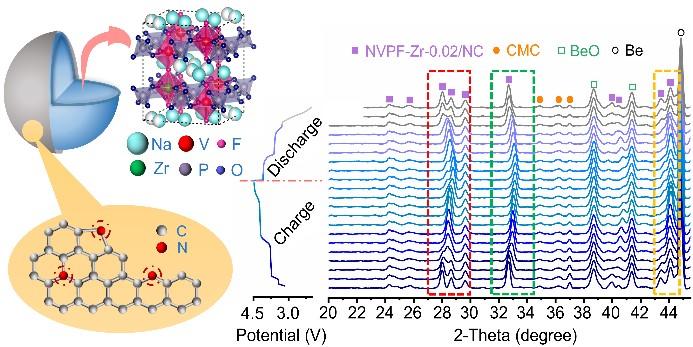
Recently, a group led by Prof. Shuangqiang Chen and Prof. Yong Wang from Shanghai University synthesized zirconium-doped NVPF nanoparticles coated with a nitrogen-doped carbon layer and demonstrated a synergistic effect on the overall electrochemical performance. Specifically, the optimized NVPF-Zr-0.02/NC electrode led to high reversible capacity (119.2 mA h g-1 at 0.5 C), superior rate capacity (98.1 mA h g-1 at 20 C), and excellent cycling performance (capacity retention of 90.2% in 1000 cycles at 20 C). In situ XRD characterization of the NVPF-Zr-0.02/NC electrode was performed to monitor the real-time structural evolution in different charge/discharge states. The results confirmed the presence of several intermediates with new phases, following a step-wise Na-extraction/intercalation mechanism with reversible multiphase changes. In addition, NVPF-Zr-0.02/NC//hard carbon full cells demonstrated a high reversible capacity of 99.8 mA h g-1 at 0.5C, with an average output voltage of 3.5 V, high energy density of ~194 Wh kg-1, and good cycling stability, thus indicating excellent potential for practical application.

“Such attempts provide meaningful guidance and reference for practical SIBs with high capacity, long cycle life, and good structural stability,” said Prof. Chen.

###

The authors gratefully acknowledge the National Natural Science Foundation of China (21975154), the Shanghai Municipal Education Commission (Innovation Program (2019-01-07-00-09-E00021) and Innovative Research Team of High-level Local Universities in Shanghai. Research is also supported by The Program for Professor of Special Appointment (Eastern Scholar) at Shanghai Institutions of Higher Learning and Shanghai Key Laboratory of Materials Protection and Advanced Materials in Electric Power. The authors thank Laboratory for Microstructures, Instrumental Analysis, and Research Center of Shanghai University for offering access to material characterizations.

This paper, entitled “In-situ structural evolution analysis of Zr-doped Na3V2(PO4)2F3 coated by N-doped carbon layer as high-performance cathode for sodium-ion batteries,” has been published in Journal of Energy Chemistry. (https://doi.org/10.1016/j.jechem.2021.06.015)

About the journal

The Journal of Energy Chemistry is a publication that mainly reports on creative researches and innovativeapplications of chemical conversions of fossil energy, carbon dioxide, electrochemical energy and hydrogen energy,as well as the conversions of biomass and solar energy related with chemical issues to promote academicexchanges in the field of energy chemistry and to accelerate the exploration, research and development of energyscience and technologies.

At Elsevier
https://www.sciencedirect.com/journal/journal-of-energy-chemistry

Manuscript submission
https://www.editorialmanager.com/jechem/default.aspx

Media Contact
Xiaoluan Wei
[email protected]

Related Journal Article

http://dx.doi.org/10.1016/j.jechem.2021.06.015

Tags: Chemistry/Physics/Materials SciencesEnergy/Fuel (non-petroleum)Industrial Engineering/ChemistryMaterials
Share12Tweet8Share2ShareShareShare2

Related Posts

Starburst Winds Drain Supernova Energy Quickly

Starburst Winds Drain Supernova Energy Quickly

March 26, 2026
Decoding the Phosphorus Puzzle: How Microplastics and Hydrochar Transform Nutrient Dynamics in Rice Paddies

Decoding the Phosphorus Puzzle: How Microplastics and Hydrochar Transform Nutrient Dynamics in Rice Paddies

March 26, 2026

Microtubules Found to Actively Ensure Accurate Chromosome Distribution During Cell Division

March 25, 2026

Aversive Learning Hijacks Brain Sugar Sensor

March 25, 2026
Please login to join discussion

POPULAR NEWS

  • blank

    Revolutionary AI Model Enhances Precision in Detecting Food Contamination

    96 shares
    Share 38 Tweet 24
  • Imagine a Social Media Feed That Challenges Your Views Instead of Reinforcing Them

    1003 shares
    Share 397 Tweet 248
  • Uncovering Functions of Cavernous Malformation Proteins in Organoids

    54 shares
    Share 22 Tweet 14
  • Promising Outcomes from First Clinical Trials of Gene Regulation in Epilepsy

    51 shares
    Share 20 Tweet 13

About

We bring you the latest biotechnology news from best research centers and universities around the world. Check our website.

Follow us

Recent News

In-Sensor Cryptography Links Physical Process to Digital Identity

Can Psychosocial Factors Influence Cancer Risk?

Depression Factors in Elderly: Pre vs. Post-COVID Analysis

Subscribe to Blog via Email

Enter your email address to subscribe to this blog and receive notifications of new posts by email.

Join 78 other subscribers
  • Contact Us

Bioengineer.org © Copyright 2023 All Rights Reserved.

Welcome Back!

Login to your account below

Forgotten Password?

Retrieve your password

Please enter your username or email address to reset your password.

Log In
No Result
View All Result
  • Homepages
    • Home Page 1
    • Home Page 2
  • News
  • National
  • Business
  • Health
  • Lifestyle
  • Science

Bioengineer.org © Copyright 2023 All Rights Reserved.