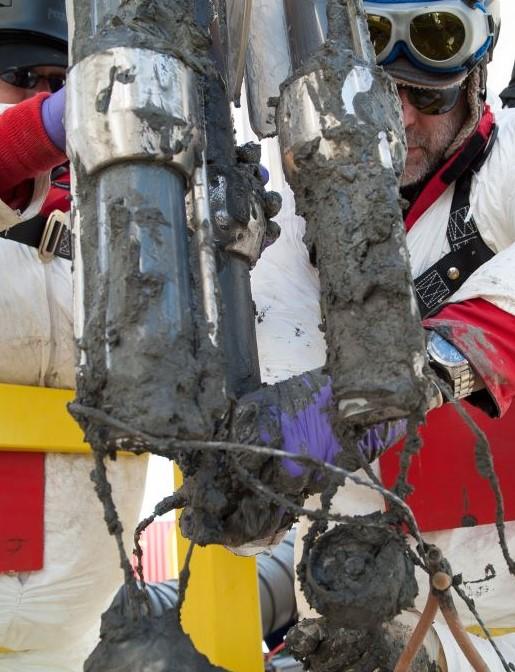
Pioneering research has revealed the erosion of ancient sediments found deep beneath Antarctic ice could be a vital and previously unknown source of nutrients and energy for abundant microbial life.
The study, led by the University of Bristol and published today in Nature’s Communications Earth & Environment journal, sheds new light on the many compounds supporting various microbes which form part of a huge subglacial ecosystem.
Lead author Dr Beatriz Gill Olivas, a Post-Doctoral Research Associate at the University of Bristol, said: “Although the study focused on samples obtained from a single subglacial lake, the results could have much wider implications. Subglacial Lake Whillans is part of a large interconnected hydrological system, so erosion taking place upstream could represent a potential source of biologically important compounds to this and other lakes within the system that might harbour thriving communities of microbial life.”
The international research team replicated erosion processes in ice sheets by crushing sediments extracted from Lake Whillans, a subglacial lake in Antarctica, spanning around 60 km2, some 800m below the ice surface, then wetting these sediments and keeping them at 0 °C without oxygen, to approximate subglacial conditions.
Findings showed a single crushing event down to a depth of 10 cm, followed by a 41-day incubation period, of these same sediments has the potential to provide up to a quarter (24 per cent) of the estimated methane required by methanotrophs, tiny microbes which depend on methane as their source of carbon and energy, present in these environments. Substantial concentrations of hydrogen and carbon dioxide were also produced during crushing and incubation. These gases could potentially be used by methane-generating microbes, called methanogens, to produce enough methane which would help explain its widely varying levels within Lake Whillans.
Another previously unidentified finding was the detection of measurable concentrations of ammonium in water after incubation with crushed sediments. This is of particular significance to Lake Whillans, where there is an abundance of microbial taxa that have the potential to derive energy from ammonium oxidation, a process known as nitrification. The study demonstrated a single high-energy crushing event, followed by the same incubation period, has the potential to produce more than the annual ammonium demand (120 per cent) within the lake.
“Our previous understanding suggests the structure and function of subglacial ecosystems depends on the presence of redox species and redox gradients within liquid water. This study shows the process of erosion could potentially split water on freshly abraded mineral surfaces and produce hydrogen (a reducing end member species) and hydrogen peroxide (a highly oxidizing compound), creating a redox gradient and providing a previously unrecognised source of energy to microbial ecosystems,” Dr Gill Olivas explained.
“Only two previous studies have looked at the potential influence of erosion on subglacial energy and nutrient sources, which involved crushing largely unweathered rock samples. This is the first study to use highly weathered, ancient marine sediments, yet concentrations of gases measured largely agreed with previous results.”
Dr Gill Olivas added: “Whilst these experiments do not reflect the true extent of erosion under glaciers, they do hint at the potential for the crushing of sediments to supply important sources of nutriment to subglacial ecosystems. Further study is now needed to identify the complete range of reactions resulting directly from erosion processes and how they may vary with differences in the underlying sediment.”
###
Paper
‘Subglacial erosion has the potential to sustain microbial processes in Subglacial Lake Whillans, Antarctica’ in Nature’s Communications Earth & Environment by Beatriz Gill Olivas et al.
Notes to editors
Dr Beatriz Gill Olivas is available for interview. To schedule this, please email [email protected] and Victoria Tagg, Media & PR Manager (Research) at the University of Bristol: [email protected]
Pictures
https:/
Caption: Photo of core catcher used to extract subglacial sediments.
Credit: John Priscu
https:/
Caption: Photo of the field location including the tents and labs set up at Subglacial Lake Whillans, Antarctica
Credit: John Priscu
https:/
Caption: Taken from a different project, SALSA, which involved drilling another subglacial lake, Lake Mercer, the photo shows the UV collar, borehole and hot water drill.
Credit: Billy Collins
https:/
Caption: Taken from the SALSA project at Subglacial Lake Mercer, the photo shows the UV collar in the borehole.
Credit: Kathy Kasic
Media Contact
Victoria Tagg
[email protected]