• HOME
  • NEWS
  • EXPLORE
    • CAREER
      • Companies
      • Jobs
    • EVENTS
    • iGEM
      • News
      • Team
    • PHOTOS
    • VIDEO
    • WIKI
  • BLOG
  • COMMUNITY
    • FACEBOOK
    • INSTAGRAM
    • TWITTER
Saturday, February 7, 2026
BIOENGINEER.ORG
No Result
View All Result
  • Login
  • HOME
  • NEWS
  • EXPLORE
    • CAREER
      • Companies
      • Jobs
        • Lecturer
        • PhD Studentship
        • Postdoc
        • Research Assistant
    • EVENTS
    • iGEM
      • News
      • Team
    • PHOTOS
    • VIDEO
    • WIKI
  • BLOG
  • COMMUNITY
    • FACEBOOK
    • INSTAGRAM
    • TWITTER
  • HOME
  • NEWS
  • EXPLORE
    • CAREER
      • Companies
      • Jobs
        • Lecturer
        • PhD Studentship
        • Postdoc
        • Research Assistant
    • EVENTS
    • iGEM
      • News
      • Team
    • PHOTOS
    • VIDEO
    • WIKI
  • BLOG
  • COMMUNITY
    • FACEBOOK
    • INSTAGRAM
    • TWITTER
No Result
View All Result
Bioengineer.org
No Result
View All Result
Home NEWS Science News Health

AI used to predict unknown links between viruses and mammals

Bioengineer by Bioengineer
September 6, 2025
in Health
Reading Time: 2 mins read
0
IMAGE
Share on FacebookShare on TwitterShare on LinkedinShare on RedditShare on Telegram

A new University of Liverpool study could help scientists mitigate the future spread of zoonotic and livestock diseases caused by existing viruses.

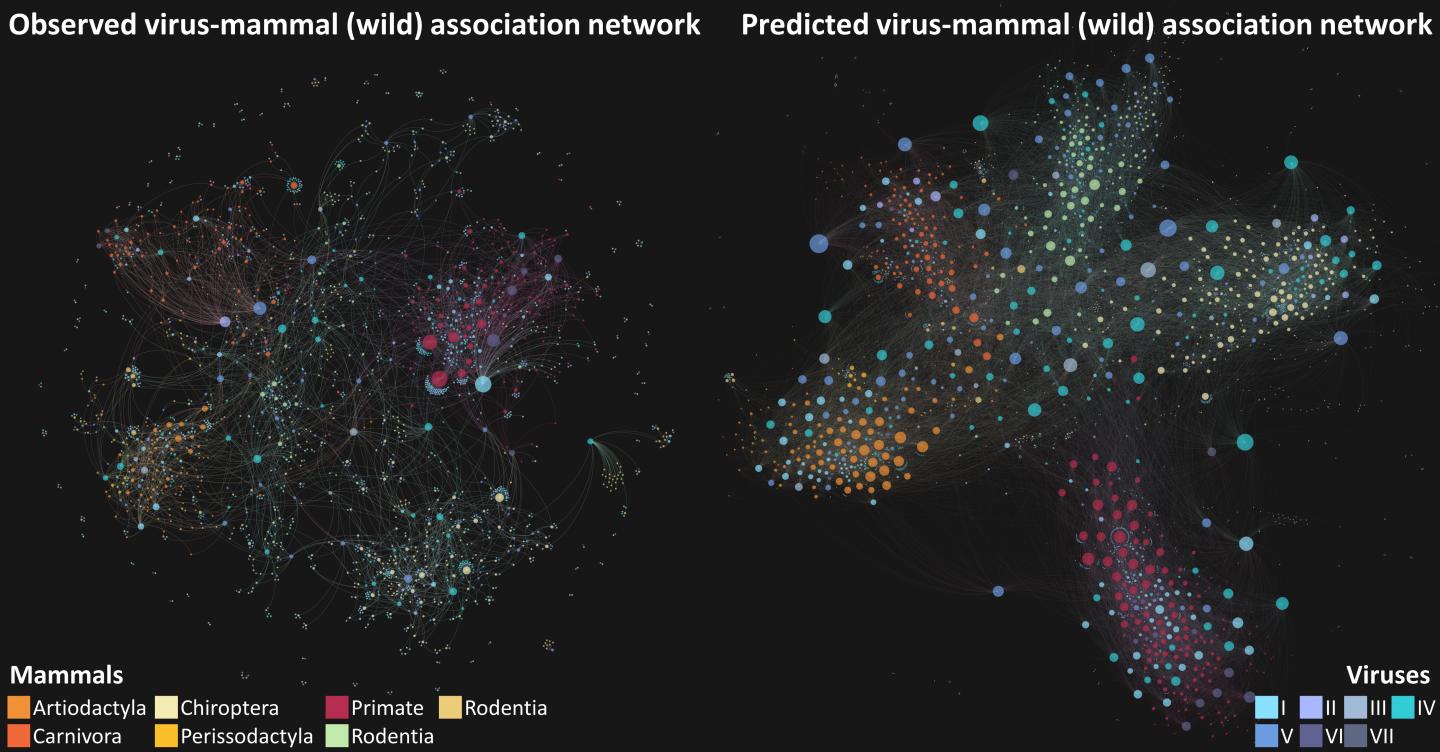
Researchers have used a form or artificial intelligence (AI) called machine-learning to predict more than 20,000 unknown associations between known viruses and susceptible mammalian species. The findings, which are published in Nature Communications, could be used to help target disease surveillance programmes.

Thousands of viruses are known to affect mammals, with recent estimates indicating that less than 1% of mammalian viral diversity has been discovered to date. Some of these viruses such as human and feline immunodeficiency viruses have a very narrow host range, whereas others such as rabies and West Nile viruses have very wide host ranges.

“Host range is an important predictor of whether a virus is zoonotic and therefore poses a risk to humans. Most recently, SARS-CoV-2 has been found to have a relatively broad host range which may have facilitated its spill-over to humans. However, our knowledge of the host range of most viruses remains limited,” explains lead researcher Dr Maya Wardeh from the University’s Institute of Infection, Veterinary and Ecological Sciences.

To address this knowledge gap, the researchers developed a novel machine learning framework to predict unknown associations between known viruses and susceptible mammalian species by consolidating three distinct perspectives – that of each virus, each mammal, and the network connecting them, respectively.

Their results suggests that there are more than five times as many associations between known zoonotic viruses and wild and semi-domesticated mammals than previously thought. In particular, bats and rodents, which have been associated with recent outbreaks of emerging viruses such as coronaviruses and hantaviruses, were linked with increased risk of zoonotic viruses.

The model also predicts a five-fold increase in associations between wild and semi-domesticated mammals and viruses of economically important domestic species such as livestock and pets.

Dr Wardeh said: “As viruses continue to move across the globe, our model provides a powerful way to assess potential hosts they have yet to encounter. Having this foresight could help to identify and mitigate zoonotic and animal-disease risks, such as spill-over from animal reservoirs into human populations.”

Dr Wardeh is currently expanding the approach to predict the ability of ticks and insects to transmit viruses to birds and mammals, which will enable prioritisation of laboratory-based vector-competence studies worldwide to help mitigate future outbreaks of vector-borne diseases.

###

Media Contact
Nicola Frost
[email protected]

Related Journal Article

http://dx.doi.org/10.1038/s41467-021-24085-w

Tags: BioinformaticsBiologyEcology/EnvironmentInfectious/Emerging DiseasesPopulation BiologyVirology
Share13Tweet8Share2ShareShareShare2

Related Posts

Evaluating Pediatric Emergency Care Quality in Ethiopia

February 7, 2026

TPMT Expression Predictions Linked to Azathioprine Side Effects

February 7, 2026

Improving Dementia Care with Enhanced Activity Kits

February 7, 2026

Decoding Prostate Cancer Origins via snFLARE-seq, mxFRIZNGRND

February 7, 2026
Please login to join discussion

POPULAR NEWS

  • Robotic Ureteral Reconstruction: A Novel Approach

    Robotic Ureteral Reconstruction: A Novel Approach

    82 shares
    Share 33 Tweet 21
  • Digital Privacy: Health Data Control in Incarceration

    63 shares
    Share 25 Tweet 16
  • Study Reveals Lipid Accumulation in ME/CFS Cells

    57 shares
    Share 23 Tweet 14
  • Breakthrough in RNA Research Accelerates Medical Innovations Timeline

    53 shares
    Share 21 Tweet 13

About

We bring you the latest biotechnology news from best research centers and universities around the world. Check our website.

Follow us

Recent News

Evaluating Pediatric Emergency Care Quality in Ethiopia

TPMT Expression Predictions Linked to Azathioprine Side Effects

Improving Dementia Care with Enhanced Activity Kits

Subscribe to Blog via Email

Success! An email was just sent to confirm your subscription. Please find the email now and click 'Confirm' to start subscribing.

Join 73 other subscribers
  • Contact Us

Bioengineer.org © Copyright 2023 All Rights Reserved.

Welcome Back!

Login to your account below

Forgotten Password?

Retrieve your password

Please enter your username or email address to reset your password.

Log In
No Result
View All Result
  • Homepages
    • Home Page 1
    • Home Page 2
  • News
  • National
  • Business
  • Health
  • Lifestyle
  • Science

Bioengineer.org © Copyright 2023 All Rights Reserved.