Pheromones mediate asymmetric mating behavior in isogamous yeast
Researchers from the Max-Planck Institute for Terrestrial Microbiology have discovered a surprising asymmetry in the mating behavior of unicellular yeast that emerges solely from molecular differences in pheromone signaling. Their results, published in the current issue of “Science Advances“, might shed new light on the evolutionary origins of sexual dimorphism in higher eukaryotes.
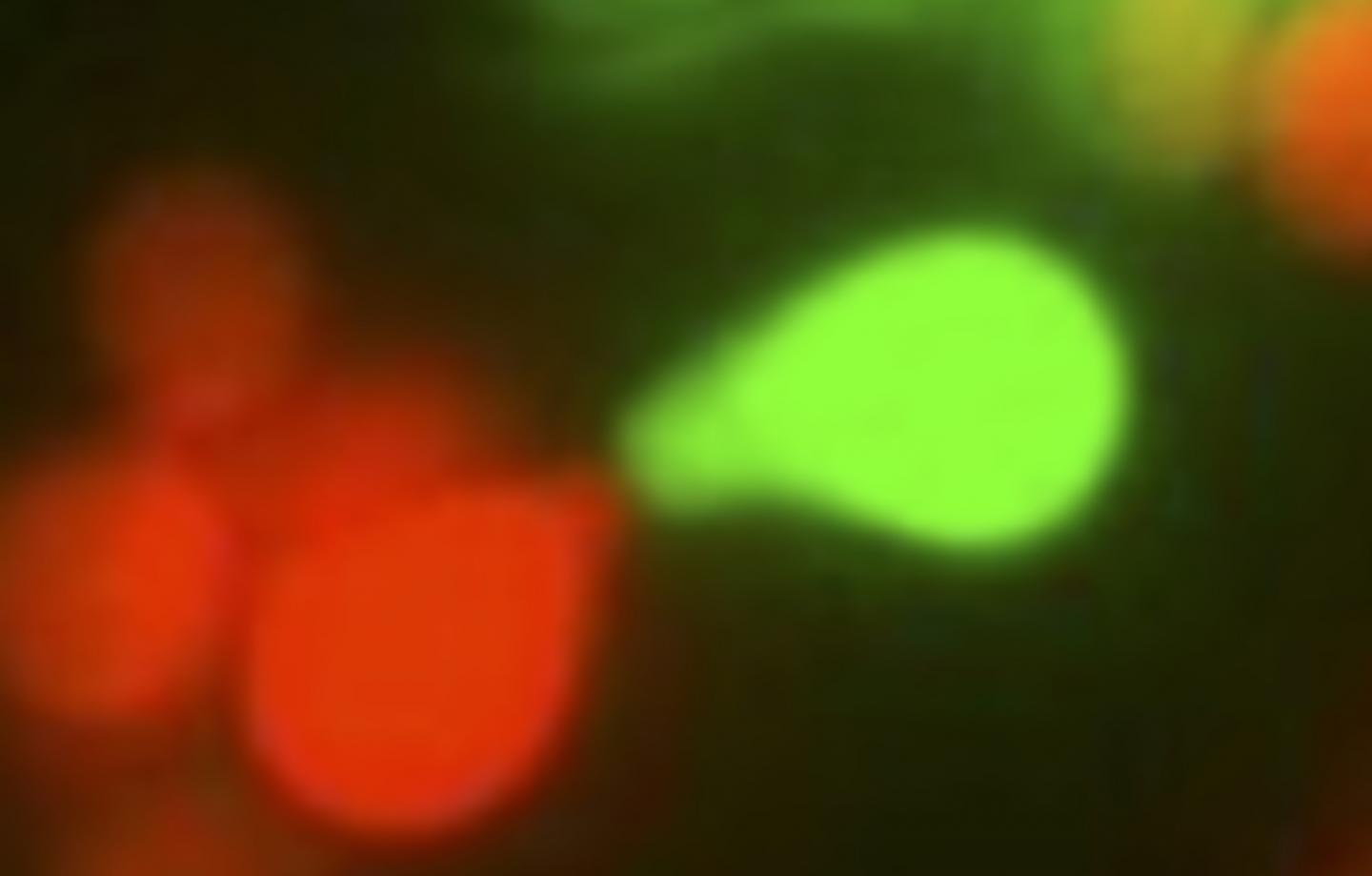
Resemblant of higher organisms, yeast gametes communicate during the mating process by secreting and sensing sexual pheromones. However, in contrast to higher eukaryotes, budding yeast is isogamous: seen through a microscope, gametes of both mating types (“sexes”), MATa and MATα, look exactly the same. Since anisogamy — difference in size between male and female gametes –was considered to be the starting point of sexual selection that drives the evolution of differences in sexual behavior, mating types of S. cerevisiae were assumed to be not only morphologically but also behaviorally symmetric.
Now a research team led by Victor Sourjik from the Max-Planck Institute for Terrestrial Microbiology and his former postdoctoral fellow Alvaro Banderas, now at the Institut Curie in Paris, has discovered a hidden behavioral asymmetry that emerges solely from molecular differences in pheromone signaling between the two mating types, which might have wide-reaching implications for understanding evolution of sexual dimorphism in higher organisms.
Yeast mating involves a- and α-pheromones that trigger the interactions between the two different types, MATa and MATα. Although the pheromones and their respective receptors are chemically different, the remainder of the pheromone response pathway (one of the best-studied models for eukaryotic signal transduction) is the same for both mating types. It was therefore thought that in yeast, as well as in other isogamous eukaryotic microorganisms, molecular differences between the a- and α-pheromones and their receptors are only required in order to ensure self-incompatibility between the two mating types but have no further functional consequences.
“As a matter of fact, our original intention was to confirm that the behavior of both mating types is similar. Yet, to our surprise, we found it to be strikingly different”, says Alexander Anders, first author of the manuscript.
Remarkably, the observed differences, with MATa cells exhibiting exploratory search behavior and MATα cells showing short-range gradient sensing and polarization towards the proximal mate, resemble well-established asymmetries between gametes in anisogamous organisms. “It turns out that behavioral asymmetry of the gametes is not necessarily a consequence of anisogamy, but could actually have preceded it – this challenges the previous assumptions on evolution by sexual selection as the sole generative mechanism of differences in mating behavior between sexes”, says Alvaro Banderas, the co-corresponding author of the manuscript.
Importantly, mathematical modeling and computer simulations suggest that such asymmetric behavior might provide selective fitness advantage by enhancing efficiency of mating over a wide range of environments. “Behavioral asymmetry could maximize frequency of mating encounters under different conditions, meaning that it might be an evolutionary selected emergent property”, says Remy Colin, who performed mathematical modeling.
What do these findings tell us about the origins of sexual behavior? “Although further theoretical analysis is clearly required to test our hypothesis”, emphasizes Victor Sourjik, “our work on mating of a model unicellular eukaryote provides a new perspective on what might have been the starting point for the evolution of the amazing diversity of sexual dimorphisms observed today”.
###
Original publication
Anders, A.; Colin, R.; Banderas, A; Sourjik, V.
Asymmetric mating behavior of isogamous budding yeast.
Science Advances 7, eabf8404 (2021)
Published 11 Jun 2021
Media Contact
Dr. Virginia Geisel
[email protected]
Original Source
https:/
Related Journal Article
http://dx.