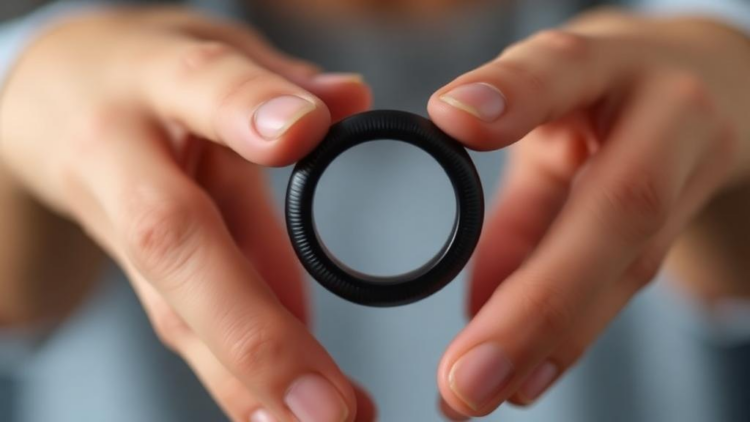
A sleek titanium ring worn on a finger, sold to consumers as a sleep and fitness gadget, may be able to detect the physiological fingerprints of depression and anxiety, according to a new study published in BMC Medicine. Researchers from the University of Oulu in Finland and TU Dortmund University in Germany found that people with more severe symptoms of these common mental health conditions showed measurably different sleep architecture, nighttime heart rate, heart rate variability, and daily movement patterns than their symptom-free peers. The findings, drawn from more than a thousand young adults in a nationally significant birth cohort, suggest that consumer-grade wearables could become a low-cost, continuous window into mental well-being, one that does not depend on questionnaires or clinic visits.
The study tapped the Northern Finland Birth Cohort 1986, one of the world’s longest-running population-based longitudinal studies, which has followed thousands of individuals since before birth. When participants reached 33 to 35 years of age, they were asked to wear an Oura Ring, a commercially available smart ring, for two weeks. To ensure the data were robust, the researchers only included participants who provided at least one weekday and one weekend day with no less than fifteen hours of wear time. That filtering step left 1,290 participants with valid recordings, a remarkably large sample for research involving continuous physiological monitoring.
During those two weeks, the ring captured an unusually rich set of digital metrics. It recorded sleep architecture, meaning the distribution of sleep stages across the night, including rapid eye movement (REM) sleep, deep sleep, and light sleep. It measured nocturnal heart rate using photoplethysmography, an optical technique that tracks blood volume pulses beneath the skin. It derived heart rate variability, indexed by the root mean square of successive differences between normal heartbeats, a statistic known as RMSSD that reflects the fine-tuned activity of the autonomic nervous system. And it logged minute-by-minute movement intensity throughout the day, providing an objective picture of physical activity levels.
Mental health symptoms were assessed with two well-validated screening instruments. The Generalized Anxiety Disorder 7-item scale, or GAD-7, quantified anxiety symptoms, allowing participants to be grouped into no, mild, and moderate-to-severe symptom categories. The Hopkins Symptom Checklist-25, or HSCL-25, captured a broader blend of depression and anxiety symptoms, dividing participants into those with and without clinically relevant symptom burden. The researchers then compared the wearable-derived metrics across these groups using analysis of covariance, a statistical technique that controls for potential confounding variables, followed by Tukey’s post hoc test to pinpoint which group differences were statistically meaningful.
The results were striking in their consistency. Participants with moderate-to-severe anxiety on the GAD-7, and those flagged by the HSCL-25 as having depression and anxiety symptoms, spent a lower percentage of the night in REM sleep and deep sleep, and a higher percentage in light sleep, compared with participants who reported no depression or anxiety. REM sleep is the stage most closely associated with emotional memory processing and mood regulation, while deep sleep supports physical restoration and cognitive function. A shift away from these restorative stages toward lighter, more fragmented sleep is a well-documented feature of mood and anxiety disorders, but it had rarely been captured so cleanly in a free-living population using an unobtrusive consumer device.
The physiological differences extended beyond sleep staging. The symptomatic groups showed higher nocturnal heart rates and lower RMSSD during sleep, a combination that points to sustained sympathetic arousal, the fight-or-flight branch of the autonomic nervous system remaining more active than usual even during rest. Elevated resting heart rate and suppressed heart rate variability are classic correlates of chronic stress and have been linked in prior research to cardiovascular risk, making their presence in young adults with mental health symptoms particularly noteworthy. In parallel, the same groups recorded lower levels of physical activity during the day, consistent with the fatigue, anhedonia, and behavioral withdrawal that often accompany depression and anxiety.
Notably, the picture was less clear-cut for people with mild anxiety. The differences between the mild anxiety group and both the symptom-free and moderate-to-severe groups were overall less apparent on average, suggesting that the wearable metrics scale with symptom severity rather than merely detecting the presence of any symptoms at all. This dose-response-like pattern strengthens the argument that the ring’s data carry genuine signal about mental state, rather than simply flagging anyone who differs from the population average. It also hints at a potential role for such devices in tracking symptom trajectories over time, since worsening physiology might accompany worsening symptoms.
The researchers describe these wearable-derived measures as digital biomarkers, objective physiological and behavioral signals that can be collected continuously and passively in everyday life. The concept of digital phenotyping, using data from personal devices to characterize health states, has gained momentum as smartphones and wearables have become ubiquitous. What distinguishes this study is its population-based design and its use of a consumer-grade device rather than research-grade laboratory equipment. Polysomnography, the gold standard for sleep measurement, requires an overnight clinic stay with electrodes glued to the scalp and chest, an experience so intrusive that a single night’s recording may not represent typical sleep. A ring, by contrast, collects weeks of data in the participant’s own bed.
The implications reach into clinical practice and public health alike. Depression and anxiety are among the most common mental health conditions worldwide, yet they are frequently underdiagnosed, and treatment monitoring typically relies on periodic self-report questionnaires that are vulnerable to recall bias and stigma. If wearable metrics can complement these tools, clinicians might one day spot early warning signs between appointments, tailor interventions to individual physiological profiles, and evaluate treatment response with far greater temporal resolution. The study’s authors suggest that consumer wearables may be a promising tool for enhancing symptom tracking and informing personalized care strategies, though they stop short of claiming diagnostic capability.
Important caveats remain. The study was cross-sectional, capturing a snapshot in time, so it cannot determine whether the physiological differences cause the symptoms, result from them, or arise from shared underlying factors. The cohort, born in northern Finland in 1986, is predominantly young and Finnish, and generalization to other ages and populations will require further study. Screening questionnaires are not clinical diagnoses, and the effect sizes, while statistically significant, describe group averages rather than individual predictions. Still, the scale and consistency of the findings mark a milestone for the field. As wearables spread to hundreds of millions of wrists and fingers, the quiet data they gather each night may prove to be one of the most valuable untapped resources in mental health research, turning an ordinary consumer gadget into a sentinel for the mind.
Subject of Research: Digital biomarkers of depression and anxiety severity measured with a consumer wearable ring
Article Title: Severity of depression and anxiety symptoms is reflected in physiological and behavioral metrics collected from a consumer-grade wearable ring
Article References: Azadifar, S., Sameh, A., Nauha, L., Kärmeniemi, M., Niemelä, M., & Farrahi, V. (2026). Severity of depression and anxiety symptoms is reflected in physiological and behavioral metrics collected from a consumer-grade wearable ring. BMC Medicine, 24(1), Article 532. https://doi.org/10.1186/s12916-026-05276-y
Image Credits: AI Generated
DOI: 10.1186/s12916-026-05276-y
Keywords: wearable technology, digital biomarkers, depression, anxiety, Oura ring, sleep architecture, heart rate variability, mental health, digital phenotyping, Northern Finland Birth Cohort, BMC Medicine, population health
Cite Scienmag News
APA MLA Chicago
Glenn Wilkins. (October 1, 2026). Smart Ring Data Reveal Hidden Signs of Depression and Anxiety. Scienmag. https://scienmag.com/smart-ring-data-reveal-hidden-signs-of-depression-and-anxiety/
Glenn Wilkins. “Smart Ring Data Reveal Hidden Signs of Depression and Anxiety.” Scienmag, 1 October 2026, https://scienmag.com/smart-ring-data-reveal-hidden-signs-of-depression-and-anxiety/. Accessed 1 October 2026.
Glenn Wilkins. “Smart Ring Data Reveal Hidden Signs of Depression and Anxiety.” Scienmag. October 1, 2026. https://scienmag.com/smart-ring-data-reveal-hidden-signs-of-depression-and-anxiety/
Copy citation Download RIS
Tags: anxietyBMC Medicineconsumer-grade mental health wearablescontinuous mental well-being trackingDepressiondigital biomarkersdigital phenotypingheart rate variabilitylong-term mental health studieslow-cost mental health screening toolsMental healthmental health monitoringNorthern Finland Birth CohortNorthern Finland Birth Cohort mental health researchOura ringOura Ring sleep and activity dataphysiological biomarkers of depressionpopulation healthsleep and heart rate variability in mental healthsleep architecturesleep architecture and mental healthsmart rings for anxiety assessmentwearable technologywearable technology for depression detection