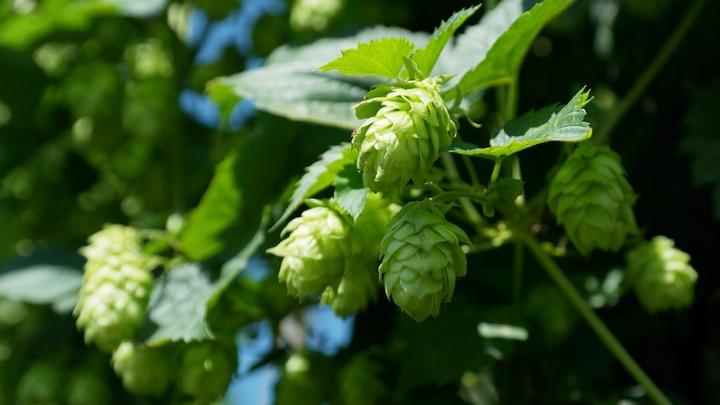
CORVALLIS, Ore. – Research by Oregon State University suggests a pair of compounds originating from hops can help thwart a dangerous buildup of fat in the liver known as hepatic steatosis.
The findings, published today in eLife, are important because the condition affects roughly one-fourth of people in the United States and Europe. While heavy drinking is often associated with liver problems, people with little or no history of alcohol use comprise that 25%, which is why their illness is known as non-alcoholic fatty liver disease, or NAFLD.
Resistance to insulin, the hormone that helps control blood sugar levels, is a risk factor for NAFLD, as are obesity, a high-fat diet and elevated levels of fat in the blood. The liver helps the body process nutrients and also acts as a filter for the circulatory system, and too much fat in the liver can lead to inflammation and liver failure.
XN is a prenylated flavonoid produced by hops, the plant that gives beer its flavor and color, and TXN is a hydrogenated derivative of XN.
In the study, 60 mice were randomly assigned to one of five groups – low-fat diet, high-fat diet, high-fat diet supplemented by XN, high-fat diet supplemented by more XN, and high-fat diet supplemented by TXN.
The scientists found that TXN helped put the brakes on the weight gain associated with a high-fat diet and also helped stabilize blood sugar levels, both factors in thwarting the buildup of fat in the liver.
“We demonstrated that TXN was very effective in suppressing the development and progression of hepatic steatosis caused by diet,” said Gombart, professor of biochemistry and biophysics in the OSU College of Science and a principal investigator at the Linus Pauling Institute. “TXN appeared to be more effective than XN perhaps because significantly higher levels of TXN are able to accumulate in the liver, but XN can slow progression of the condition as well, at the higher dose.”
The mechanism behind the compounds’ effectiveness involves PPARγ, a nuclear receptor protein – one that regulates gene expression. PPARγ controls glucose metabolism and the storage of fatty acids, and the genes it activates stimulate the creation of fat cells from stem cells.
XN and TXN act as “antagonists” for PPARγ – they bind to the protein without sending it into action, unlike a PPARγ agonist, which would activate it as well as bind to it. The upshot of antagonism in this case is less fat collecting in the liver.
“Activated PPAR? in liver stimulates storage of lipids and our data suggest that XN and TXN block activation and greatly reduce expression of the genes the promote lipid storage in the liver,” Gombart elaborated. “These findings are consistent with studies that show weaker PPARγ agonists are more effective at treating hepatic steatosis than strong agonists. In other words, lower PPARγ activation in the liver may be beneficial.”
TXN was better at accumulating in the liver than XN, which may explain why it was more effective in reducing lipids, but the difference in tissue accumulation is not fully understood.
“It may be because XN is metabolized by the host and its gut microbiota more than TXN is, but additional studies are needed to figure that out,” Gombart said. “Also, while XN and TXN are effective preventative approaches in rodents, future studies need to determine if the compounds can treat existing obesity in humans. But our findings suggest antagonism of PPARγ in the liver is a logical approach to prevent and treat diet-induced liver steatosis and related metabolic disorders, and they support further development of XN and TXN as low-cost therapeutic compounds.”
###
Also collaborating on this research were Yang Zhang, Matthew Robinson, Donald Jump and Carmen Wong of OSU’s College of Public Health and Human Sciences; Gerd Bobe of the College of Agricultural Sciences; Cristobal Miranda and Fred Stevens of the College of Pharmacy; Malcolm Lowry, Thomas Sharpton, Claudia Maier and Victor Hsu of the College of Science; and Christiane V. Lo?hr of the Carlson College of Veterinary Medicine.
Funding the study were the National Institutes of Health; the Linus Pauling Institute; the OSU College of Pharmacy; Hopsteiner, Inc; and the OSU Foundation Buhler-Wang Research Fund.
Media Contact
Adrian Gombart
[email protected]
Original Source
https:/
Related Journal Article
http://dx.