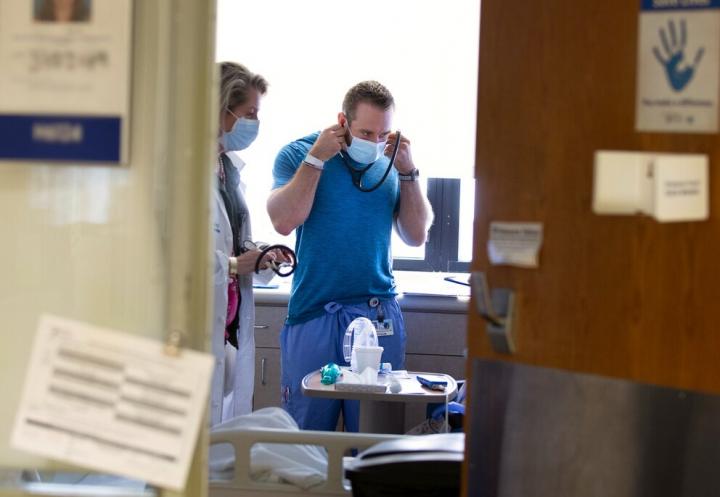
The American Medical Association (AMA) has awarded Penn State College of Medicine $1.8 million to lead a five-year, multi-institution initiative that aims to better prepare resident physicians to practice medicine. The goal is to equip residents with the knowledge, skills and attitudes they need to deliver the best patient care possible amidst the complexities of ever-evolving health systems.
The grant is part of the AMA Reimagining Residency initiative, which supports 11 innovation projects led by medical schools, residency programs and health systems from across the country. These projects will help ensure future physicians are prepared for and safely transition from medical school to residency, develop the skills needed to enhance their readiness for practice, and train in an environment that promotes their well-being.
“After establishing a framework for creating the medical schools of the future, the AMA is now supporting innovation projects to significantly improve residency training. We are pleased to include Penn State College of Medicine’s project as part of our effort to better align residency training with the evolving needs of patients and communities, as well as the workforce needs of the current and future health care system,” said AMA Group Vice President of Medical Education, Dr. Susan Skochelak. “As the health care landscape and technology rapidly evolve, the AMA will continue working with its community of innovation to drive the future of medicine by supporting significant redesign in physician training.”
Dr. Terry Wolpaw, vice dean for educational affairs, is leading a group of educators and resident physicians from the College of Medicine, Allegheny Health Network, Geisinger and Kaiser Permanente to enhance residency education with support from the Accreditation Council for Graduate Medical Education and members of the AMA’s Accelerating Change in Medical Education Consortium. The goal of the multi-year initiative is to train residents in systems-based practice competencies and to identify barriers they may have to integrate these concepts into their practice.
“Penn State College of Medicine is proud to lead this project that aims to shape the future of graduate medical education,” said Dr. Edward Bollard, associate dean for graduate medical education. “Our goal is to ensure that our trainees provide the best care possible for their patients by understanding the health systems they work in and how to navigate them.”
Dr. Jed Gonzalo, associate dean for health systems education, said that the project will build off of previous funding the College of Medicine received from the AMA to develop and implement curriculum changes supporting health systems science and medical education transformation.
“Health systems science is all about ensuring patients receive good care,” Gonzalo said. “We hope to help our residents understand that while the role they play in a patient’s care is important, there is a more complex set of factors influencing a patient’s care from the time they leave the office or are discharged that can influence whether they are receiving optimal care.”
Gonzalo, who played a key role in the writing of the original textbook on health systems science, said that this project is innovative in its team-based approach. Educators and residents from the College of Medicine and the other three health systems will collaborate to identify barriers to implementing health systems science competencies into practice while also proposing and piloting possible solutions for implementation.
“This project ties directly into the College of Medicine’s newly launched strategic plan,” Gonzalo said. “Training residents to deliver exceptional care by navigating complex health systems demonstrates our commitment to develop future health care professionals who utilize the principles of health systems science to enhance health and community impact.”
The project kicked off in the spring of 2020 with leaders from each institution meeting weekly to discuss their progress. Five work groups have formed that are focusing on initiatives ranging from defining the qualities of a systems-focused physician to measuring how changes to graduate medical education programs affect patient outcomes. One of the work groups is focused on helping residency programs implement systems-based processes. Within the next year, project leaders hope to launch pilots of their proposed systems-based training into residency programs and will measure the success of those pilots in the years that follow.
Members of the grant team will listen to residents who are trying to integrate systems-based competencies into their practice while also learning best practices from institutions that have had success in the past. Gonzalo hopes that learning from others on what approaches have been successful will ultimately allow health systems and medical schools to make meaningful changes in residency training.
According to Wolpaw, the project will address all three Reimagining Residency Initiative aims by helping to ensure residents are ready for practice by bridging the gap between the health systems science concepts learned in medical school and the systems-based practice competencies expected by the end of residency. The team hopes that by identifying the essential criteria for creating learning environments that can develop system citizens, there will be positive impacts on well-being among trainees, mentors and staff.
“This unique collaboration of institutions, which includes progressive health systems and a medical school that has led the development of health systems science education creates an ideal opportunity for us to develop and implement methods for us to train tomorrow’s physicians to provide the best possible care for their patients by understanding how to best navigate the health systems they will work in,” Wolpaw said.
###
Media Contact
A’ndrea Elyse Messer
[email protected]