• HOME
  • NEWS
  • EXPLORE
    • CAREER
      • Companies
      • Jobs
    • EVENTS
    • iGEM
      • News
      • Team
    • PHOTOS
    • VIDEO
    • WIKI
  • BLOG
  • COMMUNITY
    • FACEBOOK
    • INSTAGRAM
    • TWITTER
Sunday, May 10, 2026
BIOENGINEER.ORG
No Result
View All Result
  • Login
  • HOME
  • NEWS
  • EXPLORE
    • CAREER
      • Companies
      • Jobs
        • Lecturer
        • PhD Studentship
        • Postdoc
        • Research Assistant
    • EVENTS
    • iGEM
      • News
      • Team
    • PHOTOS
    • VIDEO
    • WIKI
  • BLOG
  • COMMUNITY
    • FACEBOOK
    • INSTAGRAM
    • TWITTER
  • HOME
  • NEWS
  • EXPLORE
    • CAREER
      • Companies
      • Jobs
        • Lecturer
        • PhD Studentship
        • Postdoc
        • Research Assistant
    • EVENTS
    • iGEM
      • News
      • Team
    • PHOTOS
    • VIDEO
    • WIKI
  • BLOG
  • COMMUNITY
    • FACEBOOK
    • INSTAGRAM
    • TWITTER
No Result
View All Result
Bioengineer.org
No Result
View All Result
Home NEWS Science News Chemistry

Yale-NUS College scientist discovers how leafbirds make complex color-producing crystals

Bioengineer by Bioengineer
September 6, 2025
in Chemistry
Reading Time: 2 mins read
0
IMAGE
Share on FacebookShare on TwitterShare on LinkedinShare on RedditShare on Telegram

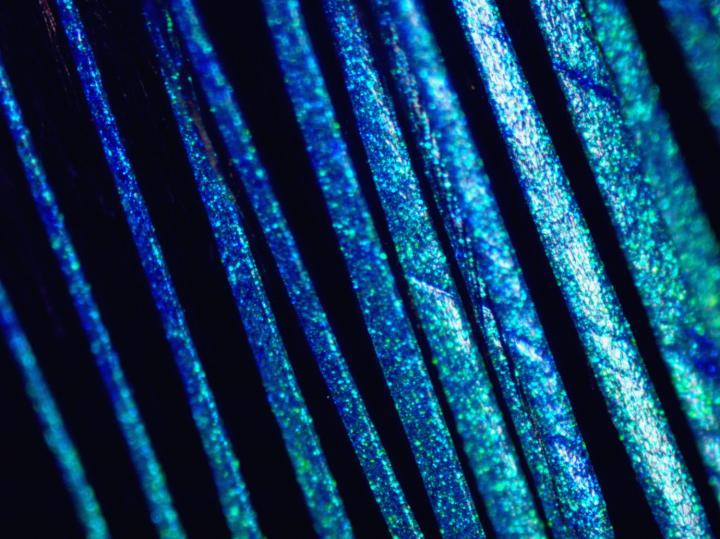
These mind-bendingly complex crystals called the single gyroid, found in blue-winged leafbirds, have the potential to make fiber optics, solar cells and fuel cells more efficient

A recent study by a team of researchers led by Dr Vinod Kumar Saranathan from the Division of Science at Yale-NUS College has discovered a complex, three-dimensional crystal called the single gyroid within feathers of the blue-winged leafbird. Dr Saranathan and his team’s breakthrough came from their investigation of the feather colours of leafbirds, an enigmatic group of perching birds endemic to South and Southeast Asia (including Singapore), one species of which has evolved the unique crystals in its plumage.

By comparing the colour-producing nanostructures present in close relatives, the team reported that this species is able to directly synthesise single gyroid photonic crystals, which have highly desirable optical and electronic properties that make them ideal for use in photovoltaic cells to generate solar energy. Use of this crystal – a “crowning achievement” in material science engineering which thus far has been manufactured only with great difficulty – has the potential not only to improve photovoltaic cells, meaning they can be produced more easily and cheaply, but also for use in other industrial applications like catalysis in fuel cells and fibre optics.

Published in Proceedings of the National Academy of Sciences of the United States of America (PNAS), this study is particularly relevant as the search for renewable sources of energy and sustainable manufacturing has taken on a fresh urgency.

“Our research provides a clear insight on the class of patchy particles like charged proteins that researchers can investigate in the future, to see if they can be coaxed into forming these crystals at visible light scales. Knowing how leafbirds manufacture these exotic structures can spur novel biomimetic eco-friendly self-assembly strategies for large-scale materials synthesis at these highly challenging optical length-scales, given the urgent ecological need for such materials.”

###

The research team includes Dr Suresh Narayanan and Dr Alec Sandy from the Argonne National Laboratory, Professor Eric R Dufresne from ETH Zurich, and Professor Richard O Prum from Yale University.

Media Contact
Joshua Wong
[email protected]

Original Source

https://www.yale-nus.edu.sg/newsroom/yale-nus-college-scientist-discovers-how-leafbirds-make-complex-colour-producing-crystals/

Related Journal Article

http://dx.doi.org/10.1073/pnas.2101357118

Tags: BiologyBiomechanics/BiophysicsBiotechnologyCell BiologyChemistry/Physics/Materials SciencesMaterials
Share13Tweet8Share2ShareShareShare2

Related Posts

Miniature Sensor Uses Light to Detect Touch — Chemistry

Miniature Sensor Uses Light to Detect Touch

May 8, 2026
Iron Minerals Determine Whether Dissolved Organic Matter Fuels Microbes or Becomes Long-Term Carbon Storage — Chemistry

Iron Minerals Determine Whether Dissolved Organic Matter Fuels Microbes or Becomes Long-Term Carbon Storage

May 8, 2026

Kate Evans Appointed Associate Lab Director for Biological and Environmental Systems Science at ORNL

May 8, 2026

Advancing Multiscale Modeling and Overcoming Operational Challenges in Autothermal COâ‚‚-to-Methanol Reactors

May 8, 2026
Please login to join discussion

POPULAR NEWS

  • Research Indicates Potential Connection Between Prenatal Medication Exposure and Elevated Autism Risk

    840 shares
    Share 336 Tweet 210
  • New Study Reveals Plants Can Detect the Sound of Rain

    727 shares
    Share 290 Tweet 181
  • Scientists Investigate Possible Connection Between COVID-19 and Increased Lung Cancer Risk

    68 shares
    Share 27 Tweet 17
  • Salmonella Haem Blocks Macrophages, Boosts Infection

    61 shares
    Share 24 Tweet 15

About

We bring you the latest biotechnology news from best research centers and universities around the world. Check our website.

Follow us

Recent News

Evaluating Digoxin Use in Patients with Symptomatic Rheumatic Heart Disease

Evaluating the Effectiveness and Safety of Digitalis Glycosides in Treating Heart Failure

Urdu Fall Risk Questionnaire Adapted for Elderly

Subscribe to Blog via Email

Enter your email address to subscribe to this blog and receive notifications of new posts by email.

Join 82 other subscribers
  • Contact Us

Bioengineer.org © Copyright 2023 All Rights Reserved.

Welcome Back!

Login to your account below

Forgotten Password?

Retrieve your password

Please enter your username or email address to reset your password.

Log In
No Result
View All Result
  • Homepages
    • Home Page 1
    • Home Page 2
  • News
  • National
  • Business
  • Health
  • Lifestyle
  • Science

Bioengineer.org © Copyright 2023 All Rights Reserved.