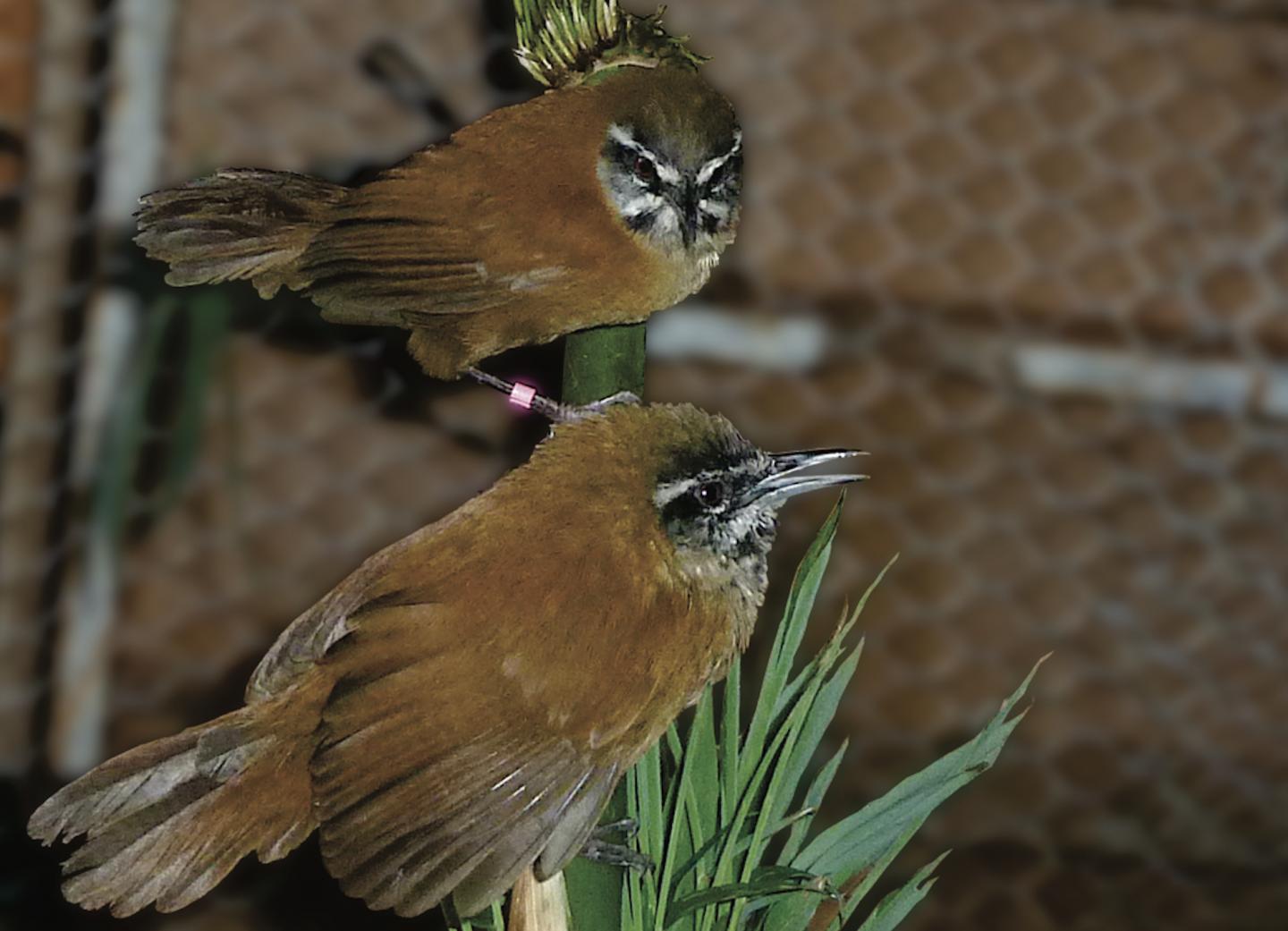
There’s Simon and Garfunkel, Tina and Ike, and Armstrong and Fitzgerald. But now, nature’s famed duet singers, the plain-tail wren, shows neurobiologists the magic between collaborative performers sparks when music-making parts of the brain go silent.
Art Garfunkel once described his legendary musical chemistry with Paul Simon, “We meet somewhere in the air through the vocal cords … .” But a new study of duetting songbirds from Ecuador, the plain-tail wren (Pheugopedius euophrys), has offered another tune explaining the mysterious connection between successful performing duos.
It’s a link of their minds, and it happens, in fact, as each singer mutes the brain of the other as they coordinate their duets.
In a study published May 31 in Proceedings of the National Academy of Sciences, a team of researchers studying brain activity of singing male and female plain-tailed wrens has discovered that the species synchronizes their frenetically paced duets, surprisingly, by inhibiting the song-making regions of their partner’s brain as they exchange phrases.
Researchers say that the auditory feedback exchanged between wrens during their opera-like duets momentarily inhibits motor circuits used for singing in the listening partner, which helps link the pair’s brains and coordinate turn-taking for a seemingly telepathic performance. The study also offers fresh insight into how humans and other cooperative animals use sensory cues to act in concert with one another.
“You could say that timing is everything,” said Eric Fortune, co-author of the study and neurobiologist at New Jersey Institute of Technology’s Department of Biological Sciences. “What these wrens have shown us is that for any good collaboration, partners need to become ‘one’ through sensory linkages. The take-home message is that when we are cooperating well… we become a single entity with our partners.”
“Think of these birds like jazz singers,” added Melissa Coleman, the paper’s corresponding author and associate professor of biology at Scripps College. “Duetting wrens have a rough song structure planned before they sing, but as the song evolves, they must rapidly coordinate by receiving constant input from their counterpart.
“What we expected to find was a highly active set of specialized neurons that coordinate this turn-taking, but instead what we found is that hearing each other actually causes inhibition of those neurons — that’s the key regulating the incredible timing between the two.”
For the study, the team had to travel to the heart of the plain-tail wren music scene, within remote bamboo forests on the slopes of Ecuador’s active Antisana Volcano. Camped at the Yanayacu Biological Station’s lab, the team made neurophysiological recordings of four pairs of native wrens as they sang solo and duet songs, analyzing sensorimotor activity in a premotor area of the birds’ brains where specialized neurons for learning and making music are active.
The recordings showed that during duet turn-taking — which often take the form of tightly knit call-and-answer phrases, or syllables, that together sound as if a single bird is singing — the birds’ neurons fired rapidly when they produced their own syllables.
Yet, as one wren begins to hear their partner’s syllables sung in the duet, the neurons quiet down significantly.
“You can think of inhibition as acting like a trampoline,” explained Fortune. “When the birds hear their partner, the neurons are inhibited, but just like rebounding off a trampoline, the release from that inhibition causes them to swiftly respond when it’s their time to sing.”
Next, the team played recordings of wrens duetting while they were in a sleep-like state, anesthetized with a drug that affects a major inhibitory neurotransmitter in the wrens’ brains that is also found in humans, gamma-aminobutyric acid (GABA). The drug transformed the activity in the brain, from inhibition to bursts of activity when the wrens heard their own music.
“These mechanisms are shared or similar to what happens in our brains because we are doing the same kind of things,” said Fortune. “There are similar brain circuits in humans that are involved in learning and coordinating vocalizations.”
Fortune and Coleman say the results offer a fresh look into how the brains of humans and other cooperating animals use sensory cues to act in concert with each other, from flowing musical and dance performances, or even the disjointed feeling of inhibition commonly experienced today during video conferencing.
“These days, inhibition is occurring at all the wrong times when we have poor internet connections during our Zoom, WebEx, and Facetime conferences. The delays affect the sensory information that we rely on for coordinating the timing of our conversations,” said Coleman. “I think this study is important for understanding how we interact with the world whenever we are trying to produce a single behavior as two performers. We are wired for cooperation, the same way as these jazz singing wrens.”
###
Media Contact
Deric Raymond
[email protected]
Related Journal Article
http://dx.