• HOME
  • NEWS
  • EXPLORE
    • CAREER
      • Companies
      • Jobs
    • EVENTS
    • iGEM
      • News
      • Team
    • PHOTOS
    • VIDEO
    • WIKI
  • BLOG
  • COMMUNITY
    • FACEBOOK
    • INSTAGRAM
    • TWITTER
Thursday, March 26, 2026
BIOENGINEER.ORG
No Result
View All Result
  • Login
  • HOME
  • NEWS
  • EXPLORE
    • CAREER
      • Companies
      • Jobs
        • Lecturer
        • PhD Studentship
        • Postdoc
        • Research Assistant
    • EVENTS
    • iGEM
      • News
      • Team
    • PHOTOS
    • VIDEO
    • WIKI
  • BLOG
  • COMMUNITY
    • FACEBOOK
    • INSTAGRAM
    • TWITTER
  • HOME
  • NEWS
  • EXPLORE
    • CAREER
      • Companies
      • Jobs
        • Lecturer
        • PhD Studentship
        • Postdoc
        • Research Assistant
    • EVENTS
    • iGEM
      • News
      • Team
    • PHOTOS
    • VIDEO
    • WIKI
  • BLOG
  • COMMUNITY
    • FACEBOOK
    • INSTAGRAM
    • TWITTER
No Result
View All Result
Bioengineer.org
No Result
View All Result
Home NEWS Science News

Study of Fe2+ ions contributes to further understanding of magnetoelectric coupling

Bioengineer by Bioengineer
September 6, 2025
in Science News
Reading Time: 2 mins read
0
IMAGE
Share on FacebookShare on TwitterShare on LinkedinShare on RedditShare on Telegram

A paper by Kazan Federal University saw light in Journal of Physics: Condensed Matter

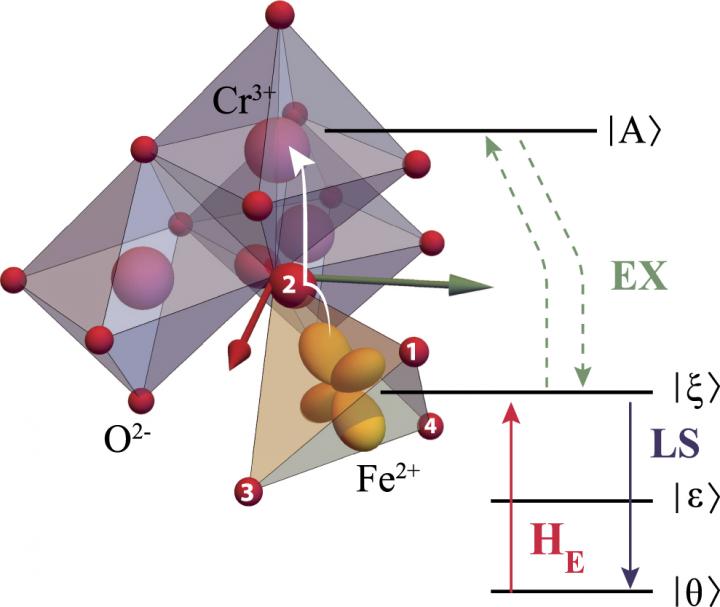
The researchers developed a microscopic theory of magnetoelectric effect involved Fe2+ and Cr3+ spins. They found two effective mechanisms: the single-ion which demands at least a short-range order of Fe spins (spin-liquid or spin-glass, for instance), and the two-ions mechanism, where the canting between Fe and Cr spins is required. Both reproduce the existing experimental data on the electric polarization measurements by the order of the magnitude and the optical absorption spectrum.

Multiferroics are fascinating multifunctional materials which have a wide range of applications in electronics and spintronics, such as actuators, new types of non-volatile energy efficient memory, electric valves driven by magnetic field. etc. Putting this simply, we can magnetize the medium using electric field and vice versa. Magnetoelectric coupling depends on many competing interactions, and the theory is still unclear. The paper provides a method of calculations of the magnetoelectric and electron-deformation coupling parameters for 3D ions. The latter is also used to calculate magnetostriction, which is important for building sensors (like sonars) and actuators.

One of the important consequences is that the magnetic anisotropy can maintain not only the magnetic “memory”, but also the electric “memory” of the material. The spin structure must have no inversion symmetry to maintain the electric polarization in the ground state. Also, the interplay of electric and magnetic domains may have a significant impact on electric polarization. To solve these issues, it is necessary to study the magnetic subsystem more accurate as well, which is unclear due to the lack of the experimental data and the complexity of the compound.

###

Media Contact
Yury Nurmeev
[email protected]

Original Source

https://eng.kpfu.ru/novosti/study-of-fe2-ions-contributes-to-further-understanding-of-magnetoelectric-coupling/

Related Journal Article

http://dx.doi.org/10.1088/1361-648X/abe730

Tags: Chemistry/Physics/Materials SciencesElectromagnetics
Share12Tweet8Share2ShareShareShare2

Related Posts

Microtubules Found to Actively Ensure Accurate Chromosome Distribution During Cell Division

March 25, 2026

Aversive Learning Hijacks Brain Sugar Sensor

March 25, 2026

Isolated H2-Reduced Clusters Boost CO2-to-Methanol Catalysis

March 25, 2026

In-Sensor Cryptography Links Physical Process to Digital Identity

March 25, 2026
Please login to join discussion

POPULAR NEWS

  • blank

    Revolutionary AI Model Enhances Precision in Detecting Food Contamination

    96 shares
    Share 38 Tweet 24
  • Imagine a Social Media Feed That Challenges Your Views Instead of Reinforcing Them

    1003 shares
    Share 397 Tweet 248
  • Uncovering Functions of Cavernous Malformation Proteins in Organoids

    54 shares
    Share 22 Tweet 14
  • Promising Outcomes from First Clinical Trials of Gene Regulation in Epilepsy

    51 shares
    Share 20 Tweet 13

About

We bring you the latest biotechnology news from best research centers and universities around the world. Check our website.

Follow us

Recent News

In-Sensor Cryptography Links Physical Process to Digital Identity

Can Psychosocial Factors Influence Cancer Risk?

Depression Factors in Elderly: Pre vs. Post-COVID Analysis

Subscribe to Blog via Email

Enter your email address to subscribe to this blog and receive notifications of new posts by email.

Join 78 other subscribers
  • Contact Us

Bioengineer.org © Copyright 2023 All Rights Reserved.

Welcome Back!

Login to your account below

Forgotten Password?

Retrieve your password

Please enter your username or email address to reset your password.

Log In
No Result
View All Result
  • Homepages
    • Home Page 1
    • Home Page 2
  • News
  • National
  • Business
  • Health
  • Lifestyle
  • Science

Bioengineer.org © Copyright 2023 All Rights Reserved.