• HOME
  • NEWS
  • EXPLORE
    • CAREER
      • Companies
      • Jobs
    • EVENTS
    • iGEM
      • News
      • Team
    • PHOTOS
    • VIDEO
    • WIKI
  • BLOG
  • COMMUNITY
    • FACEBOOK
    • INSTAGRAM
    • TWITTER
Thursday, March 26, 2026
BIOENGINEER.ORG
No Result
View All Result
  • Login
  • HOME
  • NEWS
  • EXPLORE
    • CAREER
      • Companies
      • Jobs
        • Lecturer
        • PhD Studentship
        • Postdoc
        • Research Assistant
    • EVENTS
    • iGEM
      • News
      • Team
    • PHOTOS
    • VIDEO
    • WIKI
  • BLOG
  • COMMUNITY
    • FACEBOOK
    • INSTAGRAM
    • TWITTER
  • HOME
  • NEWS
  • EXPLORE
    • CAREER
      • Companies
      • Jobs
        • Lecturer
        • PhD Studentship
        • Postdoc
        • Research Assistant
    • EVENTS
    • iGEM
      • News
      • Team
    • PHOTOS
    • VIDEO
    • WIKI
  • BLOG
  • COMMUNITY
    • FACEBOOK
    • INSTAGRAM
    • TWITTER
No Result
View All Result
Bioengineer.org
No Result
View All Result
Home NEWS Science News Biology

Research: Countries in violation of Baltic Sea Convention, polluting marine environment

Bioengineer by Bioengineer
September 6, 2025
in Biology
Reading Time: 2 mins read
0
IMAGE
Share on FacebookShare on TwitterShare on LinkedinShare on RedditShare on Telegram

The countries around the Baltic Sea do not respect their binding international agreement to reduce agricultural pollution of the marine environment.

The countries around the Baltic Sea do not respect their binding international agreement to reduce agricultural pollution of the marine environment. Despite farming activities being the single most important source of nutrient pollution to the Baltic Sea.

An international research team presents evidence on these circumstances in a recent scientific article in the journal Ambio, published by the Royal Swedish Academy of Sciences.

The countries made a commitment 20 years ago to implement 10 specific reduction measures in their national legislation on agricultural pollution – e.g. featuring minimum storage capacity for manure and regulations on animal densities.

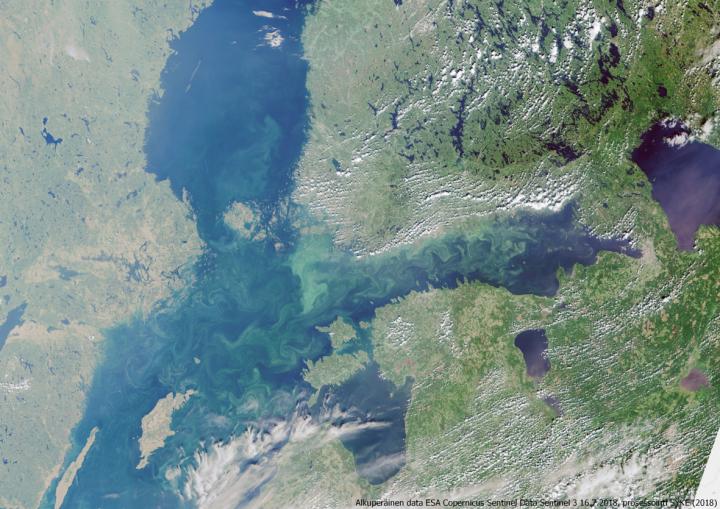
Now the researchers’ study of legislations and regulations in place at national level, to address nutrients, finds that none of the nine signatories to the Convention is respecting fully the legally binding agreement. Hence, nutrients are leaching to the marine environment in excess of the Baltic Sea’s tolerance limits, causing excess algae growth and eutrophication even in the open sea (see photo).

The larger countries, Poland, Germany and Russia, have the weakest record of implementing the reduction measures in their national legislation. Performance is especially poor in Russia and Poland, but also Germany, despite a ruling by the European Court, lags behind. The best performing countries are Sweden and Estonia. Nevertheless, in all nine countries the study identifies shortcomings in compliance with important reduction measures of the Convention.

“Although the Convention specifies ceilings on the amounts of nutrients that farmers may apply to their crops, ceilings are not implemented fully by any country. Either nutrient ceilings are too generous, apply to part of the territory only or are entirely absent. Notably the ceiling of 25 kg phosphorus per hectare is absent in most places, even if the reduction needs are now most pressing with regard to phosphorus” says Mikael Skou Andersen, professor of environmental science at Aarhus University. He is part of the research authors’ team.

The reduction measures were adopted under the Convention in anticipation of financial transfers from the EU to farmers in Poland and the Baltic countries. Yet, the researchers find that the eastern countries only to a very limited extent have put to use the economic support available as part of the Common Agricultural Policy, to provide support for reducing nutrient pollution of the marine environment.
The Baltic Sea Action Plan is up for revision every seven years. During the current German Presidency of HELCOM an update and revision is expected to be concluded at the Ministerial meeting October 20.th in Lübeck.

###

Media Contact
Prof. Mikael Skou Andersen, Aarhus University
[email protected]

Related Journal Article

http://dx.doi.org/10.1007/s13280-021-01549-3

Tags: Earth ScienceGuidelines/Treaties/AgreementsHydrology/Water ResourcesPollution/Remediation
Share12Tweet8Share2ShareShareShare2

Related Posts

How to sway group opinions: Encourage opponents to stay undecided

How to sway group opinions: Encourage opponents to stay undecided

March 23, 2026
Deep Learning Model Maps How Individual Cells Shape Disease Outcomes

Deep Learning Model Maps How Individual Cells Shape Disease Outcomes

March 20, 2026

Removing only 15 female sharks annually could endanger the entire population, scientists warn

March 20, 2026

Scientists Urge Fragrance Industry to Transition from Sustainability Talk to Active Funding of Plant Conservation

March 20, 2026
Please login to join discussion

POPULAR NEWS

  • blank

    Revolutionary AI Model Enhances Precision in Detecting Food Contamination

    96 shares
    Share 38 Tweet 24
  • Imagine a Social Media Feed That Challenges Your Views Instead of Reinforcing Them

    1003 shares
    Share 397 Tweet 248
  • Uncovering Functions of Cavernous Malformation Proteins in Organoids

    54 shares
    Share 22 Tweet 14
  • Promising Outcomes from First Clinical Trials of Gene Regulation in Epilepsy

    51 shares
    Share 20 Tweet 13

About

We bring you the latest biotechnology news from best research centers and universities around the world. Check our website.

Follow us

Recent News

In-Sensor Cryptography Links Physical Process to Digital Identity

Can Psychosocial Factors Influence Cancer Risk?

Depression Factors in Elderly: Pre vs. Post-COVID Analysis

Subscribe to Blog via Email

Success! An email was just sent to confirm your subscription. Please find the email now and click 'Confirm' to start subscribing.

Join 78 other subscribers
  • Contact Us

Bioengineer.org © Copyright 2023 All Rights Reserved.

Welcome Back!

Login to your account below

Forgotten Password?

Retrieve your password

Please enter your username or email address to reset your password.

Log In
No Result
View All Result
  • Homepages
    • Home Page 1
    • Home Page 2
  • News
  • National
  • Business
  • Health
  • Lifestyle
  • Science

Bioengineer.org © Copyright 2023 All Rights Reserved.