• HOME
  • NEWS
  • EXPLORE
    • CAREER
      • Companies
      • Jobs
    • EVENTS
    • iGEM
      • News
      • Team
    • PHOTOS
    • VIDEO
    • WIKI
  • BLOG
  • COMMUNITY
    • FACEBOOK
    • INSTAGRAM
    • TWITTER
Sunday, July 5, 2026
BIOENGINEER.ORG
No Result
View All Result
  • Login
  • HOME
  • NEWS
  • EXPLORE
    • CAREER
      • Companies
      • Jobs
        • Lecturer
        • PhD Studentship
        • Postdoc
        • Research Assistant
    • EVENTS
    • iGEM
      • News
      • Team
    • PHOTOS
    • VIDEO
    • WIKI
  • BLOG
  • COMMUNITY
    • FACEBOOK
    • INSTAGRAM
    • TWITTER
  • HOME
  • NEWS
  • EXPLORE
    • CAREER
      • Companies
      • Jobs
        • Lecturer
        • PhD Studentship
        • Postdoc
        • Research Assistant
    • EVENTS
    • iGEM
      • News
      • Team
    • PHOTOS
    • VIDEO
    • WIKI
  • BLOG
  • COMMUNITY
    • FACEBOOK
    • INSTAGRAM
    • TWITTER
No Result
View All Result
Bioengineer.org
No Result
View All Result
Home NEWS Science News Chemistry

New methods proposed to characterize polymer lamellar crystals

Bioengineer by Bioengineer
May 27, 2021
in Chemistry
Reading Time: 2 mins read
0
IMAGE
Share on FacebookShare on TwitterShare on LinkedinShare on RedditShare on Telegram

IMAGE

Credit: LI Xiangyang

Different from small molecules, polymer will fold into lamellar crystals during crystallization and further assemble into lamellar stacks.

Synchrotron Small-Angle X-Ray Scattering (SAXS) is an important tool to characterize such nanoscale structure and understand polymer crystallization. However, its scattering mechanism in semi-crystalline polymers is not completely elucidated yet.

Recently, a research group led by Prof. TIAN Xingyou from Institute of Solid State Physics, Hefei Institutes of Physical Science (HFIPS), proposed a complete set of new methods to characterize polymer lamellar crystals using SAXS.

“We’ve been working on this novel models for four years, from theory to application” said LI Xiangyang from HFIPS.

In 2019, the researchers first found that the existence of evanescent wave-induced scattering in transmission SAXS was possible. Moreover, the evanescent wave-induced scattering was much stronger than the scattering induced directly by incident X-ray, and the scattering of interfacial electrons within was the main origin of SAXS signal.

Then they started to try the approaches to obtain lamellar thickness, long period and lateral size. “Based on new SAXS image, we isolated the evanescent wave-induced scattering from the real scattering and reduced the influence of the scattering of bulk electrons, form factor and Porod scattering, obtaining the information on lamellar thickness and long period,” said LI.

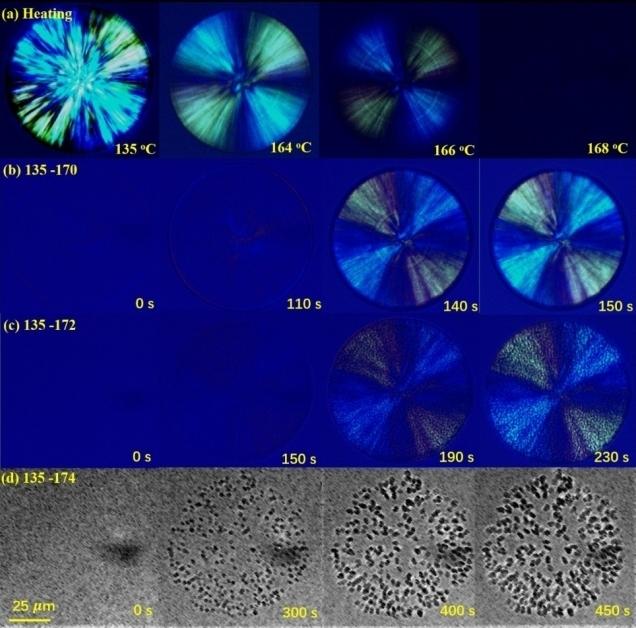
It was assumed that some residual crystals existed in the structured melt, whose lateral size is larger than critical nucleation size. However, it is hard to be testified due to the difficulty in characterization. With the new methodologies, the researchers characterized residual crystals, demonstrating previous conjecture.

This work is supported by the National Natural Science Foundation of China.

###

Media Contact
ZHAO Weiwei
[email protected]

Original Source

http://english.hf.cas.cn/new/news/rn/202105/t20210518_269779.html

Related Journal Article

http://dx.doi.org/10.1107/S2052252521003821/ed5023sup1.pdf

Tags: Chemistry/Physics/Materials SciencesMaterials
Share12Tweet8Share2ShareShareShare2

Related Posts

Intelligent Microgrid Management Promises Lower Household Energy Bills and Reduced Diesel Emissions — Chemistry

Intelligent Microgrid Management Promises Lower Household Energy Bills and Reduced Diesel Emissions

July 4, 2026
Graz University of Technology Deciphers the Structural Secrets of MOF Thin Films — Chemistry

Graz University of Technology Deciphers the Structural Secrets of MOF Thin Films

July 2, 2026

Breaking Thermodynamic Limits: Wavelength-Driven Catalysis Advances Ammonia Synthesis

July 2, 2026

From Quantum Mechanics to AI-Powered Materials Discovery: MARVEL Marks 12 Years of Transforming Computational Science

July 2, 2026
Please login to join discussion

POPULAR NEWS

  • Detection of EDCs in Breast Milk and Infant Urine Up to Six Months Highlights Early Exposure Risks

    77 shares
    Share 31 Tweet 19
  • Saying Goodbye to PGY-6: Pediatric Fellowship Realities

    103 shares
    Share 41 Tweet 26
  • New Drug Candidate Developed at McMaster Shows Potential for Treating Brain Cancer

    58 shares
    Share 23 Tweet 15
  • KTU Researchers Explore Ultrasound’s Role in Enhancing Blood Flow Beyond Diagnostics

    53 shares
    Share 21 Tweet 13

About

We bring you the latest biotechnology news from best research centers and universities around the world. Check our website.

Follow us

Recent News

Quasi-Bound States Boost Quantum Well Photoresponse

Lysine Pyruvylation Links Glycolysis to Epigenetics

Multiphysics Coupling: Single vs. Multiple DeepONet Branches

Subscribe to Blog via Email

Success! An email was just sent to confirm your subscription. Please find the email now and click 'Confirm' to start subscribing.

Join 83 other subscribers
  • Contact Us

Bioengineer.org © Copyright 2023 All Rights Reserved.

Welcome Back!

Login to your account below

Forgotten Password?

Retrieve your password

Please enter your username or email address to reset your password.

Log In
No Result
View All Result
  • Homepages
    • Home Page 1
    • Home Page 2
  • News
  • National
  • Business
  • Health
  • Lifestyle
  • Science

Bioengineer.org © Copyright 2023 All Rights Reserved.