Research teams across the UK will investigate the viability of five innovative methods of large-scale greenhouse gas removal to counter the impact of climate change
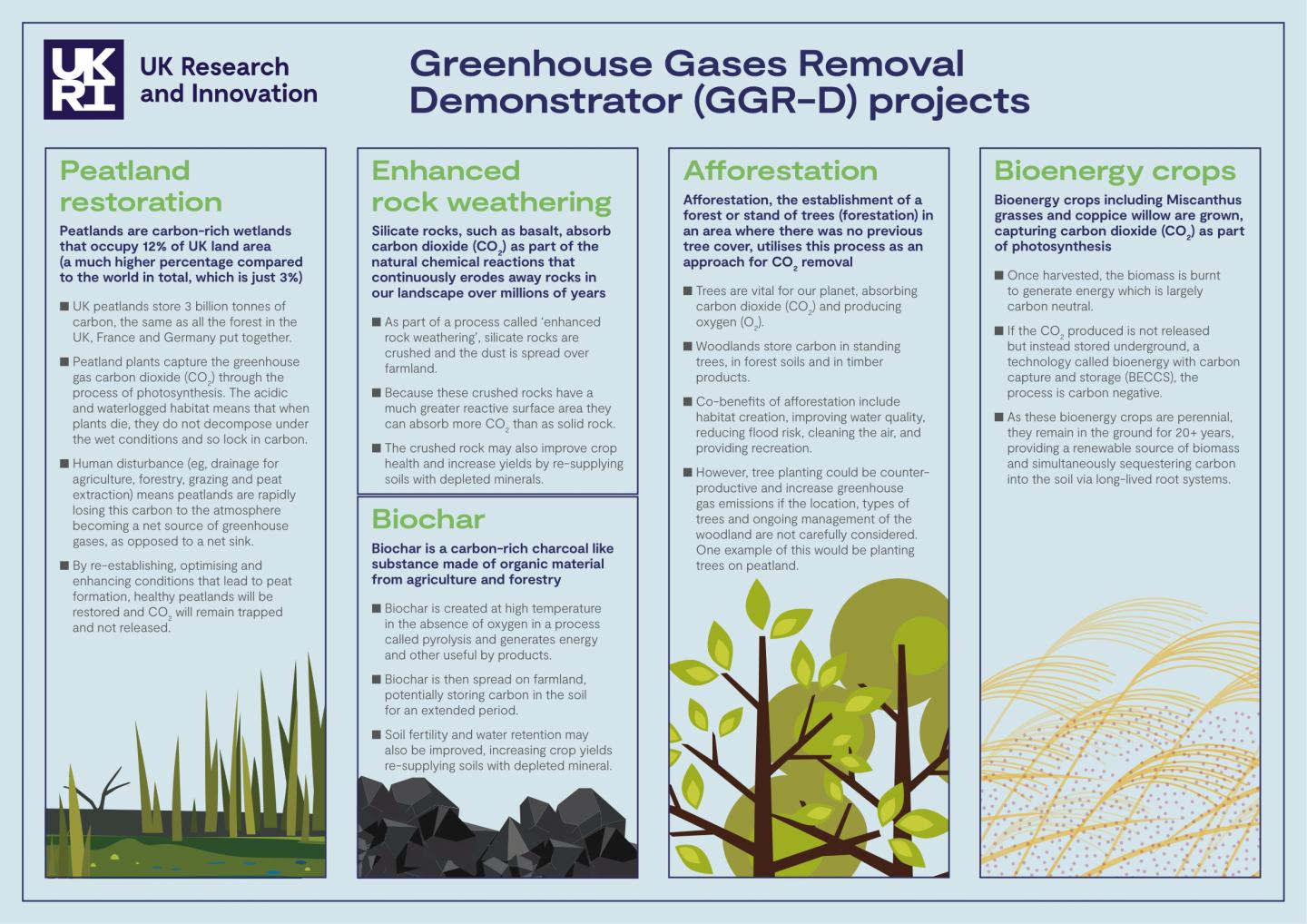
Credit: UKRI
Research teams across the UK will investigate the viability of five innovative methods of large-scale greenhouse gas removal from the atmosphere to help the UK reach its legislated Net Zero climate target by 2050.
The methods all have the potential to remove greenhouse gases from the atmosphere – but their effectiveness, cost, and limitations need to be better understood and proven at scale.
UK Research and Innovation (UKRI) will invest £30 million in five interdisciplinary projects and a central Hub located at the University of Oxford, to conduct the research over 4.5 years. An additional £1.5 million will be invested in further studies in year 3 of the research.
The results will be used to shape longer-term Government decision-making on the most effective technologies to help the UK tackle climate change and reduce CO2 emissions.
These Greenhouse Gas Removal Demonstrator projects will investigate:
- Management of peatlands to maximise their greenhouse gas removal potential in farmland near Doncaster, and at upland sites in the South Pennines and in Pwllpeiran, west Wales.
- Enhanced rock weathering – crushing silicate rocks and spreading the particles at field trial sites on farmland in mid-Wales, Devon and Hertfordshire.
- Use of biochar, a charcoal-like substance, as a viable method of carbon sequestration. Testing will take place at arable and grassland sites in the Midlands and Wales, a sewage disposal site in Nottinghamshire, former mine sites and railway embankments.
- Large-scale tree planting, or afforestation, to assess the most effective species and locations for carbon sequestration at sites across the UK, including land owned by the Ministry of Defence, the National Trust and Network Rail.
- Rapid scale-up of perennial bioenergy crops such as grasses (Miscanthus) and short rotation coppice willow at locations in Lincolnshire and Lancashire.
Greenhouse gas removals describe a group of methods that directly remove CO2 from the atmosphere and are designed to complement efforts in emission reductions targeting those sectors which are difficult to decarbonise completely such as heavy industry, agriculture and aviation.
The £31.5 million programme is part of the second wave of the Government’s Strategic Priorities Fund (SPF), which invests in high quality multi and interdisciplinary research.
Professor Sir Duncan Wingham, Executive Chair of the Natural Environment Research Council, part of UKRI, said:
“Reducing greenhouse gas emissions is a priority for the UK, but it’s clear that alone that will not be enough to reduce CO2 and meet the UK’s net zero climate target by 2050.
“These projects will investigate how we can actively remove greenhouse gases from the atmosphere using innovative technologies at the scale required to protect our planet. This investment by UKRI is especially significant as the UK prepares to host COP26 in Glasgow later this year.”
The Greenhouse Gas Removal Demonstrators programme will be supported by a central Directorate Hub to provide an overarching coordination role, with specific focus on environmental, economic, social, cultural, ethical, legal and governance issues.
The Hub will have a strong research function and will also actively engage with business communities, supporting innovation in GGR Demonstrator techniques and their progression to readiness for market.
Professor Cameron Hepburn, from the University of Oxford, is leading the Directorate Hub. He said:
“Greenhouse gas removal is essential to achieve net zero carbon emissions and stabilise the climate. Alongside the need for much faster emissions reductions now, we also need to start pulling CO2 out of the atmosphere.
“Greenhouse gas removal is not only essential, it also has the potential to become big business. As we rebuild societies and economies following Covid-19, we have an opportunity to orient ourselves towards the green jobs and industries of the future. I’m delighted that UKRI is supporting such a strategic programme.”
This work adds to UKRI’s long tradition of investing in cutting-edge research and innovation to understand, tackle and mitigate the effects of climate change. In the year the UK hosts the UN COP26 summit in November, UKRI will use its role as a steward of the research and innovation system to bring our communities together to create sustainable and resilient solutions and encourage new behaviours and new ways of living that enable the UK to reach net zero by 2050.
###
Media Contact
Sophie Docker
[email protected]