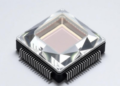
Glide symmetry offers a compact, flexible solution for suppression of channel crosstalk in SSPP transmission lines
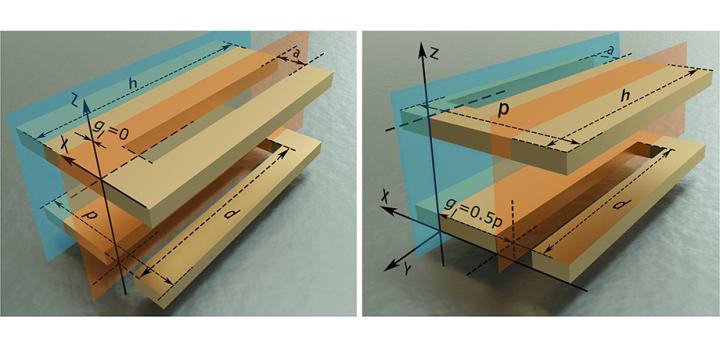
Credit: Xiao Tian Yan et al., doi 10.1117/1.AP.3.2.025001
Surface plasmon polaritons (SPPs) are highly localized surface waves on the interface between metal and dielectric in the optical frequency band. SSPs do not naturally exist in the microwave and terahertz frequencies, so “spoof” surface plasmon polaritons (SSPPs) are necessary for operations in those lower frequency bands.
Like optical SPPs, microwave SSPPs exhibit highly localized electromagnetic fields, subwavelength resolution, and extraordinary field confinement. Therefore, SSPP transmission lines (TLs) have been proposed as novel types of microwaveguides that offer new solutions for miniaturization, signal integrity, and low crosstalk in compact circuits for use in wireless communications and wearable electronics.
Recently, a research team from Southeast University in China applied a typical form of higher symmetry called “glide symmetry” in dual-strip SSPP TLs to achieve flexible control of modal fields, dispersion characteristics, and mutual coupling between TLs. As reported in Advanced Photonics, they constructed a hybrid TL array with a nonglide symmetric TL and a glide symmetric TL, in which a misalignment of half period is observed between the upper and lower strips. A broadened working bandwidth resulted from the glide symmetric TL, and the team demonstrated that the glide symmetry helps suppress channel crosstalk significantly without requiring extra space or feeding networks.
In their experimental demonstration, the cutoff frequency of the fundamental mode increases from 5 GHz (for a nonglide symmetric TL) to 9.5 GHz (for a glide symmetric TL). Because the fundamental mode of the glide symmetric TL is totally different from that of the nonglide one, the coupling coefficient between them is significantly lower than that between two uniform SSPP TLs. The team noted that, due to the mode mismatch in the hybrid array, a very limited portion of energy could be coupled to the neighboring TL.
Four-port model composed of two channels: one is the nonglide symmetric transmission line channel, and the other is the glide symmetric one. Credit: Xiao Tian Yan et al., doi 10.1117/1.AP.3.2.025001
Tie Jun Cui, professor at Southeast University’s Institute of Electromagnetic Space, remarks, “Glide symmetry offers powerful and flexible control of SSPPs and may bring about new solutions in future integrated circuits.” Cui envisions that when serious line-to-line interference damages the performance of circuits, an alternating arrangement of glide and nonglide symmetric TLs can restore and guarantee signal accuracy. Cui notes, “No extra space or design of circuits is needed when the nonglide symmetric TL is replaced with a glide one.” This space-saving solution may supply significant improvements to future integrated circuits and systems.
Read the open access article: Xiao Tian Yan et al., “Glide symmetry for mode control and significant suppression of coupling in dual-strip SSPP transmission lines,” Adv. Photon. 3(2), 026001 (2021), doi 10.1117/1.AP.3.2.025001.
Media Contact
Daneet Steffens
[email protected]
Original Source
https:/
Related Journal Article
http://dx.