• HOME
  • NEWS
  • EXPLORE
    • CAREER
      • Companies
      • Jobs
    • EVENTS
    • iGEM
      • News
      • Team
    • PHOTOS
    • VIDEO
    • WIKI
  • BLOG
  • COMMUNITY
    • FACEBOOK
    • INSTAGRAM
    • TWITTER
Sunday, May 10, 2026
BIOENGINEER.ORG
No Result
View All Result
  • Login
  • HOME
  • NEWS
  • EXPLORE
    • CAREER
      • Companies
      • Jobs
        • Lecturer
        • PhD Studentship
        • Postdoc
        • Research Assistant
    • EVENTS
    • iGEM
      • News
      • Team
    • PHOTOS
    • VIDEO
    • WIKI
  • BLOG
  • COMMUNITY
    • FACEBOOK
    • INSTAGRAM
    • TWITTER
  • HOME
  • NEWS
  • EXPLORE
    • CAREER
      • Companies
      • Jobs
        • Lecturer
        • PhD Studentship
        • Postdoc
        • Research Assistant
    • EVENTS
    • iGEM
      • News
      • Team
    • PHOTOS
    • VIDEO
    • WIKI
  • BLOG
  • COMMUNITY
    • FACEBOOK
    • INSTAGRAM
    • TWITTER
No Result
View All Result
Bioengineer.org
No Result
View All Result
Home NEWS Science News Chemistry

LAMOST helps Gaia achieve millimagnitude photometry precision

Bioengineer by Bioengineer
May 12, 2021
in Chemistry
Reading Time: 2 mins read
0
IMAGE
Share on FacebookShare on TwitterShare on LinkedinShare on RedditShare on Telegram

IMAGE

Credit: NIU Zexi

The Large Sky Area Multi-Object Fiber Spectroscopic Telescope (LAMOST) has helped Gaia achieve millimagnitude (mmag) precision in photometry, according to a study led by researchers from National Astronomical Observatories of Chinese Academy of Sciences (NAOC) and Beijing Normal University (BNU).
Their study was published in The Astrophysical Journal.
If you look at the sky on a clear, starry night, you may notice that Aldebran is relatively red and Rigel is blue. Why? The answer stems from their intrinsic physical properties. Precisely measuring magnitudes and colors helps to explain such phenomena.
The ESA Gaia satellite is well known for its remarkable capacity for astrometric observation. It delivers the most precise photometric data ever, with much higher quality than ground-based telescopes.
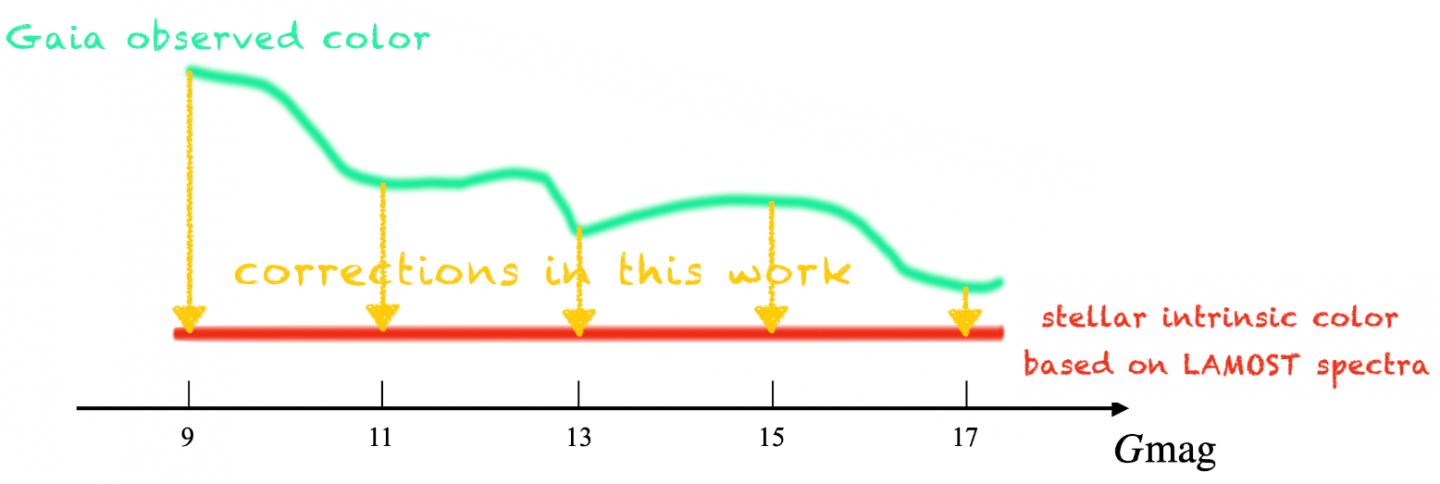
However, in order for Gaia to cover a wide magnitude range from 6 to 22 magnitude (mag), different observation modes have been adopted for stars of different brightness. In addition, photometric data in the G, BP, and RP bands come from different instruments and CCDs. Therefore, magnitude and color-dependent systematic errors exist.
The researchers combined two datasets, Gaia Data Release 2 (DR2) and LAMOST Data Release 5 (DR5), then selected samples of high data quality and low extinction.
The samples comprised 779,691 main-sequence stars and 71,952 red giant branch stars. Stars from 13.3 to 13.7 mag in the G band were selected as the control sample in order to establish the empirical relationship between intrinsic colors and physical parameters deduced from LAMOST.
“Applying the relationship to the whole sample, the differences between the observed colors and model-determining colors at different G magnitudes represent the color correction terms,” said Prof. LIU Jifeng from NAOC.
With the help of LAMOST’s massive stellar spectrum, the researchers used a spectroscopy-based stellar color regression method to correct systematic errors that are magnitude- and color-dependent. The relationship between the intrinsic colors and physical parameters of stars represents the key focus of this method.
By using a sample of about 500,000 stars from LAMOST and Gaia, color correction curves for the F/G/K stars are derived. “With an unprecedented precision of about 1 mmag, systematic trends in the G magnitude are revealed for both G-RP and BP-RP colors in detail,” said Prof. YUAN Haibo from BNU, the corresponding author of the study.
“Our work could be beneficial to studies where a high-precision color-color diagram is required, including the estimation of Gaia photometric metallicities, detection of peculiar objects, discrimination between binaries and single stars, and so on,” said NIU Zexi, Ph.D. candidate from NAOC and lead author of the study.
In addition, another study by the same team on color corrections for Gaia Data Early Release 3 (EDR3) was published in The Astrophysical Journal Letters.

###

Media Contact
XU Ang
[email protected]

Related Journal Article

http://dx.doi.org/10.3847/1538-4357/abdbac

Tags: AstronomyAstrophysicsSatellite Missions/ShuttlesSpace/Planetary Science
Share12Tweet8Share2ShareShareShare2

Related Posts

Miniature Sensor Uses Light to Detect Touch — Chemistry

Miniature Sensor Uses Light to Detect Touch

May 8, 2026
Iron Minerals Determine Whether Dissolved Organic Matter Fuels Microbes or Becomes Long-Term Carbon Storage — Chemistry

Iron Minerals Determine Whether Dissolved Organic Matter Fuels Microbes or Becomes Long-Term Carbon Storage

May 8, 2026

Kate Evans Appointed Associate Lab Director for Biological and Environmental Systems Science at ORNL

May 8, 2026

Advancing Multiscale Modeling and Overcoming Operational Challenges in Autothermal COâ‚‚-to-Methanol Reactors

May 8, 2026
Please login to join discussion

POPULAR NEWS

  • Research Indicates Potential Connection Between Prenatal Medication Exposure and Elevated Autism Risk

    840 shares
    Share 336 Tweet 210
  • New Study Reveals Plants Can Detect the Sound of Rain

    727 shares
    Share 290 Tweet 181
  • Scientists Investigate Possible Connection Between COVID-19 and Increased Lung Cancer Risk

    68 shares
    Share 27 Tweet 17
  • Salmonella Haem Blocks Macrophages, Boosts Infection

    61 shares
    Share 24 Tweet 15

About

We bring you the latest biotechnology news from best research centers and universities around the world. Check our website.

Follow us

Recent News

Evaluating Digoxin Use in Patients with Symptomatic Rheumatic Heart Disease

Evaluating the Effectiveness and Safety of Digitalis Glycosides in Treating Heart Failure

Urdu Fall Risk Questionnaire Adapted for Elderly

Subscribe to Blog via Email

Enter your email address to subscribe to this blog and receive notifications of new posts by email.

Join 82 other subscribers
  • Contact Us

Bioengineer.org © Copyright 2023 All Rights Reserved.

Welcome Back!

Login to your account below

Forgotten Password?

Retrieve your password

Please enter your username or email address to reset your password.

Log In
No Result
View All Result
  • Homepages
    • Home Page 1
    • Home Page 2
  • News
  • National
  • Business
  • Health
  • Lifestyle
  • Science

Bioengineer.org © Copyright 2023 All Rights Reserved.