• HOME
  • NEWS
  • EXPLORE
    • CAREER
      • Companies
      • Jobs
    • EVENTS
    • iGEM
      • News
      • Team
    • PHOTOS
    • VIDEO
    • WIKI
  • BLOG
  • COMMUNITY
    • FACEBOOK
    • INSTAGRAM
    • TWITTER
Thursday, June 25, 2026
BIOENGINEER.ORG
No Result
View All Result
  • Login
  • HOME
  • NEWS
  • EXPLORE
    • CAREER
      • Companies
      • Jobs
        • Lecturer
        • PhD Studentship
        • Postdoc
        • Research Assistant
    • EVENTS
    • iGEM
      • News
      • Team
    • PHOTOS
    • VIDEO
    • WIKI
  • BLOG
  • COMMUNITY
    • FACEBOOK
    • INSTAGRAM
    • TWITTER
  • HOME
  • NEWS
  • EXPLORE
    • CAREER
      • Companies
      • Jobs
        • Lecturer
        • PhD Studentship
        • Postdoc
        • Research Assistant
    • EVENTS
    • iGEM
      • News
      • Team
    • PHOTOS
    • VIDEO
    • WIKI
  • BLOG
  • COMMUNITY
    • FACEBOOK
    • INSTAGRAM
    • TWITTER
No Result
View All Result
Bioengineer.org
No Result
View All Result
Home NEWS Science News Chemistry

LAMOST helps Gaia achieve millimagnitude photometry precision

Bioengineer by Bioengineer
May 12, 2021
in Chemistry
Reading Time: 2 mins read
0
IMAGE
Share on FacebookShare on TwitterShare on LinkedinShare on RedditShare on Telegram

IMAGE

Credit: NIU Zexi

The Large Sky Area Multi-Object Fiber Spectroscopic Telescope (LAMOST) has helped Gaia achieve millimagnitude (mmag) precision in photometry, according to a study led by researchers from National Astronomical Observatories of Chinese Academy of Sciences (NAOC) and Beijing Normal University (BNU).
Their study was published in The Astrophysical Journal.
If you look at the sky on a clear, starry night, you may notice that Aldebran is relatively red and Rigel is blue. Why? The answer stems from their intrinsic physical properties. Precisely measuring magnitudes and colors helps to explain such phenomena.
The ESA Gaia satellite is well known for its remarkable capacity for astrometric observation. It delivers the most precise photometric data ever, with much higher quality than ground-based telescopes.
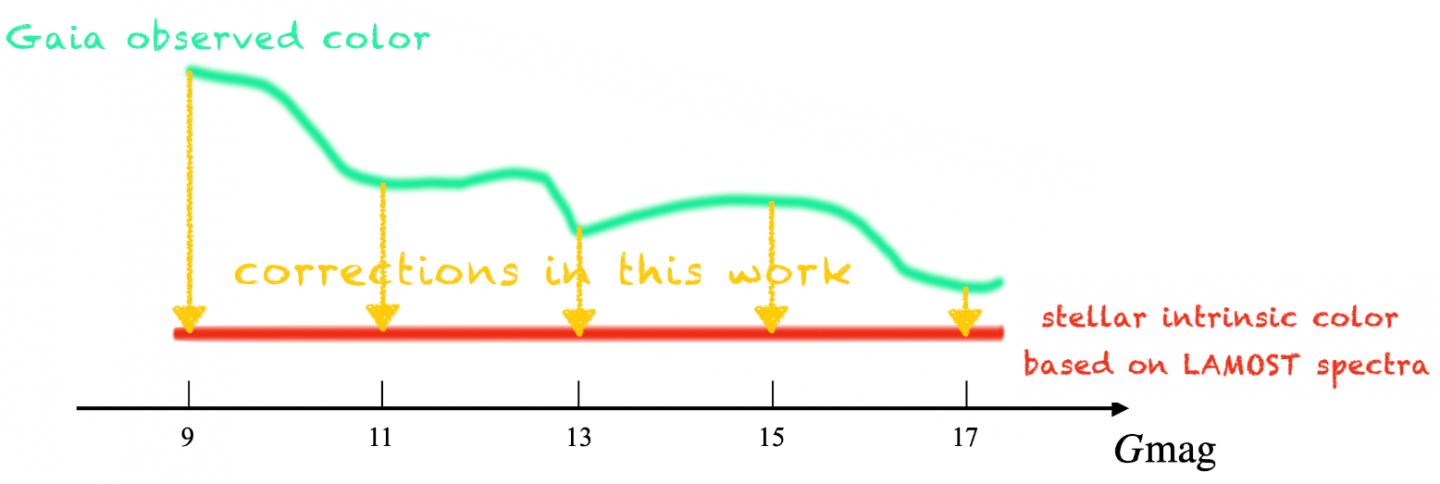
However, in order for Gaia to cover a wide magnitude range from 6 to 22 magnitude (mag), different observation modes have been adopted for stars of different brightness. In addition, photometric data in the G, BP, and RP bands come from different instruments and CCDs. Therefore, magnitude and color-dependent systematic errors exist.
The researchers combined two datasets, Gaia Data Release 2 (DR2) and LAMOST Data Release 5 (DR5), then selected samples of high data quality and low extinction.
The samples comprised 779,691 main-sequence stars and 71,952 red giant branch stars. Stars from 13.3 to 13.7 mag in the G band were selected as the control sample in order to establish the empirical relationship between intrinsic colors and physical parameters deduced from LAMOST.
“Applying the relationship to the whole sample, the differences between the observed colors and model-determining colors at different G magnitudes represent the color correction terms,” said Prof. LIU Jifeng from NAOC.
With the help of LAMOST’s massive stellar spectrum, the researchers used a spectroscopy-based stellar color regression method to correct systematic errors that are magnitude- and color-dependent. The relationship between the intrinsic colors and physical parameters of stars represents the key focus of this method.
By using a sample of about 500,000 stars from LAMOST and Gaia, color correction curves for the F/G/K stars are derived. “With an unprecedented precision of about 1 mmag, systematic trends in the G magnitude are revealed for both G-RP and BP-RP colors in detail,” said Prof. YUAN Haibo from BNU, the corresponding author of the study.
“Our work could be beneficial to studies where a high-precision color-color diagram is required, including the estimation of Gaia photometric metallicities, detection of peculiar objects, discrimination between binaries and single stars, and so on,” said NIU Zexi, Ph.D. candidate from NAOC and lead author of the study.
In addition, another study by the same team on color corrections for Gaia Data Early Release 3 (EDR3) was published in The Astrophysical Journal Letters.

###

Media Contact
XU Ang
[email protected]

Related Journal Article

http://dx.doi.org/10.3847/1538-4357/abdbac

Tags: AstronomyAstrophysicsSatellite Missions/ShuttlesSpace/Planetary Science
Share12Tweet8Share2ShareShareShare2

Related Posts

International Team Including Dresden Scientists Develops Novel Designer Proteins for Advanced Study of Living Tissue

June 25, 2026

New Study Uncovers Key Factors Driving Water Chemistry in Nanoscale Environments

June 25, 2026

Plasma Technology Extends Catalyst Lifespan in Hydrogen Production

June 24, 2026

Electric Field and Oxygen Spillover Collaborate to Control Electrode Migration in SOECs

June 24, 2026
Please login to join discussion

POPULAR NEWS

  • Saying Goodbye to PGY-6: Pediatric Fellowship Realities

    103 shares
    Share 41 Tweet 26
  • Multi-Hospital Study Reveals Long Covid Burden Is Twice as High as Current Estimates

    92 shares
    Share 36 Tweet 23
  • Detection of EDCs in Breast Milk and Infant Urine Up to Six Months Highlights Early Exposure Risks

    77 shares
    Share 31 Tweet 19
  • New Drug Candidate Developed at McMaster Shows Potential for Treating Brain Cancer

    58 shares
    Share 23 Tweet 15

About

We bring you the latest biotechnology news from best research centers and universities around the world. Check our website.

Follow us

Recent News

Rare Mixed Liver Cancer Underscores Diagnostic and Therapeutic Challenges

“International Team Discovers ‘Super-Puff’ Planets Lighter Than Candy Floss”

Discover Millions of Government Documents Effortlessly with GovScape

Subscribe to Blog via Email

Enter your email address to subscribe to this blog and receive notifications of new posts by email.

Join 82 other subscribers
  • Contact Us

Bioengineer.org © Copyright 2023 All Rights Reserved.

Welcome Back!

Login to your account below

Forgotten Password?

Retrieve your password

Please enter your username or email address to reset your password.

Log In
No Result
View All Result
  • Homepages
    • Home Page 1
    • Home Page 2
  • News
  • National
  • Business
  • Health
  • Lifestyle
  • Science

Bioengineer.org © Copyright 2023 All Rights Reserved.