Probiotic approaches could protect corals against heat stress
Credit: A. Roik.
7 May 2021/Kiel. Corals are the backbone of marine ecosystems in the tropics. They are threatened by rising water temperatures caused by global warming and they are among the first ecosystems worldwide that are on the verge of ecological collapse. Coral bleaching, which is becoming stronger and more frequent due to heat stress, has already wiped out corals at many locations globally. With the help of a microbiome-targeting strategy developed by an international team led by GEOMAR Helmholtz Centre for Ocean Research Kiel, it could become feasible to help protect corals from heat stress. The work has now been published in the international journal Microbiome.
Corals are the backbone of marine ecosystems in the tropics. They are threatened by rising water temperatures caused by global warming and they are among the first ecosystems worldwide that are on the verge of ecological collapse. Coral bleaching, which is becoming stronger and more frequent due to heat stress, has already wiped out corals at many locations globally. With the help of a microbiome-targeting strategy developed by an international team led by GEOMAR Helmholtz Centre for Ocean Research Kiel, it could become feasible to help protect corals from heat stress. The work has now been published in the international journal Microbiome.
Images of bare, naked white coral reefs have been increasingly circulating around the world. The typically colourful reefs of tropical oceans, which are home to many species of the marine ecosystem, are suffering from rising water temperatures due to global warming. There is no heat relieve for the corals in sight. Scientists are desperately seeking out ways to make the temperature-sensitive organisms more resistant to heat stress. A group of scientists led by GEOMAR Helmholtz Centre for Ocean Research Kiel are developing a promising approach, which is based on a therapeutic treatment known from human medicine. The study was published in the international journal Microbiome.
“The idea is that probiotic bacteria with beneficial functions could help a coral to better withstand heat stress,” explains Dr Anna Roik from GEOMAR, lead author of the study, which was funded as part of a Future Ocean Network project at Kiel University. “In the current study, we tested the approach of a ‘microbiome transplantation’, inspired by microbiome-based applications we know for example from clinical treatments”, Roik continues.
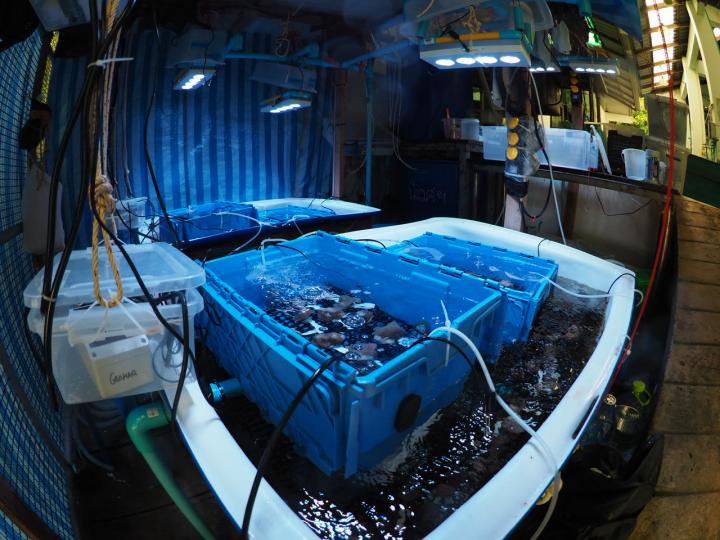
The research group conducted coral microbiome transplantation experiments with the reef-building corals Pocillopora and Porites in the Andaman Sea in Thailand. They investigated whether this technique can improve the heat resistance of corals by modifying the bacterial microbiome. The scientists first looked for more heat-tolerant “donor” corals. “We then used material from the coral tissue of the donor corals to inoculate conspecific, heat-sensitive recipients and then documented their bleaching responses and microbiome changes using a genetic analysis method called 16S rRNA gene metabarcoding”, explains Dr Roik.
The recipient corals of both species bleached more mildly compared to the control group during a short-term heat stress test (34 °C). “The results show that the inoculated corals were able to resist the heat stress response for a short time”, explains Prof. Dr Ute Hentschel Humeida, head of the Marine Symbioses Research Unit at GEOMAR and co-author of the study. “In addition, the microbiome data suggest that the ‘inoculated’ corals may favour the uptake of putative bacterial symbionts”, Dr Anna Roik continues. “However, further experimental studies are required to unravel the exact mechanism of action, as well as long-term field-based studies to test the durability of the effect”, says the marine biologist, looking ahead.
###
Scientific paper:
Doering, T., M. Wall, L. Putchim, T. Ratanawongwan, R. Schroeder, U. Hentschel, and A. Roik, 2021: Towards enhancing coral heat tolerance: a “microbiome transplantation” treatment using inoculations of homogenized coral tissues. Microbiome 9, 102, https:/
Links:
http://annaroik.
Contact:
Dr. Andreas Villwock (GEOMAR, Communication and Media), Phone: +49 0431 600-2802, [email protected]
Media Contact
Anna Roik
[email protected]
Related Journal Article
http://dx.