• HOME
  • NEWS
  • EXPLORE
    • CAREER
      • Companies
      • Jobs
    • EVENTS
    • iGEM
      • News
      • Team
    • PHOTOS
    • VIDEO
    • WIKI
  • BLOG
  • COMMUNITY
    • FACEBOOK
    • INSTAGRAM
    • TWITTER
Friday, December 26, 2025
BIOENGINEER.ORG
No Result
View All Result
  • Login
  • HOME
  • NEWS
  • EXPLORE
    • CAREER
      • Companies
      • Jobs
        • Lecturer
        • PhD Studentship
        • Postdoc
        • Research Assistant
    • EVENTS
    • iGEM
      • News
      • Team
    • PHOTOS
    • VIDEO
    • WIKI
  • BLOG
  • COMMUNITY
    • FACEBOOK
    • INSTAGRAM
    • TWITTER
  • HOME
  • NEWS
  • EXPLORE
    • CAREER
      • Companies
      • Jobs
        • Lecturer
        • PhD Studentship
        • Postdoc
        • Research Assistant
    • EVENTS
    • iGEM
      • News
      • Team
    • PHOTOS
    • VIDEO
    • WIKI
  • BLOG
  • COMMUNITY
    • FACEBOOK
    • INSTAGRAM
    • TWITTER
No Result
View All Result
Bioengineer.org
No Result
View All Result
Home NEWS Science News

Superconductivity, high critical temperature found in 2D semimetal W2N3

Bioengineer by Bioengineer
May 5, 2021
in Science News
Reading Time: 3 mins read
0
IMAGE
Share on FacebookShare on TwitterShare on LinkedinShare on RedditShare on Telegram

IMAGE

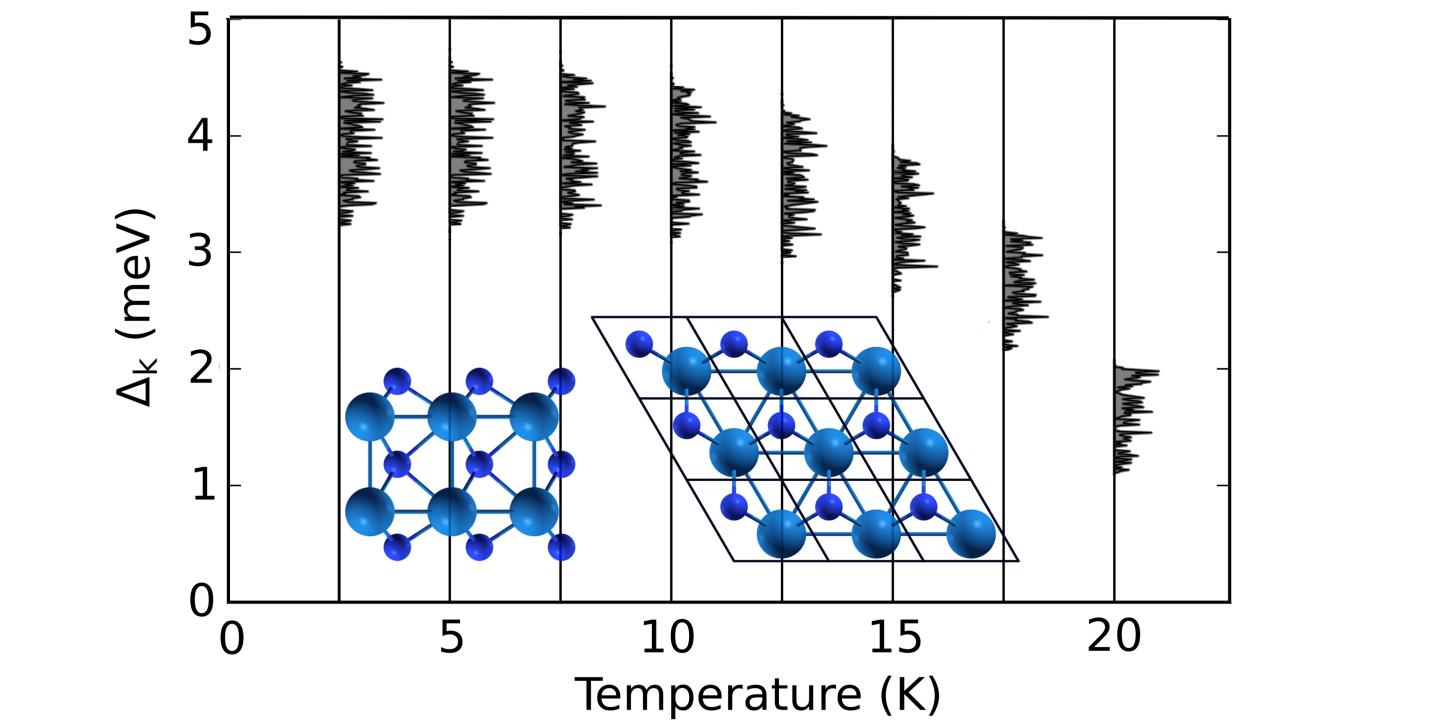
Credit: Davide Campi @EPFL

Superconductivity in two-dimensional (2D) systems has attracted much attention in recent years, both because of its relevance to our understanding of fundamental physics and because of potential technological applications in nanoscale devices such as quantum interferometers, superconducting transistors and superconducting qubits.

The critical temperature (Tc), or the temperature under which a material acts as a superconductor, is an essential concern. For most materials, it is between absolute zero and 10 Kelvin, that is, between -273 Celsius and -263 Celsius, too cold to be of any practical use. Focus has then been on finding materials with a higher Tc.

While researchers have discovered materials that act as conventional superconductors at temperatures as high as 250 K under extreme pressure, the reported record until now among 2D materials stands at between 7 and 12K in MoS2 according to experimental evidence and up to 20 K in some doped 2D materials and in intrinsic 2D metals according to theoretical modelling. Theoretical predictions have put a superconducting transition at a temperature above liquid hydrogen for some recently realized 2D boron allotropes but these materials cannot be obtained by exfoliation from van der Waals-bonded 3D parents and must be grown directly on a metal substrate. This results in relatively strong interactions that are predicted to suppress the superconducting critical temperature down to just 2 K in a supported sample.

In parallel to this search for higher Tc, researchers have been looking for materials that combine nontrivial topological properties with superconductivity. This search is driven both by a quest for exotic states of matter as well as for deeper understanding of the interactions between topological edge states and the superconducting phase.

In the paper “Prediction of phonon-mediated superconductivity with high critical temperature in the two-dimensional topological semimetal W2N3” authors Nicola Marzari, head of the Laboratory of Theory and Simulation of Materials at EPFL, scientist Davide Campi and PhD student Simran Kumari use first-principles calculations to identify intrinsic superconductivity in monolayer W2N3, a material that has recently been identified as being easily exfoliable from a layered hexagonal-W2N3 bulk by calculations, a theory also supported by experimental evidence. They find a critical temperature of 21 K, that is, just above liquid hydrogen and a record-high transition temperature for a conventional phonon-mediated 2D superconductor.

They also examine the effects of biaxial strain on the electron-phonon couplings and predict strong dependence of the electron-phonon coupling constant, making 2D W2N3 a very promising platform for studying different interaction regimes and testing the limits of current theories of superconductivity. Finally, they argue that the material could be doped such that currently unoccupied helical edge states 0.5 eV above the Fermi level become filled, even while superconductivity persists–albeit with a much lower transition temperature–making W2N3 a viable candidate for studying and exploiting the possible coexistence and interactions of the superconducting state with topologically protected edge states.

###

Media Contact
Carey Sargent
[email protected]

Original Source

https://nccr-marvel.ch/highlights/2021-04-superconductivity

Related Journal Article

http://dx.doi.org/10.1021/acs.nanolett.0c05125

Tags: Atomic/Molecular/Particle PhysicsChemistry/Physics/Materials SciencesElectromagneticsMaterialsSuperconductors/Semiconductors
Share12Tweet8Share2ShareShareShare2

Related Posts

Deep Learning Enhances Academic Performance Predictions for Students

Deep Learning Enhances Academic Performance Predictions for Students

December 26, 2025

Ultrasound Microbubbles Enhance Tumor Blood Flow

December 26, 2025

Obacunone Reduces Polycystic Ovary Syndrome via STAT3 Inhibition

December 26, 2025

Enhanced Supercapacitor Performance with Sulfur-Nickel Composites

December 26, 2025
Please login to join discussion

POPULAR NEWS

  • Nurses’ Views on Online Learning: Effects on Performance

    Nurses’ Views on Online Learning: Effects on Performance

    70 shares
    Share 28 Tweet 18
  • NSF funds machine-learning research at UNO and UNL to study energy requirements of walking in older adults

    71 shares
    Share 28 Tweet 18
  • Unraveling Levofloxacin’s Impact on Brain Function

    54 shares
    Share 22 Tweet 14
  • Exploring Audiology Accessibility in Johannesburg, South Africa

    51 shares
    Share 20 Tweet 13

About

We bring you the latest biotechnology news from best research centers and universities around the world. Check our website.

Follow us

Recent News

Deep Learning Enhances Academic Performance Predictions for Students

Ultrasound Microbubbles Enhance Tumor Blood Flow

Obacunone Reduces Polycystic Ovary Syndrome via STAT3 Inhibition

Subscribe to Blog via Email

Enter your email address to subscribe to this blog and receive notifications of new posts by email.

Join 71 other subscribers
  • Contact Us

Bioengineer.org © Copyright 2023 All Rights Reserved.

Welcome Back!

Login to your account below

Forgotten Password?

Retrieve your password

Please enter your username or email address to reset your password.

Log In
No Result
View All Result
  • Homepages
    • Home Page 1
    • Home Page 2
  • News
  • National
  • Business
  • Health
  • Lifestyle
  • Science

Bioengineer.org © Copyright 2023 All Rights Reserved.