• HOME
  • NEWS
  • EXPLORE
    • CAREER
      • Companies
      • Jobs
    • EVENTS
    • iGEM
      • News
      • Team
    • PHOTOS
    • VIDEO
    • WIKI
  • BLOG
  • COMMUNITY
    • FACEBOOK
    • INSTAGRAM
    • TWITTER
Saturday, February 7, 2026
BIOENGINEER.ORG
No Result
View All Result
  • Login
  • HOME
  • NEWS
  • EXPLORE
    • CAREER
      • Companies
      • Jobs
        • Lecturer
        • PhD Studentship
        • Postdoc
        • Research Assistant
    • EVENTS
    • iGEM
      • News
      • Team
    • PHOTOS
    • VIDEO
    • WIKI
  • BLOG
  • COMMUNITY
    • FACEBOOK
    • INSTAGRAM
    • TWITTER
  • HOME
  • NEWS
  • EXPLORE
    • CAREER
      • Companies
      • Jobs
        • Lecturer
        • PhD Studentship
        • Postdoc
        • Research Assistant
    • EVENTS
    • iGEM
      • News
      • Team
    • PHOTOS
    • VIDEO
    • WIKI
  • BLOG
  • COMMUNITY
    • FACEBOOK
    • INSTAGRAM
    • TWITTER
No Result
View All Result
Bioengineer.org
No Result
View All Result
Home NEWS Science News Biology

Plankton have a genome like no other

Bioengineer by Bioengineer
April 29, 2021
in Biology
Reading Time: 3 mins read
0
IMAGE
Share on FacebookShare on TwitterShare on LinkedinShare on RedditShare on Telegram

IMAGE

Credit: © 2021 KAUST

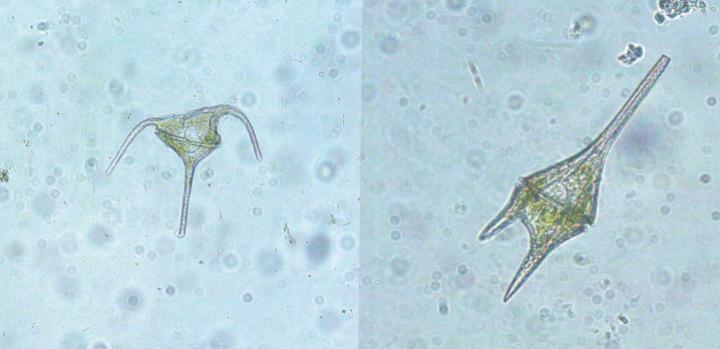
The genome of single-celled plankton, known as dinoflagellates, is organized in an incredibly strange and unusual way, according to new research. The findings lay the groundwork for further investigation into these important marine organisms and dramatically expand our picture of what a eukaryotic genome can look like.

Researchers from KAUST, the U.S. and Germany have investigated the genomic organization of the coral-symbiont dinoflagellate Symbiodinium microadriaticum. The S. microadriaticum genome had already been sequenced and assembled into segments known as scaffolds but lacked a chromosome-level assembly.

The team used a technique known as Hi-C to detect interactions in the dinoflagellate’s chromatin, the combination of DNA and protein that makes up a chromosome. By analyzing these interactions, they could figure out how the scaffolds were connected together into chromosomes, giving them a view into the spatial and structural organization of the genome.

A striking finding was that the genes in the genome tended to be organized in alternating unidirectional blocks. “That’s really, really different to what you see in other organisms,” says Octavio Salazar, a Ph.D. student in Manuel Aranda’s group at KAUST and one of the lead authors of the study. The orientation of genes on a chromosome is usually random. In this case, however, genes were consistently oriented one way and then the other, with the boundaries between blocks showing up clearly in the chromatin interaction data.

“Nature can work in a completely different way than we thought.”

This organization is also reflected in the three-dimensional structure of the genome, which the team inferred comprises rod-shaped chromosomes that fold into structural domains at the boundaries where gene blocks converge. Even more intriguingly, this structure appears to be dependent on transcriptional activity. When the researchers treated cells with a chemical that blocks gene transcription, the structural domains disappeared.

This unusual link is consistent with another strange fact about dinoflagellates — they have very few transcription factors in their genome and do not seem to respond to environmental changes by altering gene expression. They may use gene dosage to control expression and adapt to the environment by losing or gaining chromosomes or perhaps via epigenetic structural modifications. The researchers plan to explore all of these questions.

Another open question is the origin of this exceptional genome structure. Dinoflagellates produce very few histones, the proteins used by other eukaryotes to structure their DNA, instead using viral proteins incorporated into their genome long ago. The extraordinary genome structure and genetic regulation may be a consequence of how these viral proteins work, but that remains to be confirmed.

The dinoflagellate genome defies the expectation and dogmas built from studying other eukaryotes. “It shows that nature can work in a completely different way than we thought,” says Salazar. “There are so many possibilities for what could have happened as life evolved.”

###

Media Contact
Carolyn Unck
[email protected]

Original Source

https://discovery.kaust.edu.sa/en/article/1128/plankton-have-a-genome-like-no-other

Related Journal Article

http://dx.doi.org/10.1038/s41588-021-00841-y

Tags: BiodiversityBiologyCell BiologyClimate ChangeEcology/EnvironmentEvolutionGeneticsMarine/Freshwater BiologyMicrobiology
Share13Tweet8Share2ShareShareShare2

Related Posts

Florida Cane Toad: Complex Spread and Selective Evolution

Florida Cane Toad: Complex Spread and Selective Evolution

February 7, 2026
New Study Uncovers Mechanism Behind Burn Pit Particulate Matter–Induced Lung Inflammation

New Study Uncovers Mechanism Behind Burn Pit Particulate Matter–Induced Lung Inflammation

February 6, 2026

DeepBlastoid: Advancing Automated and Efficient Evaluation of Human Blastoids with Deep Learning

February 6, 2026

Navigating the Gut: The Role of Formic Acid in the Microbiome

February 6, 2026
Please login to join discussion

POPULAR NEWS

  • Robotic Ureteral Reconstruction: A Novel Approach

    Robotic Ureteral Reconstruction: A Novel Approach

    82 shares
    Share 33 Tweet 21
  • Digital Privacy: Health Data Control in Incarceration

    63 shares
    Share 25 Tweet 16
  • Study Reveals Lipid Accumulation in ME/CFS Cells

    57 shares
    Share 23 Tweet 14
  • Breakthrough in RNA Research Accelerates Medical Innovations Timeline

    53 shares
    Share 21 Tweet 13

About

We bring you the latest biotechnology news from best research centers and universities around the world. Check our website.

Follow us

Recent News

Decoding Prostate Cancer Origins via snFLARE-seq, mxFRIZNGRND

Digital Health Perspectives from Baltic Sea Experts

Florida Cane Toad: Complex Spread and Selective Evolution

Subscribe to Blog via Email

Enter your email address to subscribe to this blog and receive notifications of new posts by email.

Join 73 other subscribers
  • Contact Us

Bioengineer.org © Copyright 2023 All Rights Reserved.

Welcome Back!

Login to your account below

Forgotten Password?

Retrieve your password

Please enter your username or email address to reset your password.

Log In
No Result
View All Result
  • Homepages
    • Home Page 1
    • Home Page 2
  • News
  • National
  • Business
  • Health
  • Lifestyle
  • Science

Bioengineer.org © Copyright 2023 All Rights Reserved.