• HOME
  • NEWS
  • EXPLORE
    • CAREER
      • Companies
      • Jobs
    • EVENTS
    • iGEM
      • News
      • Team
    • PHOTOS
    • VIDEO
    • WIKI
  • BLOG
  • COMMUNITY
    • FACEBOOK
    • INSTAGRAM
    • TWITTER
Sunday, July 5, 2026
BIOENGINEER.ORG
No Result
View All Result
  • Login
  • HOME
  • NEWS
  • EXPLORE
    • CAREER
      • Companies
      • Jobs
        • Lecturer
        • PhD Studentship
        • Postdoc
        • Research Assistant
    • EVENTS
    • iGEM
      • News
      • Team
    • PHOTOS
    • VIDEO
    • WIKI
  • BLOG
  • COMMUNITY
    • FACEBOOK
    • INSTAGRAM
    • TWITTER
  • HOME
  • NEWS
  • EXPLORE
    • CAREER
      • Companies
      • Jobs
        • Lecturer
        • PhD Studentship
        • Postdoc
        • Research Assistant
    • EVENTS
    • iGEM
      • News
      • Team
    • PHOTOS
    • VIDEO
    • WIKI
  • BLOG
  • COMMUNITY
    • FACEBOOK
    • INSTAGRAM
    • TWITTER
No Result
View All Result
Bioengineer.org
No Result
View All Result
Home NEWS Science News Chemistry

Novel imaging method to visualize respiratory activity of 3D tissue models

Bioengineer by Bioengineer
April 28, 2021
in Chemistry
Reading Time: 2 mins read
0
IMAGE
Share on FacebookShare on TwitterShare on LinkedinShare on RedditShare on Telegram

IMAGE

Credit: Kaoru Hiramoto, et al.

Cells breathe, to an extent, exchanging gases, taking in energy sources from the environment and processing it. Now, researchers from Tohoku University in Japan have shone a light on the process in a new way.

Their demonstrated visualization method in model systems was made available online on March 12th in Biosensors and Bioelectronics, ahead of the June print edition.

The researchers used spheroids – cultured cells within a close-to-natural environment – to mimic a biological tissue using mesenchymal stem cells (MSCs). Due to MCSs’ ability to self-renew and differentiate into various tissues, they are of significant interest for use in regenerative medicine and to test different therapeutics in different tissue models.

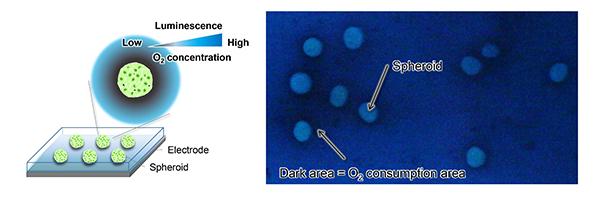
They settled the spheroids on a gold electrode dosed in luminescent solution. The researchers applied stepped electric potential – the energy needed to convert oxygen – to the set up where the solution was then oxidized sensitized to produce luminescent, which is dependent on oxygen concentration. The spheroids glowed brightly, surrounded by a ring of darkness where oxygen concentration was low due to gas exchanges. They call the process potential step-based electrochemiluminescence (ECL) imaging.

“As living spheroids consume oxygen to produce energy, the respiratory activity was elegantly visualized by the distribution of luminescence around the spheroids,” said Kaoru Hiramoto of the JSPS Research Fellowship for Young Scientists, who developed the ECL imaging system.

The researchers used a digital camera to visualize multiple spheroids with a single shot, demonstrating both the high spatial resolution of their system, as well as the low background noise.

“The system offers high throughput analysis of spheroids, in addition to highly improving resolution of the images compared to conventional electrode array devices,” said co-corresponding authors Kosuke Ino and Hitoshi Shiku, assistant professor and professor in the Graduate School of Engineering, Tohoku University. “The system offers novel insights into electrochemical devices and imaging systems for cell spheroids.”

ECL imaging is still in the development phase, the researchers said. They plan to improve the sensitivity and selectivity, as well as analyze other data that might be collected in the system, such as cellular metabolites attached to the electrode. They also plan to use the system to investigate more complicated biological models, as well as patient-derived cell spheroids.

“To the best of our knowledge, this is the first attempt to visualize the respiratory activity of spheroids by direct conversion of oxygen concentration into ECL imaging,” Ino said. “The features of the proposed system – high spatial resolution with the ability for simultaneous imaging of multiple spheroids – are promising for transplantation research and drug screening utilizing cell spheroids.”

###

Media Contact
Kosuke Ino
[email protected]

Original Source

https://www.tohoku.ac.jp/en/press/novel_imaging_respiratory_activity_3d_tissue.html

Related Journal Article

http://dx.doi.org/10.1016/j.bios.2021.113123

Tags: Chemistry/Physics/Materials SciencesMaterials
Share12Tweet8Share2ShareShareShare2

Related Posts

Intelligent Microgrid Management Promises Lower Household Energy Bills and Reduced Diesel Emissions — Chemistry

Intelligent Microgrid Management Promises Lower Household Energy Bills and Reduced Diesel Emissions

July 4, 2026
Graz University of Technology Deciphers the Structural Secrets of MOF Thin Films — Chemistry

Graz University of Technology Deciphers the Structural Secrets of MOF Thin Films

July 2, 2026

Breaking Thermodynamic Limits: Wavelength-Driven Catalysis Advances Ammonia Synthesis

July 2, 2026

From Quantum Mechanics to AI-Powered Materials Discovery: MARVEL Marks 12 Years of Transforming Computational Science

July 2, 2026
Please login to join discussion

POPULAR NEWS

  • Detection of EDCs in Breast Milk and Infant Urine Up to Six Months Highlights Early Exposure Risks

    77 shares
    Share 31 Tweet 19
  • Saying Goodbye to PGY-6: Pediatric Fellowship Realities

    103 shares
    Share 41 Tweet 26
  • New Drug Candidate Developed at McMaster Shows Potential for Treating Brain Cancer

    58 shares
    Share 23 Tweet 15
  • KTU Researchers Explore Ultrasound’s Role in Enhancing Blood Flow Beyond Diagnostics

    53 shares
    Share 21 Tweet 13

About

We bring you the latest biotechnology news from best research centers and universities around the world. Check our website.

Follow us

Recent News

Quasi-Bound States Boost Quantum Well Photoresponse

Lysine Pyruvylation Links Glycolysis to Epigenetics

Multiphysics Coupling: Single vs. Multiple DeepONet Branches

Subscribe to Blog via Email

Success! An email was just sent to confirm your subscription. Please find the email now and click 'Confirm' to start subscribing.

Join 83 other subscribers
  • Contact Us

Bioengineer.org © Copyright 2023 All Rights Reserved.

Welcome Back!

Login to your account below

Forgotten Password?

Retrieve your password

Please enter your username or email address to reset your password.

Log In
No Result
View All Result
  • Homepages
    • Home Page 1
    • Home Page 2
  • News
  • National
  • Business
  • Health
  • Lifestyle
  • Science

Bioengineer.org © Copyright 2023 All Rights Reserved.