Researchers find new technique for rapid hyperpolarization and purification of fumarate in aqueous solution; obstacles involving the use of parahydrogen overcome
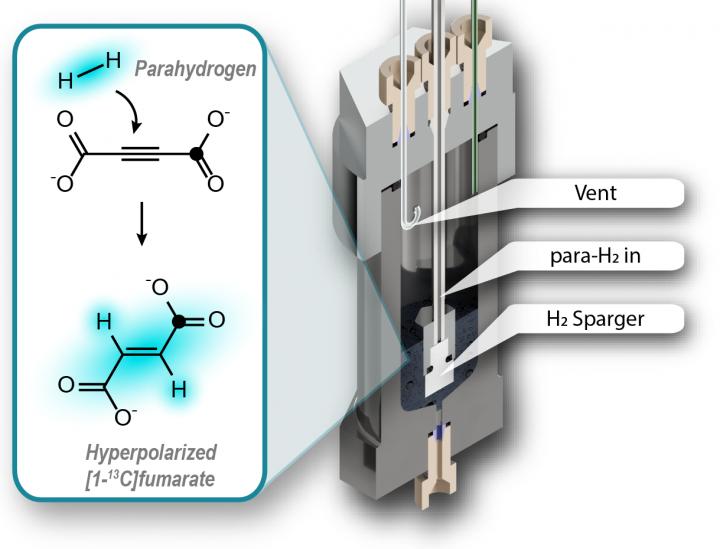
Credit: ill./©: John Blanchard, James Eills / JGU
A promising new concept published by an interdisciplinary research team in “Proceedings of the National Academy of Sciences” (PNAS) paves the way for major advances in the field of magnetic resonance imaging (MRI). Their new technique could significantly simplify hyperpolarized MRI, which developed around 20 years ago for observing metabolic processes in the body. The proposal involves the hyperpolarization of the metabolic product fumarate using parahydrogen and the subsequent purification of the metabolite. “This technique would not only be simpler, but also much cheaper than the previous procedure,” said leader of the project Dr. James Eills, a member of the research team of Professor Dmitry Budker at Johannes Gutenberg University Mainz (JGU) and the Helmholtz Institute Mainz (HIM). Also participating in the project were scientists from the fields of chemistry, biotechnology, and physics at TU Darmstadt, TU Kaiserslautern, the University of California Berkeley in the United States, the University of Turin in Italy, and the University of Southampton in England.
Fumarate is a key biosensor for hyperpolarized imaging
The potential applications of MRI are hindered by its low sensitivity and the technique is essentially limited to observing water molecules in the body. Researchers are therefore constantly working on different ways of improving MRI. A major breakthrough was achieved around 20 years ago when hyperpolarized magnetic resonance imaging was first developed: Because hyperpolarized molecules emit significantly stronger MRI signals, substances that are only present in low concentrations in the body can also be visualized. By hyperpolarizing biomolecules and introducing them in patients, it is possible to track metabolism in real time, thus providing doctors with much more information.
Hyperpolarized fumarate is a promising biosensor for the imaging of metabolic processes. Fumarate is a metabolite of the citric acid cycle that plays an important role in the energy production of living beings. For imaging purposes, the fumarate is tagged with carbon-13 as the atomic nuclei of this isotope can be hyperpolarized. Dynamic nuclear polarization is the current state-of-the-art method for hyperpolarizing fumarate, but this is expensive and relatively slow. The equipment required costs one to two million euros. “Dynamic nuclear polarization is very difficult to use in everyday clinical practice due to the related high costs and technical complexity. Using parahydrogen, we are able to hyperpolarize this important biomolecule in a cost-effective and convenient way,” said Dr. Stephan Knecht of TU Darmstadt, the first author of the published article.
A new method to hyperpolarize and purify fumarate for subsequent use as a biosensor
The research team led by Dr. James Eills has already been working on this concept for some time. “We have made a significant breakthrough as our approach is not only cheap, but also fast and easy to handle,” emphasized Eills. However, parahydrogen-induced polarization, or PHIP for short, also has its disadvantages. The low level of polarization and the large number of unwanted accompanying substances are particularly problematic in the case of this chemistry-based technique. Among other things, transferring the polarization from parahydrogen into fumarate requires a catalyst, which remains in the reaction fluid just like other reaction side-products. “The chemical contaminants must be removed from the solution so it is biocompatible and can be injected in living beings. This is essential if we think about the future clinical translation of this hyperpolarized biosensor,” said Dr. Eleonora Cavallari, a physicist from the Department of Molecular Biotechnology and Health Sciences in Turin.
The solution to this problem is to purify the hyperpolarized fumarate through precipitation. The fumarate then takes the form of a purified solid and can be redissolved at the desired concentration later. “This means we have a product from which all toxic substances have been removed so that it can readily be used in the body,” added Dr. James Eills. In addition, compared to previous experiments with PHIP, the polarization is increased to remarkable 30 to 45 percent. Preclinical studies have already shown that hyperpolarized fumarate imaging is a suitable method of monitoring how tumors respond to therapy as well as for imaging acute kidney injuries or the effects of myocardial infarction. This new way of producing hyperpolarized fumarate should greatly accelerate preclinical studies and bring this technology to more laboratories.
###
Media Contact
Dr. James Eills
[email protected]
Original Source
https:/
Related Journal Article
http://dx.