Finding could lead to better understanding, new treatments for stroke
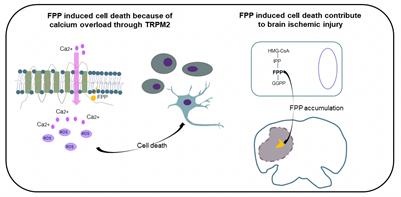
Credit: Wanli Liu
A vital intermediate in normal cell metabolism is also, in the right context, a trigger for cell death, according to a new study from Wanli Liu and Yonghui Zhang of Tsinghua University, and Yong Zhang of Peking University in Beijing, publishing 26th April 2021 in the open access journal PLOS biology. The discovery may contribute to a better understanding of the damage caused by stroke, and may offer a new drug target to reduce that damage.
Farnesyl pyrophosphate (FPP) is an intermediate in the mevalonate pathway, a series of biochemical reactions in every cell that contributes to protein synthesis, energy production, and construction of cell membranes. During a search for regulators of immune cell function, the authors unexpectedly discovered that FPP, when present at high concentrations outside of cells, caused rapid and extensive death of cells. FPP carries both a highly charged phosphate head and a long hydrophobic hydrocarbon tail, and by altering each in turn, the researchers showed that both were necessary for the effect, suggesting that FPP might interact specifically with some complementary receptors.
Depletion of extracellular calcium prevented the lethal effect of FPP, providing a further clue as to the mechanism. By knocking out a variety of cation channels, the team found that one, called TRPM2, contributed at a certain level to FPP-induced cell death, and that an inhibitor blocking FPP induced TRPM2 open can inhibit FPP induced cell death.
FPP is normally present in the microenvironment at too low a concentration to trigger cell death, but that may change during an ischemic stroke, as mevalonate pathway are known to be highly active in neurons and neurons could rapidly release their cellular contents in stress induced necrosis, leading to elevated levels of many otherwise-rare biomolecules in the microenvironment. The authors showed that in a mouse model of ischemic injury, the concentration of FPP rose, and that pre-administration of the calcium channel blocker could reduce the extent of injury. Moreover, inhibitors that prevent the metabolic production of FPP also reduced the extent of injury.
These results suggest that blockade of FPP’s action could be a new avenue for reducing the damage from stroke, either by inhibiting TRPM2 to reduce calcium influx or targeting its metabolic synthesizing pathway. Much will need to be learned about this new cell death pathway first, including the duration of the window during which such interventions might be amenable to therapy.
Nonetheless, Liu and colleagues said, “These findings point to novel, potentially druggable targets to treat ischemic injury. In view of the complex nature of human ischemic injury, targeting this pathway might best be combined with current therapies to improve the therapeutic effects.”
###
In your coverage please use these URLs to provide access to the freely available articles in PLOS Biology: http://journals.
Citation: Chen J, Zhang X, Li L, Ma X, Yang C, Liu Z, et al. (2021) Farnesyl pyrophosphate is a new danger signal inducing acute cell death. PLoS Biol 19(4): e3001134. https:/
Funding: This work is supported by funds from Institute for Immunology and Center for Life Sciences, Tsinghua University. W.L. and B.K.R. were supported by UAEU-Tsinghua Asian Universities Alliance Joint-Grant (G00002992). YH. Z. was supported by National Natural Science Foundation (81991492), Beijing Natural Science Foundation (Z190015) and Beijing Advanced Innovation Center for Structural Biology. Y.Z. is supported by the National Key R & D Program of China (2017YFE0103400), National Natural Science Foundation of China (31771125, 31970911, 81521063), and Beijing Municipal Science & Technology Commission (Z181100001518001). W.H. is supported in part by grants from the National Institutes of Health in the United States (AI146226, AI137822, GM130555-6610, AI129422 and AI138497). X. Z. is supported in part by the Postdoctoral Fellowship of Peking-Tsinghua Center for Life Sciences and China Postdoctoral Science Foundation (2019M660361). The funders had no role in study design, data collection and analysis, decision to publish, or preparation of the manuscript.
Competing Interests: The authors have declared that no competing interests exist.
Media Contact
Wanli Liu
[email protected]
Related Journal Article
http://dx.