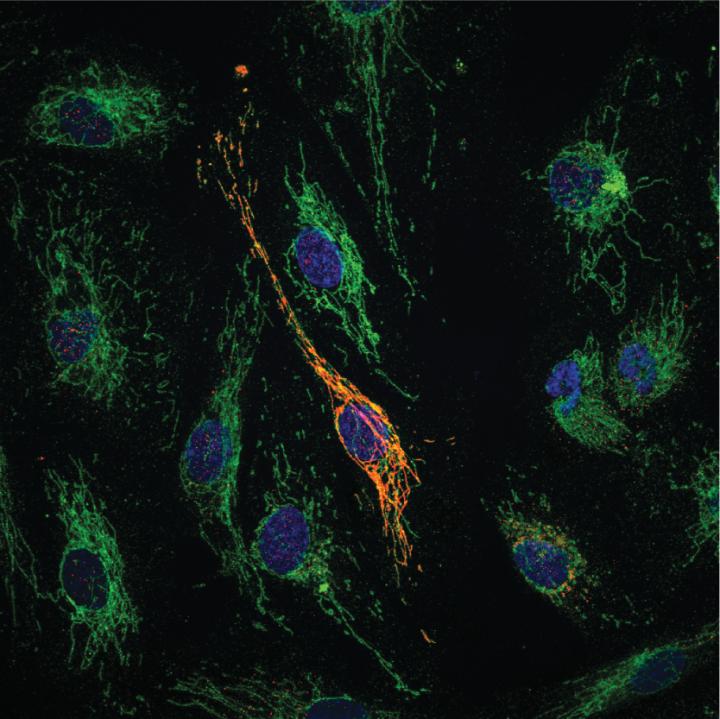
Credit: Duke-NUS Medical School
SINGAPORE, 22 April 2021 – A multidisciplinary team of researchers from Duke-NUS Medical School and the Agency for Science, Technology and Research (A*STAR) in Singapore discovered a new mitochondrial peptide called MOCCI that plays an important role in regulating inflammation of blood vessel and immunity. The study, published in the journal Nature Communications, revealed how one gene encoded two molecules that provide two-pronged protection following viral infection.
Chronic and excessive inflammation of the blood vessels, known as vascular inflammation, can lead to tissue damage and cardiovascular diseases such as atherosclerosis and fibrosis. Although some therapies have shown promising results in clinical trials, they have considerable side effects, such as immunosuppression leading to increased risk of infection, and limited efficacy. Therefore, more effective treatments are urgently needed.
“In this study, we aimed to identify new targets to combat inflammation in the lining of blood vessels. Specifically, we wanted to target small naturally-produced peptides that have not been studied before,” explained Assistant Professor Lena Ho, from the Cardiovascular and Metabolic Diseases Programme at Duke-NUS, who led the team that included Associate Professor Ashley St John, Assistant Professor Owen Rackham and Senior Research Fellow Dr Cheryl Lee.
The Duke-NUS team, in collaboration with colleagues from the Institute of Molecular and Cell Biology at A*STAR Singapore, investigated a group of peptides called Mito-SEPs that localise in mitochondria, the cellular organelles well-known for their role in cellular energy production. After observing that Mito-SEPs appear to be involved in regulating inflammation, they screened cells from the lining of human aortic blood vessels to uncover peptides involved in this process.
They found a new peptide, which they named MOCCI–short for Modulator of Cytochrome C oxidase during Inflammation–that is made only when cells undergo inflammation and infection.
To their surprise, they discovered that MOCCI is a hitherto unknown component of Complex IV, a part of a series of enzymes in the mitochondria responsible for energy production, called the electron transport chain. During inflammation, MOCCI incorporates into Complex IV to dampen its activity. Collaborating with Assoc Prof St John at Duke-NUS, the researchers found that this dampening is required to reduce inflammation following viral infection.
“Our finding that the composition of the electron transport chain changes in response to inflammation is novel. MOCCI in essence repurposes part of the energy production centre in the cell to regulate inflammation,” said Dr Lee, the lead author of this study.
The researchers also discovered that MOCCI is made together with a micro-RNA molecule called miR-147b. The two molecules are made from different sections of the same gene. MOCCI originates from the sequence of the gene that codes for proteins, while miR-147b is made from the non-coding section.
While the miR-147b molecule also exerts anti-inflammatory effects, it actively prevents viruses from replicating at the same time. This implies that MOCCI and miR-147b function in tandem to help to control viral infection and suppress inflammation.
“This dual-pronged strategy is an elegant mechanism that the body has put in place to prevent excessive and potentially tissue-damaging inflammation during infection, such as the cytokine storm seen in COVID-19 infection, and colitis” said Asst Prof Ho. “The gene encoding MOCCI is one of the first genes described to have both coding and non-coding functions. The fact these dual functions are coordinated to achieve a concerted biological outcome is a significant finding in cell biology.”
Professor Patrick Casey, Senior Vice-Dean for Research at Duke-NUS, commented, “Medicine and healthcare advance with the aid of new discoveries in fundamental research. This study by Asst Prof Ho and her collaborators provides valuable insight on inflammation and immunity–a topic that has become even more important in the context of COVID-19.”
The researchers say the next step is to explore how to develop targeted pharmacological treatments that can mimic the anti-inflammatory effects of MOCCI and miR147b. They also plan to investigate the role of MOCCI in common chronic inflammatory diseases such as colitis and psoriasis.
###
Media Contact
Federico Graciano
[email protected]
Original Source
https:/
Related Journal Article
http://dx.