• HOME
  • NEWS
  • EXPLORE
    • CAREER
      • Companies
      • Jobs
    • EVENTS
    • iGEM
      • News
      • Team
    • PHOTOS
    • VIDEO
    • WIKI
  • BLOG
  • COMMUNITY
    • FACEBOOK
    • INSTAGRAM
    • TWITTER
Wednesday, February 4, 2026
BIOENGINEER.ORG
No Result
View All Result
  • Login
  • HOME
  • NEWS
  • EXPLORE
    • CAREER
      • Companies
      • Jobs
        • Lecturer
        • PhD Studentship
        • Postdoc
        • Research Assistant
    • EVENTS
    • iGEM
      • News
      • Team
    • PHOTOS
    • VIDEO
    • WIKI
  • BLOG
  • COMMUNITY
    • FACEBOOK
    • INSTAGRAM
    • TWITTER
  • HOME
  • NEWS
  • EXPLORE
    • CAREER
      • Companies
      • Jobs
        • Lecturer
        • PhD Studentship
        • Postdoc
        • Research Assistant
    • EVENTS
    • iGEM
      • News
      • Team
    • PHOTOS
    • VIDEO
    • WIKI
  • BLOG
  • COMMUNITY
    • FACEBOOK
    • INSTAGRAM
    • TWITTER
No Result
View All Result
Bioengineer.org
No Result
View All Result
Home NEWS Science News Chemistry

Inhibition of meprin β enzyme linked to the development of Alzheimer’s disease analyzed

Bioengineer by Bioengineer
April 20, 2021
in Chemistry
Reading Time: 2 mins read
0
IMAGE
Share on FacebookShare on TwitterShare on LinkedinShare on RedditShare on Telegram

Findings of researchers at Mainz University could lead to the creation of new drugs
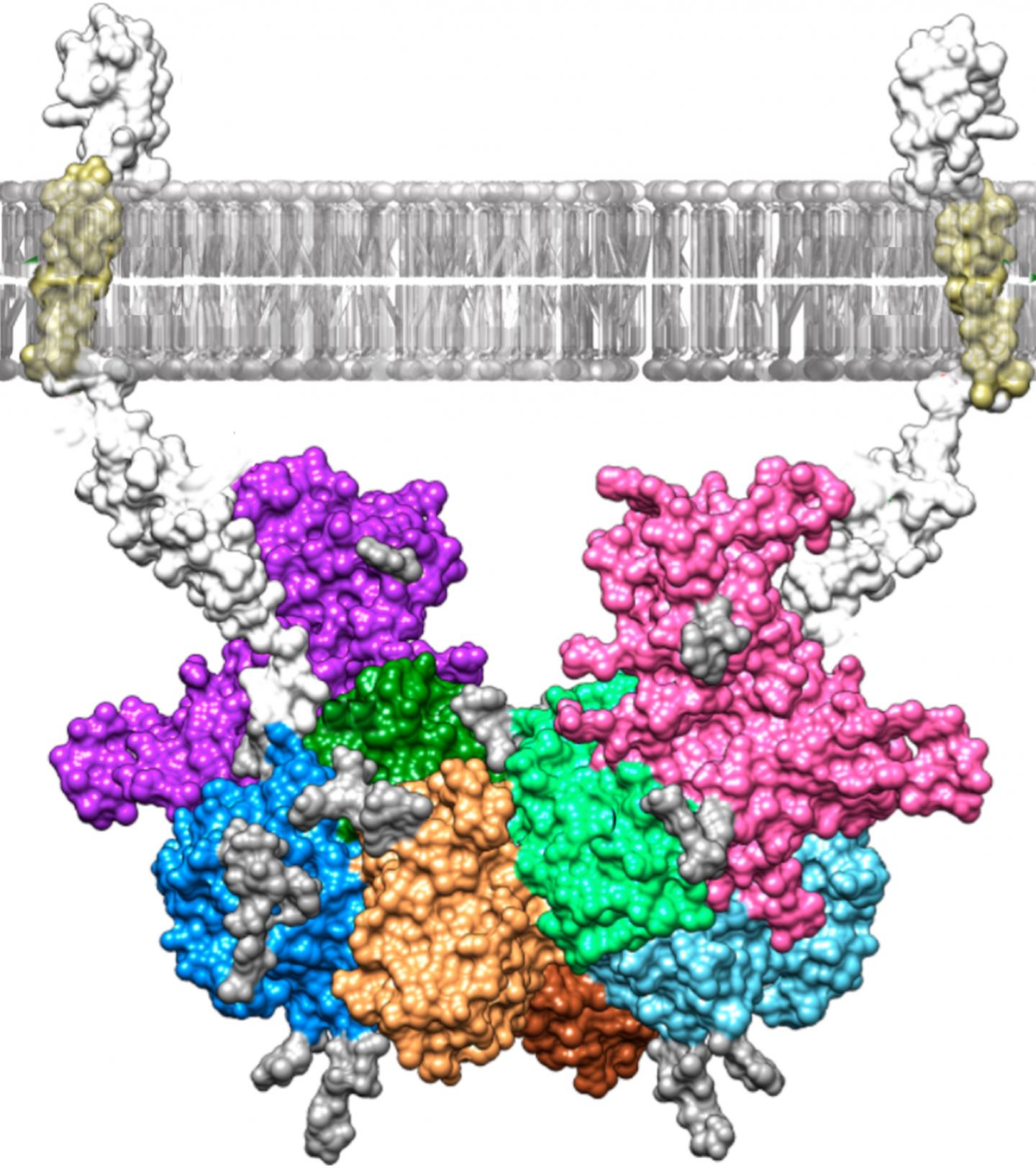
IMAGE

Credit: ill./©: Walter Stöcker

Researchers at Johannes Gutenberg University Mainz (JGU) in Germany and the Institute of Molecular Biology of Barcelona in Spain have discovered how the blood plasma protein fetuin-B binds to the enzyme meprin β and used a computer model to visualize their findings. These results could lead to the development of new drugs to treat serious diseases such as Alzheimer’s and cancer. Meprin β releases proteins from cell membranes, thus controlling important physiological functions in the human body. However, a dysregulation of this process can trigger the development of Alzheimer’s and cancer. Meprin β is regulated by fetuin-B binding to the enzyme when required, thereby preventing the release of other proteins. Presenting their findings in the journal “Proceedings of the National Academy of Sciences“, the researchers are now the first to describe this binding in detail.

The team at Mainz University produced both meprin β and fetuin-B in insect cells and then allowed them to react with one other in a test tube. By means of measurement of enzyme kinetics and biophysical analyses, the researchers determined that this reaction resulted in an exceptionally stable, high-molecular-mass complex. Their colleagues in Barcelona subsequently managed to crystallize the complex and determine its three-dimensional structure using X-ray crystallography. This involved X-rays being fired at the protein crystals, which allowed the atomic structure of the crystals to be calculated from the diffraction of the X-rays. A computer model of the structure was then generated. “Thanks to the model, we can now see exactly how meprin β and fetuin-B bind together,” said Professor Walter Stöcker, who conducted the research at JGU together with Dr. Hagen Körschgen and Nele von Wiegen. “This research represents an excellent starting point for gaining a better understanding of diseases such as Alzheimer’s and for developing the drugs to combat them.” Meprin β is already known to be involved in the formation of so-called beta-amyloid plaques, which are a characteristic feature of the condition. Moreover, people with Alzheimer’s disease have relatively little fetuin-B in their blood, which in turn may lead to a lack of regulation of meprin β. “If it is possible to develop a drug that binds to the enzyme and inhibits it in a similar way to fetuin-B, this could be a new way of treating Alzheimer’s,” concluded Stöcker.

###

Media Contact
Professor Dr. Walter Stöcker
[email protected]

Original Source

https://www.uni-mainz.de/presse/aktuell/13477_ENG_HTML.php

Related Journal Article

http://dx.doi.org/10.1073/pnas.2023839118

Tags: AlzheimerBiochemistryBiologycancerMedicine/HealthMolecular Biologyneurobiology
Share12Tweet8Share2ShareShareShare2

Related Posts

Researchers Reveal How Biochar Microzones Shield Crops from Toxic Cadmium Exposure

Researchers Reveal How Biochar Microzones Shield Crops from Toxic Cadmium Exposure

February 3, 2026
blank

Could We Have Witnessed a Black Hole Explosion? Physicists at UMass Amherst Say Yes—and It Might Explain Nearly Everything

February 3, 2026

Cavendish Laboratory and FormationQ Partner to Launch Applied Quantum Program Powered by IonQ Technology

February 3, 2026

Breakthrough in Solving a Classic Magnetism Mystery

February 3, 2026
Please login to join discussion

POPULAR NEWS

  • Enhancing Spiritual Care Education in Nursing Programs

    158 shares
    Share 63 Tweet 40
  • Robotic Ureteral Reconstruction: A Novel Approach

    81 shares
    Share 32 Tweet 20
  • Digital Privacy: Health Data Control in Incarceration

    63 shares
    Share 25 Tweet 16
  • Study Reveals Lipid Accumulation in ME/CFS Cells

    57 shares
    Share 23 Tweet 14

About

We bring you the latest biotechnology news from best research centers and universities around the world. Check our website.

Follow us

Recent News

How Triterpenoids Block Fungal β-Glucan Synthases

Decoding Neural Population Geometry in Shared Tasks

Missing Key Symptoms Linked to Kawasaki Heart Risks

Subscribe to Blog via Email

Enter your email address to subscribe to this blog and receive notifications of new posts by email.

Join 73 other subscribers
  • Contact Us

Bioengineer.org © Copyright 2023 All Rights Reserved.

Welcome Back!

Login to your account below

Forgotten Password?

Retrieve your password

Please enter your username or email address to reset your password.

Log In
No Result
View All Result
  • Homepages
    • Home Page 1
    • Home Page 2
  • News
  • National
  • Business
  • Health
  • Lifestyle
  • Science

Bioengineer.org © Copyright 2023 All Rights Reserved.