• HOME
  • NEWS
  • EXPLORE
    • CAREER
      • Companies
      • Jobs
    • EVENTS
    • iGEM
      • News
      • Team
    • PHOTOS
    • VIDEO
    • WIKI
  • BLOG
  • COMMUNITY
    • FACEBOOK
    • INSTAGRAM
    • TWITTER
Sunday, August 23, 2026
BIOENGINEER.ORG
No Result
View All Result
  • Login
  • HOME
  • NEWS
  • EXPLORE
    • CAREER
      • Companies
      • Jobs
        • Lecturer
        • PhD Studentship
        • Postdoc
        • Research Assistant
    • EVENTS
    • iGEM
      • News
      • Team
    • PHOTOS
    • VIDEO
    • WIKI
  • BLOG
  • COMMUNITY
    • FACEBOOK
    • INSTAGRAM
    • TWITTER
  • HOME
  • NEWS
  • EXPLORE
    • CAREER
      • Companies
      • Jobs
        • Lecturer
        • PhD Studentship
        • Postdoc
        • Research Assistant
    • EVENTS
    • iGEM
      • News
      • Team
    • PHOTOS
    • VIDEO
    • WIKI
  • BLOG
  • COMMUNITY
    • FACEBOOK
    • INSTAGRAM
    • TWITTER
No Result
View All Result
Bioengineer.org
No Result
View All Result
Home NEWS Science News Health

Study identifies new targets in the angiogenesis process

Bioengineer by Bioengineer
April 16, 2021
in Health
Reading Time: 2 mins read
0
IMAGE
Share on FacebookShare on TwitterShare on LinkedinShare on RedditShare on Telegram

IMAGE

Credit: Universidad de Sevilla

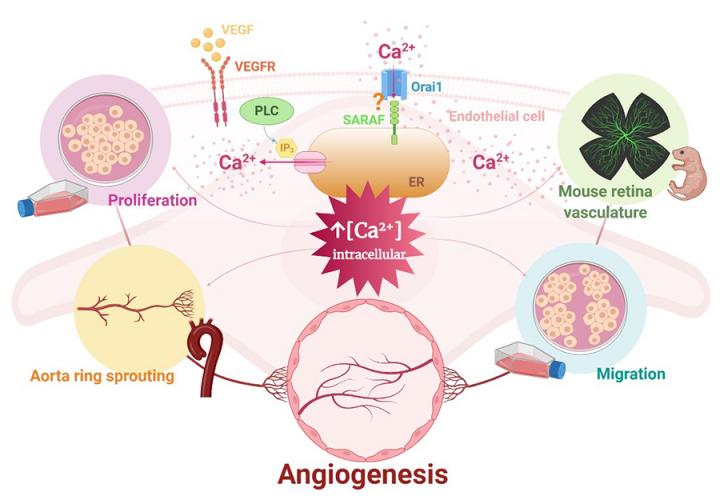
Angiogenesis is a process of new vessel formation that is activated both in physiological (tissue repair, reproduction, etc.) and pathological (myocardial infarction, diabetic retinopathy, cancer, etc.) conditions. The process is carried out by endothelial cells and includes their proliferation, migration and arrangement in tubes. Angiogenesis regulation is precise and is mainly mediated by pro-angiogenic factors, such as vascular endothelial growth factor (VEGF), which in turn promote different signalling pathways leading to an increase of intracellular Ca2+ concentrations.

The researchers from the Cardiovascular Pathophysiology group at the Institute of Biomedicine of Seville (IBiS) focused on precisely this point, demonstrating that the inhibition of certain proteins involved in the pathway’s regulation drastically affects the proper development of blood vessels. Specifically, these researchers demonstrated, for the first time, the involvement of SARAF, a SOCE regulatory protein, and Orai1, a subunit that forms the pore of the SOCE channel, in the VEGF-mediated activation of endothelial cells. Likewise, the research group has shown the importance of this Ca2+ pathway in the formation of new vessels and in the development of retinal vascularisation in neonatal mice. Thus, Orai1 and SARAF can be viewed as targets for the design of therapeutic strategies that could control angiogenesis in pathological situations such as cancer or retinopathies, or physiological situations such as post-infarction cardiac neovascularisation.

The study was funded by Spain’s Agencia Estatal de Investigación (State Research Agency) and was the result of collaboration with Dr. Rosado of the University of Extremadura, and with Dr. Khatib of the University of Bordeaux – LAMC INSERM 1029, France.

###

Media Contact
Antonio ORdonez
[email protected]

Original Source

https://www.frontiersin.org/articles/10.3389/fcell.2021.639952/full

Related Journal Article

http://dx.doi.org/10.3389/fcell.2021.639952

Tags: HematologyMedicine/HealthPhysiology
Share12Tweet8Share2ShareShareShare2

Related Posts

Blocking glucosylceramide production kills cancer cells via lysosomal dysfunction, not ceramide buildup

August 23, 2026

ZCCHC4 boosts replication-dependent histone mRNA translation by interacting with eIF3

August 23, 2026

Tirzepatide Versus GLP-1 Agonists for Stroke Risk in Atrial Fibrillation and Diabetes

August 22, 2026

Real-world study examines psychotic complications of subcutaneous foslevodopa/foscarbidopa infusions in 198 patients

August 22, 2026
Please login to join discussion

POPULAR NEWS

  • Blocking glucosylceramide production kills cancer cells via lysosomal dysfunction, not ceramide buildup

    29 shares
    Share 12 Tweet 7
  • ZCCHC4 boosts replication-dependent histone mRNA translation by interacting with eIF3

    29 shares
    Share 12 Tweet 7
  • KAIST Surface Defects Boost Droplet Formation, Removal, and Heat Transfer by 5.5-Fold

    29 shares
    Share 12 Tweet 7
  • Dual-oxygen pancreatic cancer organoids mirror basal-classical diversity, spatial transcriptomics confirms

    29 shares
    Share 12 Tweet 7

About

We bring you the latest biotechnology news from best research centers and universities around the world. Check our website.

Follow us

Recent News

Blocking glucosylceramide production kills cancer cells via lysosomal dysfunction, not ceramide buildup

ZCCHC4 boosts replication-dependent histone mRNA translation by interacting with eIF3

KAIST Surface Defects Boost Droplet Formation, Removal, and Heat Transfer by 5.5-Fold

Subscribe to Blog via Email

Enter your email address to subscribe to this blog and receive notifications of new posts by email.

Join 85 other subscribers
  • Contact Us

Bioengineer.org © Copyright 2023 All Rights Reserved.

Welcome Back!

Login to your account below

Forgotten Password?

Retrieve your password

Please enter your username or email address to reset your password.

Log In
No Result
View All Result
  • Homepages
    • Home Page 1
    • Home Page 2
  • News
  • National
  • Business
  • Health
  • Lifestyle
  • Science

Bioengineer.org © Copyright 2023 All Rights Reserved.