• HOME
  • NEWS
  • EXPLORE
    • CAREER
      • Companies
      • Jobs
    • EVENTS
    • iGEM
      • News
      • Team
    • PHOTOS
    • VIDEO
    • WIKI
  • BLOG
  • COMMUNITY
    • FACEBOOK
    • INSTAGRAM
    • TWITTER
Tuesday, August 11, 2026
BIOENGINEER.ORG
No Result
View All Result
  • Login
  • HOME
  • NEWS
  • EXPLORE
    • CAREER
      • Companies
      • Jobs
        • Lecturer
        • PhD Studentship
        • Postdoc
        • Research Assistant
    • EVENTS
    • iGEM
      • News
      • Team
    • PHOTOS
    • VIDEO
    • WIKI
  • BLOG
  • COMMUNITY
    • FACEBOOK
    • INSTAGRAM
    • TWITTER
  • HOME
  • NEWS
  • EXPLORE
    • CAREER
      • Companies
      • Jobs
        • Lecturer
        • PhD Studentship
        • Postdoc
        • Research Assistant
    • EVENTS
    • iGEM
      • News
      • Team
    • PHOTOS
    • VIDEO
    • WIKI
  • BLOG
  • COMMUNITY
    • FACEBOOK
    • INSTAGRAM
    • TWITTER
No Result
View All Result
Bioengineer.org
No Result
View All Result
Home NEWS Science News Health

Norovirus clusters are resistant to environmental stresses and UV disinfection, new study finds

Bioengineer by Bioengineer
April 15, 2021
in Health
Reading Time: 3 mins read
0
IMAGE
Share on FacebookShare on TwitterShare on LinkedinShare on RedditShare on Telegram

Findings suggest need to reconsider current disinfection, sanitation and hygiene practices
IMAGE

Credit: NIH

WASHINGTON (April 15, 2021) — Clusters of a virus known to cause stomach flu are resistant to detergent and ultraviolet disinfection, according to new research co-led by Danmeng Shuai, Ph.D., an associate professor of civil and environmental engineering at the George Washington University and Nihal Altan-Bonnet, Ph.D., a senior investigator and the head of the Laboratory of Host-Pathogen Dynamics at the National Heart, Lung, and Blood Institute, part of the National Institutes of Health. The findings suggest the need to revisit current disinfection, sanitation and hygiene practices aimed at protecting people from noroviruses.

Noroviruses are the leading cause of gastroenteritis around the world, with over 21 million cases each year in the United States alone.

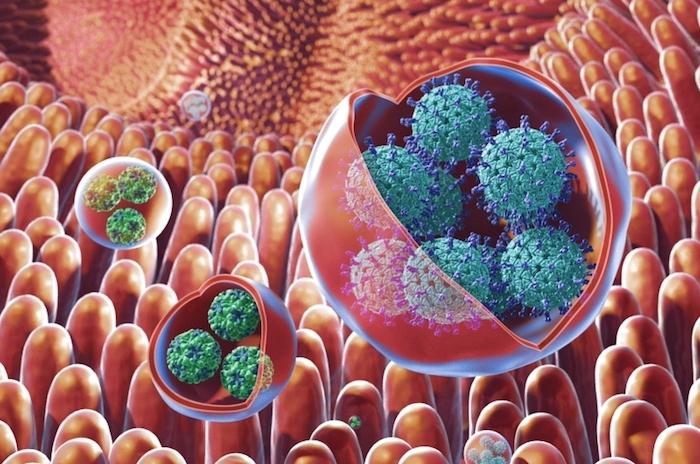
In 2018, Altan-Bonnet’s team found that noroviruses can be transmitted to humans via membrane-enclosed packets that contain more than one virus. In the past, scientists thought that viruses spread through exposure to individual virus particles, but the 2018 study–and others–showed how membrane-enclosed clusters arrive at a human cell and release an army of viruses all at once.

For the new study, Shuai, Altan-Bonnet and the study’s first author Mengyang Zhang, a doctoral student co-advised through a GW/NIH Graduate Partnerships Program, looked at the behavior of these protected virus clusters in the environment. They found that the virus clusters could survive attempts to disinfect with detergent solutions or even UV light. Water treatment plants use UV light to kill noroviruses and other pathogens.

“These membrane-cloaked viruses are tricky,” Shuai said. “Past research shows they can evade the body’s immune system and that they are highly infectious. Our study shows these membrane enclosed viruses are also able to dodge efforts to kill them with standard disinfectants.”

Altan-Bonnet added, “We have to consider these viral clusters cloaked in vesicle membranes as unique infectious agents in the public health arena. When it comes to virulence — and now with this study, disinfection and sanitation — the sum is much more than its parts. And these clusters are endowed with properties that are absent from other types of viral particles.”

According to the researchers, future studies must be done to find out if certain kinds of cleaning solutions or higher dosages of UV light would degrade the protective membrane and/or kill the viruses inside. Ultimately, the research could be used to devise more effective disinfection methods that could be used to clean surfaces at home, in restaurants and in places where norovirus can spread and cause outbreaks, like cruise ships.

“Our study’s findings represent a step towards recommendations for pathogen control in the environment, and public health protection,” Altan-Bonnet said.

###

The study, “Emerging Pathogenic Unit of Vesicle-Cloaked Murine Norovirus Clusters is Resistant to Environmental Stresses and UV254 Disinfection,” will appear online in the journal Environmental Science & Technology on April 15, 2021. This work was supported by the National Science Foundation (CBET-2028464), the National Heart, Lung, and Blood Institute, and National Institute of Allergy and Infectious Diseases Intramural Research Programs.

Media Contact
Timothy Pierce
[email protected]

Related Journal Article

http://dx.doi.org/10.1021/acs.est.1c01763

Tags: Biomedical/Environmental/Chemical EngineeringCivil EngineeringDisease in the Developing WorldEnvironmental HealthGastroenterologyInfectious/Emerging DiseasesMedicine/HealthPublic Health
Share13Tweet8Share2ShareShareShare2

Related Posts

Blood transcriptomics reveals U1-snRNP repression and miRNA–mRNA hubs before Parkinson’s disease

August 11, 2026

Unconventional T Cells Offer New Hope Against Urological Cancers

August 11, 2026

Digital program improves consistent symptom monitoring for outpatient psychiatric patients

August 11, 2026

Refeeding Syndrome Impacts Postnatal Growth in Extremely Low-Birth-Weight Infants

August 11, 2026
Please login to join discussion

POPULAR NEWS

  • Blood transcriptomics reveals U1-snRNP repression and miRNA–mRNA hubs before Parkinson’s disease

    29 shares
    Share 12 Tweet 7
  • Unconventional T Cells Offer New Hope Against Urological Cancers

    29 shares
    Share 12 Tweet 7
  • Researchers: Optimized operations are crucial for electric buses in cold climates

    29 shares
    Share 12 Tweet 7
  • Scientists identify a delivery pathway for antisense therapies

    29 shares
    Share 12 Tweet 7

About

We bring you the latest biotechnology news from best research centers and universities around the world. Check our website.

Follow us

Recent News

Blood transcriptomics reveals U1-snRNP repression and miRNA–mRNA hubs before Parkinson’s disease

Unconventional T Cells Offer New Hope Against Urological Cancers

Researchers: Optimized operations are crucial for electric buses in cold climates

Subscribe to Blog via Email

Enter your email address to subscribe to this blog and receive notifications of new posts by email.

Join 86 other subscribers
  • Contact Us

Bioengineer.org © Copyright 2023 All Rights Reserved.

Welcome Back!

Login to your account below

Forgotten Password?

Retrieve your password

Please enter your username or email address to reset your password.

Log In
No Result
View All Result
  • Homepages
    • Home Page 1
    • Home Page 2
  • News
  • National
  • Business
  • Health
  • Lifestyle
  • Science

Bioengineer.org © Copyright 2023 All Rights Reserved.