• HOME
  • NEWS
  • EXPLORE
    • CAREER
      • Companies
      • Jobs
    • EVENTS
    • iGEM
      • News
      • Team
    • PHOTOS
    • VIDEO
    • WIKI
  • BLOG
  • COMMUNITY
    • FACEBOOK
    • INSTAGRAM
    • TWITTER
Sunday, May 24, 2026
BIOENGINEER.ORG
No Result
View All Result
  • Login
  • HOME
  • NEWS
  • EXPLORE
    • CAREER
      • Companies
      • Jobs
        • Lecturer
        • PhD Studentship
        • Postdoc
        • Research Assistant
    • EVENTS
    • iGEM
      • News
      • Team
    • PHOTOS
    • VIDEO
    • WIKI
  • BLOG
  • COMMUNITY
    • FACEBOOK
    • INSTAGRAM
    • TWITTER
  • HOME
  • NEWS
  • EXPLORE
    • CAREER
      • Companies
      • Jobs
        • Lecturer
        • PhD Studentship
        • Postdoc
        • Research Assistant
    • EVENTS
    • iGEM
      • News
      • Team
    • PHOTOS
    • VIDEO
    • WIKI
  • BLOG
  • COMMUNITY
    • FACEBOOK
    • INSTAGRAM
    • TWITTER
No Result
View All Result
Bioengineer.org
No Result
View All Result
Home NEWS Science News Chemistry

Dynamical machine learning accurately reconstructs volume interiors with limited-angle data

Bioengineer by Bioengineer
April 14, 2021
in Chemistry
Reading Time: 3 mins read
0
IMAGE
Share on FacebookShare on TwitterShare on LinkedinShare on RedditShare on Telegram

IMAGE

Credit: by Iksung Kang, Alexandre Goy, and George Barbastathis

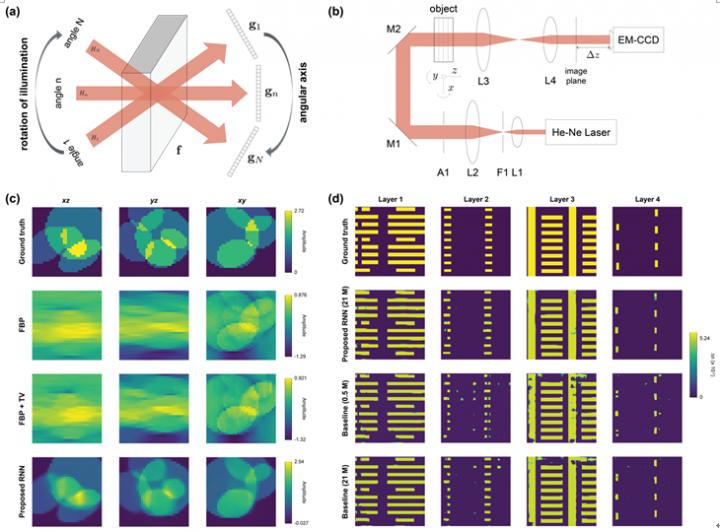
A wide range of objects, from biological cells to integrated circuits, are tomographically imaged to identify their interior structures. Volumetric reconstruction of the objects’ interiors is of practical implications, for instance, quantitative phase imaging of the cells and failure analysis of the circuits to validate their designs. Limiting the tomographic angular range is often desirable to reduce the time of radiation exposure and avoid any devastating effects upon the samples, or even unavoidable due to the structure of objects like in the case of tomosynthesis for mammography. However, tomographic reconstruction from limited angular views is not always welcome in an algorithmic sense, as it inevitably introduces artifacts and ambiguities to the reconstructions and thus, decreases overall reconstruction fidelity.

In a new paper published in Light: Science & Applications, a team at Massachusetts Institute of Technology, led by Professor George Barbastathis in the Department of Mechanical Engineering, has developed a dynamical machine learning approach to tackle this important problem, which takes a radically different path from most conventional inverse algorithms. They demonstrate the new method’s performance in two problems, limited-angle tomography under weak and strong scattering conditions. Depending on the degree of scattering due to the objects, the complexity of the problem is determined. It is often the case that hard X-rays are employed to image most materials, including biological tissues that the rays can be well approximated as straight lines without a large deviation because the materials weakly scatter the light. The next level of complexity arises when the light is more strongly scattered with objects with complex structures. The MIT team says their approach exploits “machine learning for a generic 3D refractive index reconstruction independent of the type of scattering.”

“Our motivation is that, as the angle of illumination is changed, the light goes through the same scattering volume, but the scattering events, weak or strong, follow a different sequence. At the same time, the raw image obtained from a new angle of illumination adds information to the tomographic problem, but that information is constrained by the previously obtained patterns. We interpret this as similar to a dynamical system, where the output is constrained by the history of earlier inputs as time evolves and new inputs arrive,” they added.

Recurrent neural network (RNN) architecture was their choice to implement their idea viewing the problem of limited-angle tomography as a dynamical system as the RNNs are often used to process data with dynamics. Here, the MIT team regards their raw images also as a sequence as the images are obtained one after the other. They say “our RNN architecture processes the raw images recurrently so that each raw image from a new angle improves over the reconstructions obtained from the previous angles.”

“The new method’s performance in the two problems that we tackled, tomography under weak (Radon) and strong scattering, indicates its promise for a number of other equally or more challenging inverse problems. Thus, we anticipate this publication to have significant impact beyond the immediate context that we are addressing here,” they noted.

###

Media Contact
Iksung Kang
[email protected]

Related Journal Article

http://dx.doi.org/10.1038/s41377-021-00512-x

Tags: Chemistry/Physics/Materials SciencesOptics
Share12Tweet8Share2ShareShareShare2

Related Posts

Study Reveals How Valproate Affects Early Brain Development: Insights into the Antiepileptic Drug’s Impact — Chemistry

Study Reveals How Valproate Affects Early Brain Development: Insights into the Antiepileptic Drug’s Impact

May 22, 2026
Sustainable Chemistry: Iron Replaces Noble Metals in Catalytic Reactions — Chemistry

Sustainable Chemistry: Iron Replaces Noble Metals in Catalytic Reactions

May 22, 2026

Advancing Thin-Film Device Manufacturing with Imaging Ellipsometry for Enhanced Process Control

May 22, 2026

Simple Adjustment in 3D Printing Enhances Fit of Dental Crowns

May 22, 2026
Please login to join discussion

POPULAR NEWS

  • ESMO 2025: mRNA COVID Vaccines Enhance Efficacy of Cancer Immunotherapy

    313 shares
    Share 125 Tweet 78
  • New Study Reveals Plants Can Detect the Sound of Rain

    734 shares
    Share 293 Tweet 183
  • Research Indicates Potential Connection Between Prenatal Medication Exposure and Elevated Autism Risk

    847 shares
    Share 339 Tweet 212
  • Common Food Preservatives Associated with Elevated Blood Pressure and Increased Heart Disease Risk

    55 shares
    Share 22 Tweet 14

About

We bring you the latest biotechnology news from best research centers and universities around the world. Check our website.

Follow us

Recent News

Sepsis from C. difficile Infection Has Comparable Mortality

Mortality Trends in Dallas Very Preterm Neonates, 1977–2024

Nanofiber Self-Adhesive Electrode with PEDOT, Polyurethane

Subscribe to Blog via Email

Enter your email address to subscribe to this blog and receive notifications of new posts by email.

Join 83 other subscribers
  • Contact Us

Bioengineer.org © Copyright 2023 All Rights Reserved.

Welcome Back!

Login to your account below

Forgotten Password?

Retrieve your password

Please enter your username or email address to reset your password.

Log In
No Result
View All Result
  • Homepages
    • Home Page 1
    • Home Page 2
  • News
  • National
  • Business
  • Health
  • Lifestyle
  • Science

Bioengineer.org © Copyright 2023 All Rights Reserved.