2018 eruption of Kīlauea Volcano in Hawai’i provided scientists with an unprecedented opportunity to identify new factors that could help forecast the hazard potential of future eruptions
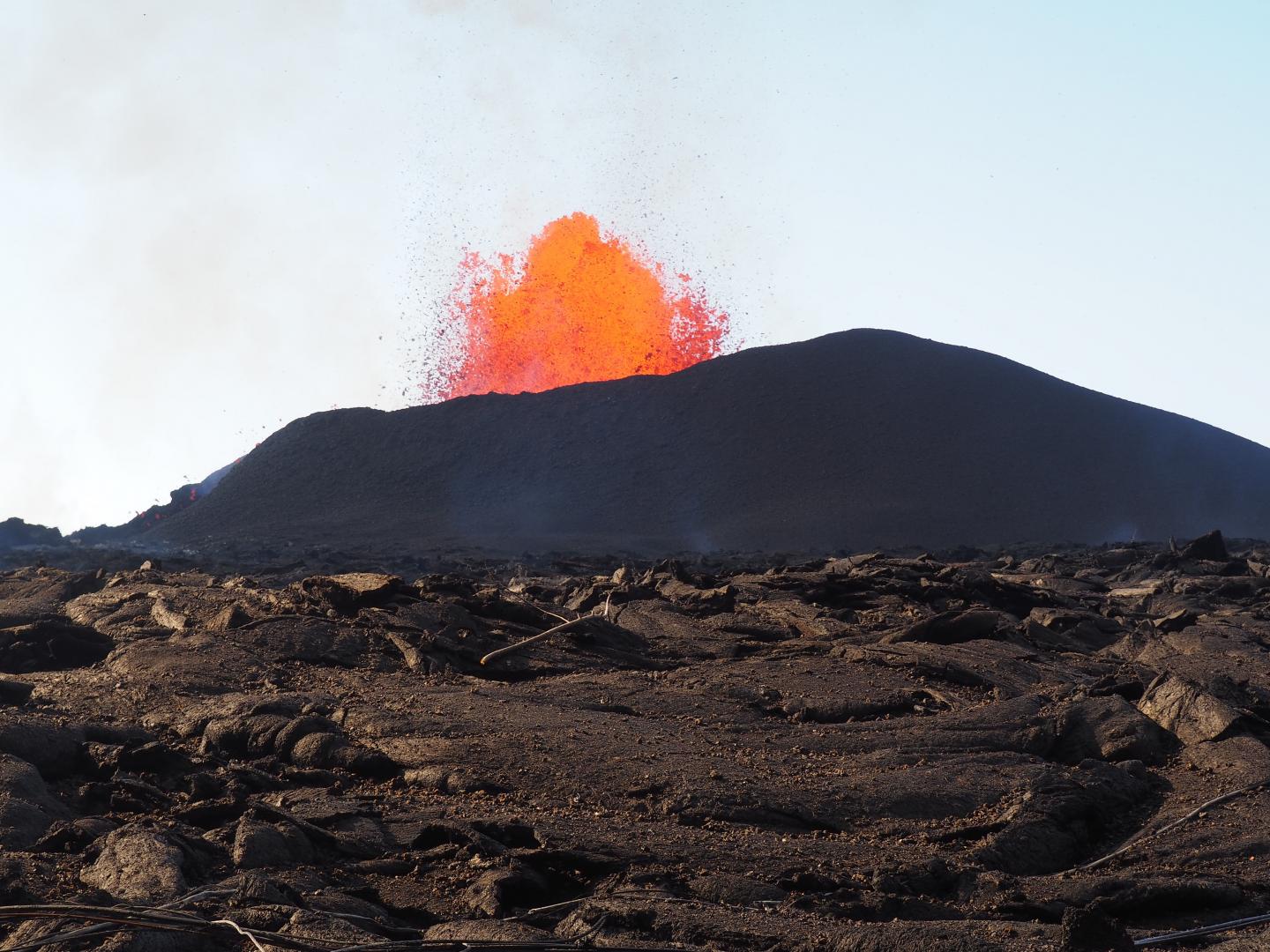
Credit: B. Shiro, USGS
Washington, DC– The 2018 eruption of Kīlauea Volcano in Hawai’i provided scientists with an unprecedented opportunity to identify new factors that could help forecast the hazard potential of future eruptions.
The properties of the magma inside a volcano affect how an eruption will play out. In particular, the viscosity of this molten rock is a major factor in influencing how hazardous an eruption could be for nearby communities.
Very viscous magmas are linked with more powerful explosions because they can block gas from escaping through vents, allowing pressure to build up inside the volcano’s plumbing system. On the other hand, extrusion of more viscous magma results in slower-moving lava flows.
“But magma viscosity is usually only quantified well after an eruption, not in advance,” explained Carnegie’s Diana Roman. “So, we are always trying to identify early indications of magma viscosity that could help forecast a volcano’s eruption style.”
She led new work identifying an indicator of magma viscosity that can be measured before an eruption. This could help scientists and emergency managers understand possible patterns of future eruptions. The findings are published in Nature.
The 2018 event included the first eruptive activity in Kīlauea’s lower East Rift Zone since 1960. The first of 24 fissures opened in early May, and the eruption continued for exactly three months. This situation provided unprecedented access to information for many researchers, including Roman and her colleagues–Arianna Soldati and Don Dingwell of Ludwig-Maximilians-University of Munich, Bruce Houghton of University of Hawai’i at Mānoa, and Brian Shiro of the U.S. Geological Survey’s Hawaiian Volcano Observatory.
The event provided a wealth of simultaneous data about the behavior of both high- and low-viscosity magma, as well as about the pre-eruption stresses in the solid rock underlying Kīlauea.
Tectonic and volcanic activity causes fractures, called faults, to form in the rock that makes up the Earth’s crust. When geologic stresses cause these faults to move against each other, geoscientists measure the 3-D orientation and movement of the faults using seismic instruments.
By studying what happened in Kīlauea’s lower East Rift Zone in 2018, Roman and her colleagues determined that the direction of the fault movements in the lower East Rift Zone before and during the volcanic eruption could be used to estimate the viscosity of rising magma during periods of precursory unrest.
“We were able to show that with robust monitoring we can relate pressure and stress in a volcano’s plumbing system to the underground movement of more viscous magma,” Roman explained. “This will enable monitoring experts to better anticipate the eruption behavior of volcanoes like Kīlauea and to tailor response strategies in advance.”
###
The research was supported by an Alexander von Humboldt postdoctoral fellowship, the European Research Council Advanced Grant 834225, the U.S. National Science Foundation, and U.S. Geological Survey Disaster Supplemental Research funding.
The Carnegie Institution for Science (carnegiescience.edu) is a private, nonprofit organization headquartered in Washington, D.C., with three research divisions on both coasts. Since its founding in 1902, the Carnegie Institution has been a pioneering force in basic scientific research. Carnegie scientists are leaders in the life and environmental sciences, Earth and planetary science, and astronomy and astrophysics.
Media Contact
Diana Roman
[email protected]
Related Journal Article
http://dx.