• HOME
  • NEWS
  • EXPLORE
    • CAREER
      • Companies
      • Jobs
    • EVENTS
    • iGEM
      • News
      • Team
    • PHOTOS
    • VIDEO
    • WIKI
  • BLOG
  • COMMUNITY
    • FACEBOOK
    • INSTAGRAM
    • TWITTER
Sunday, August 23, 2026
BIOENGINEER.ORG
No Result
View All Result
  • Login
  • HOME
  • NEWS
  • EXPLORE
    • CAREER
      • Companies
      • Jobs
        • Lecturer
        • PhD Studentship
        • Postdoc
        • Research Assistant
    • EVENTS
    • iGEM
      • News
      • Team
    • PHOTOS
    • VIDEO
    • WIKI
  • BLOG
  • COMMUNITY
    • FACEBOOK
    • INSTAGRAM
    • TWITTER
  • HOME
  • NEWS
  • EXPLORE
    • CAREER
      • Companies
      • Jobs
        • Lecturer
        • PhD Studentship
        • Postdoc
        • Research Assistant
    • EVENTS
    • iGEM
      • News
      • Team
    • PHOTOS
    • VIDEO
    • WIKI
  • BLOG
  • COMMUNITY
    • FACEBOOK
    • INSTAGRAM
    • TWITTER
No Result
View All Result
Bioengineer.org
No Result
View All Result
Home NEWS Science News

Amazing integration of technology and art: a 3D LotusMenu in your palm

Bioengineer by Bioengineer
April 5, 2021
in Science News
Reading Time: 2 mins read
0
IMAGE
Share on FacebookShare on TwitterShare on LinkedinShare on RedditShare on Telegram

IMAGE

Credit: @Science China Press

A recent study proposed a three-dimensional LotusMenu that can “bloom in the palm”. With this menu, even if you are not Nezha, you can also control your own lotus.

The research paper is titled: “LotusMenu: A 3D Menu using Wrist and Elbow Rotation Inspired by Chinese Traditional Symbol”. It’s published in SCIENCE CHINA Information Sciences recently, written by Associate Professor Lu Fei’s human-computer interaction research team from Beijing University of Posts and Telecommunications. Based on the metaphor of the traditional lotus pattern, the researchers proposed a 3D LotusMenu, which uses the rotational motion of wrist and elbow to control the menu selection.

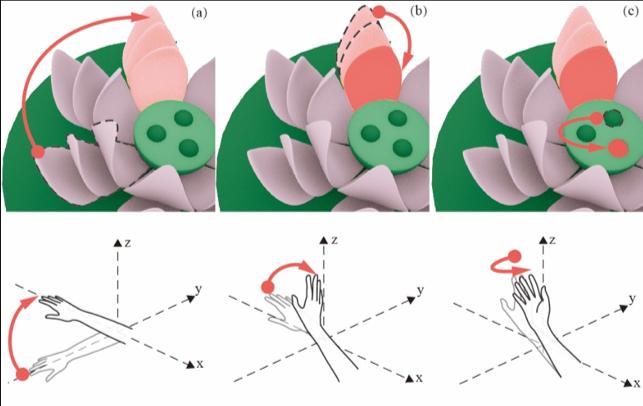
In the design of this interactive technology, the researchers corresponded the shape of the lotus to the 3D rotation gesture: mapping the selection of circular petal groups to the rolling gesture of elbow (Figure 1(a)), the selection of layered petals to the pitching gesture of wrist (Figure 1(b)), and the selection of circular lotus seeds to the yawing gesture of wrist (Figure 1(c)). During the interaction, there is almost no shoulder movement, so that the gesture can be easily performed within a small range of motion. In addition, on this basis, the rotation of the wrist and arm is merged as much as possible, so the fatigue caused by gestures is further reduced.

In the experiment, the researchers compared the user performance of LotusMenu and traditional linear menus. The results show that LotusMenu can significantly reduce the completion time of the selection task, while it perceived less fatigue as well. This result can expand the application of 3D rotating gestures in human-computer interaction, and has significant reference value for the future application of 3D rotating interactive components in large-screen interactive systems and virtual reality systems.

###

See the article:

Lyu F, Liu Y J, Huang J, et al. LotusMenu: a 3D menu using wrist and elbow rotation inspired by Chinese traditional symbol. Sci China Inf Sci, 2021, 64(10): 204101,
https://doi.org/10.1007/s11432-020-2999-y

Media Contact
LYU Fei
[email protected]

Original Source

http://doi.org/10.1007/s11432-020-2999-y

Related Journal Article

http://dx.doi.org/10.1007/s11432-020-2999-y

Tags: Technology/Engineering/Computer Science
Share12Tweet8Share2ShareShareShare2

Related Posts

ZCCHC4 boosts replication-dependent histone mRNA translation by interacting with eIF3

August 23, 2026
KAIST Surface Defects Boost Droplet Formation, Removal, and Heat Transfer by 5.5-Fold

KAIST Surface Defects Boost Droplet Formation, Removal, and Heat Transfer by 5.5-Fold

August 23, 2026

Dual-oxygen pancreatic cancer organoids mirror basal-classical diversity, spatial transcriptomics confirms

August 23, 2026

Tirzepatide Versus GLP-1 Agonists for Stroke Risk in Atrial Fibrillation and Diabetes

August 22, 2026
Please login to join discussion

POPULAR NEWS

  • ZCCHC4 boosts replication-dependent histone mRNA translation by interacting with eIF3

    29 shares
    Share 12 Tweet 7
  • KAIST Surface Defects Boost Droplet Formation, Removal, and Heat Transfer by 5.5-Fold

    29 shares
    Share 12 Tweet 7
  • Dual-oxygen pancreatic cancer organoids mirror basal-classical diversity, spatial transcriptomics confirms

    29 shares
    Share 12 Tweet 7
  • Tirzepatide Versus GLP-1 Agonists for Stroke Risk in Atrial Fibrillation and Diabetes

    29 shares
    Share 12 Tweet 7

About

We bring you the latest biotechnology news from best research centers and universities around the world. Check our website.

Follow us

Recent News

ZCCHC4 boosts replication-dependent histone mRNA translation by interacting with eIF3

KAIST Surface Defects Boost Droplet Formation, Removal, and Heat Transfer by 5.5-Fold

Dual-oxygen pancreatic cancer organoids mirror basal-classical diversity, spatial transcriptomics confirms

Subscribe to Blog via Email

Enter your email address to subscribe to this blog and receive notifications of new posts by email.

Join 85 other subscribers
  • Contact Us

Bioengineer.org © Copyright 2023 All Rights Reserved.

Welcome Back!

Login to your account below

Forgotten Password?

Retrieve your password

Please enter your username or email address to reset your password.

Log In
No Result
View All Result
  • Homepages
    • Home Page 1
    • Home Page 2
  • News
  • National
  • Business
  • Health
  • Lifestyle
  • Science

Bioengineer.org © Copyright 2023 All Rights Reserved.