• HOME
  • NEWS
  • EXPLORE
    • CAREER
      • Companies
      • Jobs
    • EVENTS
    • iGEM
      • News
      • Team
    • PHOTOS
    • VIDEO
    • WIKI
  • BLOG
  • COMMUNITY
    • FACEBOOK
    • INSTAGRAM
    • TWITTER
Monday, January 12, 2026
BIOENGINEER.ORG
No Result
View All Result
  • Login
  • HOME
  • NEWS
  • EXPLORE
    • CAREER
      • Companies
      • Jobs
        • Lecturer
        • PhD Studentship
        • Postdoc
        • Research Assistant
    • EVENTS
    • iGEM
      • News
      • Team
    • PHOTOS
    • VIDEO
    • WIKI
  • BLOG
  • COMMUNITY
    • FACEBOOK
    • INSTAGRAM
    • TWITTER
  • HOME
  • NEWS
  • EXPLORE
    • CAREER
      • Companies
      • Jobs
        • Lecturer
        • PhD Studentship
        • Postdoc
        • Research Assistant
    • EVENTS
    • iGEM
      • News
      • Team
    • PHOTOS
    • VIDEO
    • WIKI
  • BLOG
  • COMMUNITY
    • FACEBOOK
    • INSTAGRAM
    • TWITTER
No Result
View All Result
Bioengineer.org
No Result
View All Result
Home NEWS Science News Health

Engineers use tiny device to change songbird pitch, improve understanding of human speech

Bioengineer by Bioengineer
March 31, 2021
in Health
Reading Time: 3 mins read
0
IMAGE
Share on FacebookShare on TwitterShare on LinkedinShare on RedditShare on Telegram

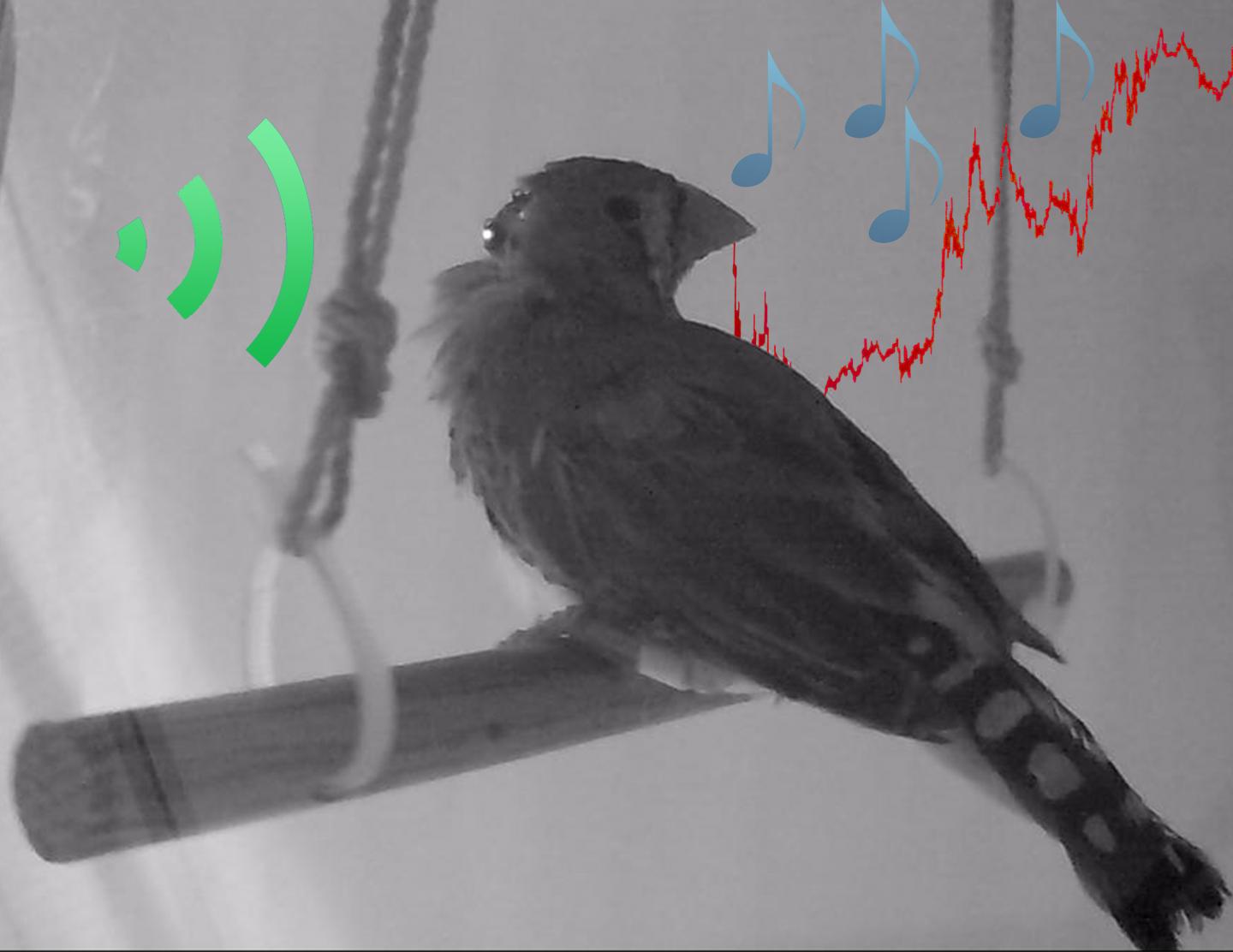
University of Arizona engineers have created a tiny, wireless device to rapidly change the pitch of adult songbirds’ songs, with the goal of better understanding communication and speech in the human brain.
IMAGE

Credit: University of Arizona Gutruf Lab

The human brain regions responsible for speech and communication keep our world running by allowing us to do things like talk with friends, shout for help in an emergency and present information in meetings.

However, scientific understanding of just how these parts of the brain work is limited. Consequently, knowledge of how to improve challenges such as speech impediments or language acquisition is limited as well.

Using an ultra-lightweight, wireless implant, a University of Arizona team is researching songbirds – one of the few species that share humans’ ability to learn new vocalizations – to improve scientific understanding of human speech. A paper about their work was published today in the journal Nature Communications.

“Using new methods of antenna design and optimized electronics, we were able to shrink the devices dramatically compared to existing versions, to about a third of the size of a dime and as thin as a sheet of paper,” said lead author Jokubas Ausra, a biomedical engineering doctoral student in the Gutruf Lab, where the devices were created.

There are several ways the device can be used to study the link between brain behavior and vocalization. It can monitor the bird for slight temperature changes that indicate when a bird is most likely to sing. Using a technique called optogenetics, researchers can modulate neuron groups in the brain regions used for birdsong. In this study, the team found that remotely controlling specific neurons during birdsong using their unique device caused the song to change pitch.

“We are excited to expand the toolbox of neuroscientists and hope to enable many exciting studies that decipher the working principles of the brain,” said senior author Philipp Gutruf, assistant professor of biomedical engineering and Craig M. Berge Fellow in the UArizona College of Engineering.

The Gutruf Lab has developed other wireless lightweight devices used to monitor brain activity in rodents, but birds’ ability to move in 3D space represents an added challenge. This tiny device allows the birds to move without restriction – a breakthrough enabled by careful management of the energy sent wirelessly to the implant.

“Because of the small size and light weight, the birds can move freely and live permanently with the implant without affecting their behavior or health, which opens up many possibilities to study the basis for vocal communication,” said co-senior author Julie Miller, an assistant professor of neuroscience and speech, language and hearing sciences at UArizona.

The team’s next goal is to expand device capabilities to also record neuron activity. This could allow researchers to visualize brain activity during song learning and performance to gain a deeper understanding of the underlying brain mechanisms.

###

Media Contact
Emily Dieckman
[email protected]

Original Source

https://news.engineering.arizona.edu/news/engineers-use-confetti-sized-device-change-songbird-pitch-improve-understanding-human-speech

Related Journal Article

http://dx.doi.org/10.1038/s41467-021-22138-8

Tags: Biomedical/Environmental/Chemical EngineeringBiotechnologyHearing/SpeechLanguage/Linguistics/SpeechNanotechnology/MicromachinesResearch/DevelopmentTechnology/Engineering/Computer Science
Share13Tweet8Share2ShareShareShare2

Related Posts

Forensic Age Estimation via Elbow MRI in Chinese

January 12, 2026

The Science Behind Honoring the Human Corpse

January 12, 2026

Exploring Health Literacy Gaps in Postoperative Breast Cancer Care

January 12, 2026

Choosing Inpatient Care: Insights from Unemployed Patients

January 12, 2026
Please login to join discussion

POPULAR NEWS

  • Enhancing Spiritual Care Education in Nursing Programs

    154 shares
    Share 62 Tweet 39
  • PTSD, Depression, Anxiety in Childhood Cancer Survivors, Parents

    146 shares
    Share 58 Tweet 37
  • Robotic Ureteral Reconstruction: A Novel Approach

    69 shares
    Share 28 Tweet 17
  • Impact of Vegan Diet and Resistance Exercise on Muscle Volume

    47 shares
    Share 19 Tweet 12

About

We bring you the latest biotechnology news from best research centers and universities around the world. Check our website.

Follow us

Recent News

Unveiling Complex Chromosomal Insertions with Karyotyping

Enhanced Coherent Ranging via Phase-Multiplied Interferometry

Adaphostin Triggers Oxidative Stress in Esophageal Cancer

Subscribe to Blog via Email

Enter your email address to subscribe to this blog and receive notifications of new posts by email.

Join 71 other subscribers
  • Contact Us

Bioengineer.org © Copyright 2023 All Rights Reserved.

Welcome Back!

Login to your account below

Forgotten Password?

Retrieve your password

Please enter your username or email address to reset your password.

Log In
No Result
View All Result
  • Homepages
    • Home Page 1
    • Home Page 2
  • News
  • National
  • Business
  • Health
  • Lifestyle
  • Science

Bioengineer.org © Copyright 2023 All Rights Reserved.