• HOME
  • NEWS
  • EXPLORE
    • CAREER
      • Companies
      • Jobs
    • EVENTS
    • iGEM
      • News
      • Team
    • PHOTOS
    • VIDEO
    • WIKI
  • BLOG
  • COMMUNITY
    • FACEBOOK
    • INSTAGRAM
    • TWITTER
Saturday, November 21, 2026
BIOENGINEER.ORG
No Result
View All Result
  • Login
  • HOME
  • NEWS
  • EXPLORE
    • CAREER
      • Companies
      • Jobs
        • Lecturer
        • PhD Studentship
        • Postdoc
        • Research Assistant
    • EVENTS
    • iGEM
      • News
      • Team
    • PHOTOS
    • VIDEO
    • WIKI
  • BLOG
  • COMMUNITY
    • FACEBOOK
    • INSTAGRAM
    • TWITTER
No Result
View All Result
Bioengineer.org
No Result
View All Result
Home NEWS Science News Chemistry

Creating patterns spontaneously in synthetic materials

Bioengineer by Bioengineer
March 24, 2021
in Chemistry
Reading Time: 3 mins read
0
IMAGE
Share on FacebookShare on TwitterShare on LinkedinShare on RedditShare on Telegram

IMAGE

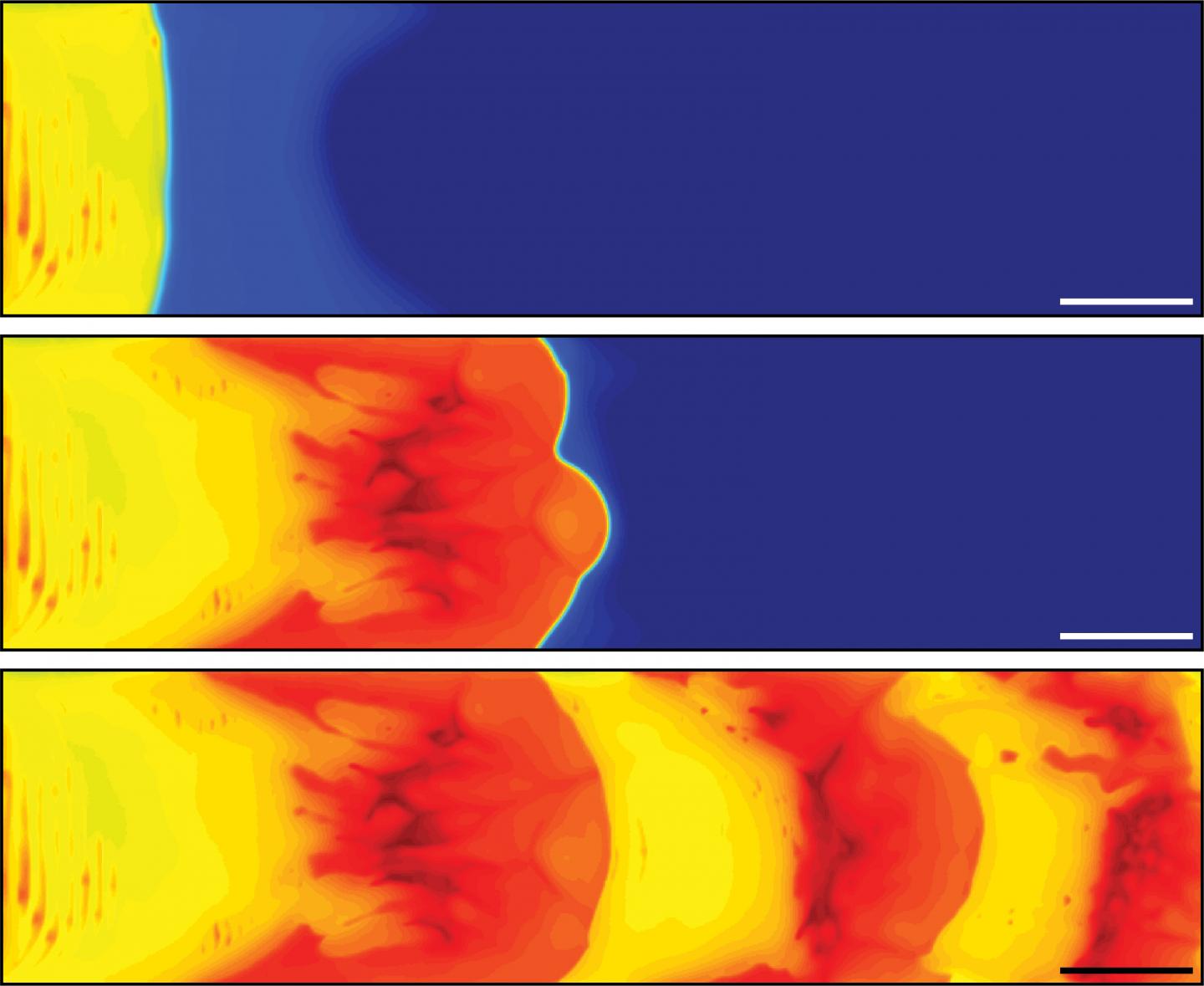
Credit: Adapted from ACS Central Science 2021, DOI: 10.1021/acscentsci.1c00110

Nature produces a startling array of patterned materials, from the sensitive ridges on a person’s fingertip to a cheetah’s camouflaging spots. Although nature’s patterns arise spontaneously during development, creating patterns on synthetic materials is more laborious. Now, researchers reporting in ACS Central Science have found an easy way to make patterned materials having complex microstructures with variations in mechanical, thermal and optical properties — without the need for masks, molds or printers.

In animals, patterns form before birth in response to genetically controlled signals that often vary in concentration along a gradient. In contrast, traditional manufacturing approaches for creating patterns and structures involve multiple steps, such as layer-by-layer assembly, lithography, molding or casting. Jeffrey Moore, Nancy Sottos, Philippe Geubelle and colleagues wanted to develop a spontaneous patterning method more akin to the biological process.

The team placed a solution of dicyclopentadiene monomer in a channel and then heated one end of the channel. The heat activated a ruthenium catalyst, which caused the monomer to polymerize, generating more heat that traveled down the channel. This continued to happen until all available monomer in the region was consumed. Eventually, heat traveled farther down the channel to a location where fresh monomer was present, and the process began again. With this technique, the team produced resins with regular ridges, and they controlled the height and spacing of the ridges by adjusting the initial temperature of the solution. By using a different monomer or adding other compounds to the solution, the researchers created materials with patterns of color and stiffness. The new method could someday be used to create a variety of new “smart” materials, from tire or shoe treads to electronics and biomaterials, the researchers say.

###

The authors acknowledge funding from the Air Force Office of Scientific Research, the Arnold & Mabel Beckman Foundation, the National Science Foundation and the Illinois Space Grant Consortium.

The paper’s abstract will be available on March 24 at 8 a.m. Eastern time here: http://pubs.acs.org/doi/abs/10.1021/acscentsci.1c00110

For more of the latest research news, register for our upcoming meeting, ACS Spring 2021. Journalists and public information officers are encouraged to apply for complimentary press registration by emailing us at newsroom@acs.org.

The American Chemical Society (ACS) is a nonprofit organization chartered by the U.S. Congress. ACS’ mission is to advance the broader chemistry enterprise and its practitioners for the benefit of Earth and all its people. The Society is a global leader in promoting excellence in science education and providing access to chemistry-related information and research through its multiple research solutions, peer-reviewed journals, scientific conferences, eBooks and weekly news periodical Chemical & Engineering News. ACS journals are among the most cited, most trusted and most read within the scientific literature; however, ACS itself does not conduct chemical research. As a specialist in scientific information solutions (including SciFinder® and STN®), its CAS division powers global research, discovery and innovation. ACS’ main offices are in Washington, D.C., and Columbus, Ohio.

To automatically receive news releases from the American Chemical Society, contact newsroom@acs.org.

Follow us: Twitter | Facebook

Media Contact
Katie Cottingham
k_cottingham@acs.org

Tags: BiotechnologyChemistry/Physics/Materials SciencesMaterialsTechnology/Engineering/Computer Science
Share12Tweet8Share2ShareShareShare2

Related Posts

Mathematical Models Map Structural Complexity and Entropy in Silicon Carbide Networks

Mathematical Models Map Structural Complexity and Entropy in Silicon Carbide Networks

November 21, 2026
Electrical Biosensors for Liver Cancer Liquid Biopsy Face Translation Hurdles

Electrical Biosensors for Liver Cancer Liquid Biopsy Face Translation Hurdles

November 21, 2026

Co-Pyrolyzed Sewage Sludge and Bagasse Bio-Char Effectively Removes Anthocyanin Pigment From Water

November 21, 2026

Pyridine Schiff Base Ligands Enable High-Efficiency Liquid Extraction of Mercury Ions

November 21, 2026
Please login to join discussion

POPULAR NEWS

  • Enhanced 3D ResNet Model Classifies Active Pulmonary Tuberculosis on Chest CT

    Enhanced 3D ResNet Model Classifies Active Pulmonary Tuberculosis on Chest CT

    29 shares
    Share 12 Tweet 7
  • Analysis of Real-World Data Details Skin Toxicities Across Eleven Targeted Cancer Drugs

    29 shares
    Share 12 Tweet 7
  • Lightweight CPU Fingerprinting Enhances Post-Quantum BIKE Key Generation Against Seed Prediction

    29 shares
    Share 12 Tweet 7
  • Regional Biopsy Matches Standard Sampling for Suspected Prostate Cancer Across PI-RADS Scores

    29 shares
    Share 12 Tweet 7

About

We bring you the latest biotechnology news from best research centers and universities around the world. Check our website.

Follow us

Recent News

Melanin Nanomedicines Hitchhike on Myeloperoxidase to Target and Alleviate Chronic Inflammation

Tumor Genotype Dictates Avapritinib and Sunitinib Efficacy in Advanced GIST

Plasma Proteomics Reveals Distinct Resistance and Survival Signatures in Lung Cancer

Subscribe to Blog via Email

Enter your email address to subscribe to this blog and receive notifications of new posts by email.

Join 89 other subscribers
  • Contact Us

Bioengineer.org © Copyright 2023 All Rights Reserved.

Welcome Back!

Login to your account below

Forgotten Password?

Retrieve your password

Please enter your username or email address to reset your password.

Log In
No Result
View All Result
  • Homepages
    • Home Page 1
    • Home Page 2
  • News
  • National
  • Business
  • Health
  • Lifestyle
  • Science

Bioengineer.org © Copyright 2023 All Rights Reserved.