• HOME
  • NEWS
  • EXPLORE
    • CAREER
      • Companies
      • Jobs
    • EVENTS
    • iGEM
      • News
      • Team
    • PHOTOS
    • VIDEO
    • WIKI
  • BLOG
  • COMMUNITY
    • FACEBOOK
    • INSTAGRAM
    • TWITTER
Saturday, February 7, 2026
BIOENGINEER.ORG
No Result
View All Result
  • Login
  • HOME
  • NEWS
  • EXPLORE
    • CAREER
      • Companies
      • Jobs
        • Lecturer
        • PhD Studentship
        • Postdoc
        • Research Assistant
    • EVENTS
    • iGEM
      • News
      • Team
    • PHOTOS
    • VIDEO
    • WIKI
  • BLOG
  • COMMUNITY
    • FACEBOOK
    • INSTAGRAM
    • TWITTER
  • HOME
  • NEWS
  • EXPLORE
    • CAREER
      • Companies
      • Jobs
        • Lecturer
        • PhD Studentship
        • Postdoc
        • Research Assistant
    • EVENTS
    • iGEM
      • News
      • Team
    • PHOTOS
    • VIDEO
    • WIKI
  • BLOG
  • COMMUNITY
    • FACEBOOK
    • INSTAGRAM
    • TWITTER
No Result
View All Result
Bioengineer.org
No Result
View All Result
Home NEWS Science News Health

CT colonography most effective noninvasive colorectal cancer screening test

Bioengineer by Bioengineer
March 12, 2021
in Health
Reading Time: 3 mins read
0
IMAGE
Share on FacebookShare on TwitterShare on LinkedinShare on RedditShare on Telegram

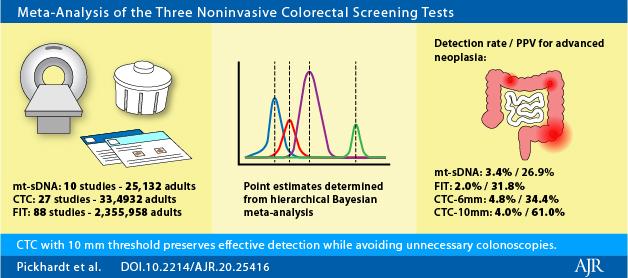
Compared with multi-target stool-DNA and fecal immunochemical test, CT colonography with 10 mm threshold most effectively targets advanced neoplasia–preserving detection while decreasing unnecessary colonoscopies
IMAGE

Credit: American Roentgen Ray Society (ARRS), American Journal of Roentgenology (AJR)

Leesburg, VA, March 12, 2021–According to an open-access article in ARRS’ American Journal of Roentgenology (AJR), compared with multi-target stool-DNA (mt-sDNA) and fecal immunochemical test (FIT), CT colonography (CTC) with 10 mm threshold most effectively targets advanced neoplasia (AN)–preserving detection while decreasing unnecessary colonoscopies.

“CTC performed with a polyp size threshold for colonoscopy referral set at 10 mm represents the most effective and efficient non-invasive screening test for colorectal cancer (CRC) prevention and detection,” clarified first author Perry J. Pickhardt from the department of radiology at the University of Wisconsin School of Medicine & Public Health.

Because the relative performance characteristics of available noninvasive tests had not yet been adequately compared, Pickhardt’s team systematically searched PubMed and Google Scholar, including 10 mt-sDNA, 27 CTC, and 88 FIT published screening studies involving 25,132, 33,4932, and 2,355,958 asymptomatic adults, respectively. To determine test-positivity rates (TPR) leading to optical colonoscopy (OC), as well as positive predictive value (PPV) and detection rate (DR) for both AN and CRC, meta-analysis with hierarchical Bayesian modeling was conducted, in accordance with Cochrane Collaboration and PRISMA guidelines.

Pickhardt and colleagues’ results showed that CRC prevention via screen detection of AN was highest with CTC, followed by mt- sDNA, and lowest with FIT due to the differing TPR and PPV, although overlap existed in the 95% CIs when accounting for uncertainty. Compared with mt-sDNA and CTC6, FIT and CTC10 strategies yielded substantially lower colonoscopy resource utilization, while mt-sDNA performance appeared to be similar to FIT at low positivity thresholds.

Acknowledging that each CRC screening option has relative advantages and disadvantages that should be carefully considered and tailored to the individual, “in the end,” the authors of this AJR article concluded, “the ‘best’ test may be the one that the patient is willing to undergo.”

An electronic supplement to this article is available here: https://www.ajronline.org/doi/10.2214/AJR.20.25416

###

Founded in 1900, the American Roentgen Ray Society (ARRS) is the first and oldest radiological society in North America, dedicated to the advancement of medicine through the profession of radiology and its allied sciences. An international forum for progress in medical imaging since the discovery of the x-ray, ARRS maintains its mission of improving health through a community committed to advancing knowledge and skills with an annual scientific meeting, monthly publication of the peer-reviewed American Journal of Roentgenology (AJR), quarterly issues of InPractice magazine, AJR Live Webinars and Podcasts, topical symposia, print and online educational materials, as well as awarding scholarships via The Roentgen FundĀ®.

Media Contact
Logan K. Young
[email protected]

Original Source

https://arrs.org/ARRSLIVE/Pressroom/PressReleases/CT_Colonography_Most_Effective_Noninvasive_Colorectal_Cancer_Screening_Test_Advanced_Neoplasia.aspx

Related Journal Article

http://dx.doi.org/10.2214/AJR.20.25416

Tags: cancerCarcinogensDiagnosticsGastroenterologyHealth Care Systems/ServicesInternal MedicineMedicine/HealthPublic Health
Share12Tweet8Share2ShareShareShare2

Related Posts

Exploring Decision-Making in Dementia Caregivers’ Mobility

February 7, 2026

Succinate Receptor 1 Limits Blood Cell Formation, Leukemia

February 7, 2026

Palmitoylation of Tfr1 Drives Platelet Ferroptosis and Exacerbates Liver Damage in Heat Stroke

February 7, 2026

Oxygen-Enhanced Dual-Section Microneedle Patch Improves Drug Delivery and Boosts Photodynamic and Anti-Inflammatory Treatment for Psoriasis

February 7, 2026
Please login to join discussion

POPULAR NEWS

  • Robotic Ureteral Reconstruction: A Novel Approach

    Robotic Ureteral Reconstruction: A Novel Approach

    82 shares
    Share 33 Tweet 21
  • Digital Privacy: Health Data Control in Incarceration

    63 shares
    Share 25 Tweet 16
  • Study Reveals Lipid Accumulation in ME/CFS Cells

    57 shares
    Share 23 Tweet 14
  • Breakthrough in RNA Research Accelerates Medical Innovations Timeline

    53 shares
    Share 21 Tweet 13

About

We bring you the latest biotechnology news from best research centers and universities around the world. Check our website.

Follow us

Recent News

Exploring Decision-Making in Dementia Caregivers’ Mobility

Succinate Receptor 1 Limits Blood Cell Formation, Leukemia

Palmitoylation of Tfr1 Drives Platelet Ferroptosis and Exacerbates Liver Damage in Heat Stroke

Subscribe to Blog via Email

Enter your email address to subscribe to this blog and receive notifications of new posts by email.

Join 73 other subscribers
  • Contact Us

Bioengineer.org Ā© Copyright 2023 All Rights Reserved.

Welcome Back!

Login to your account below

Forgotten Password?

Retrieve your password

Please enter your username or email address to reset your password.

Log In
No Result
View All Result
  • Homepages
    • Home Page 1
    • Home Page 2
  • News
  • National
  • Business
  • Health
  • Lifestyle
  • Science

Bioengineer.org Ā© Copyright 2023 All Rights Reserved.