Study urges the use of leg bands for marking individuals instead of wing tags
Credit: VulPro
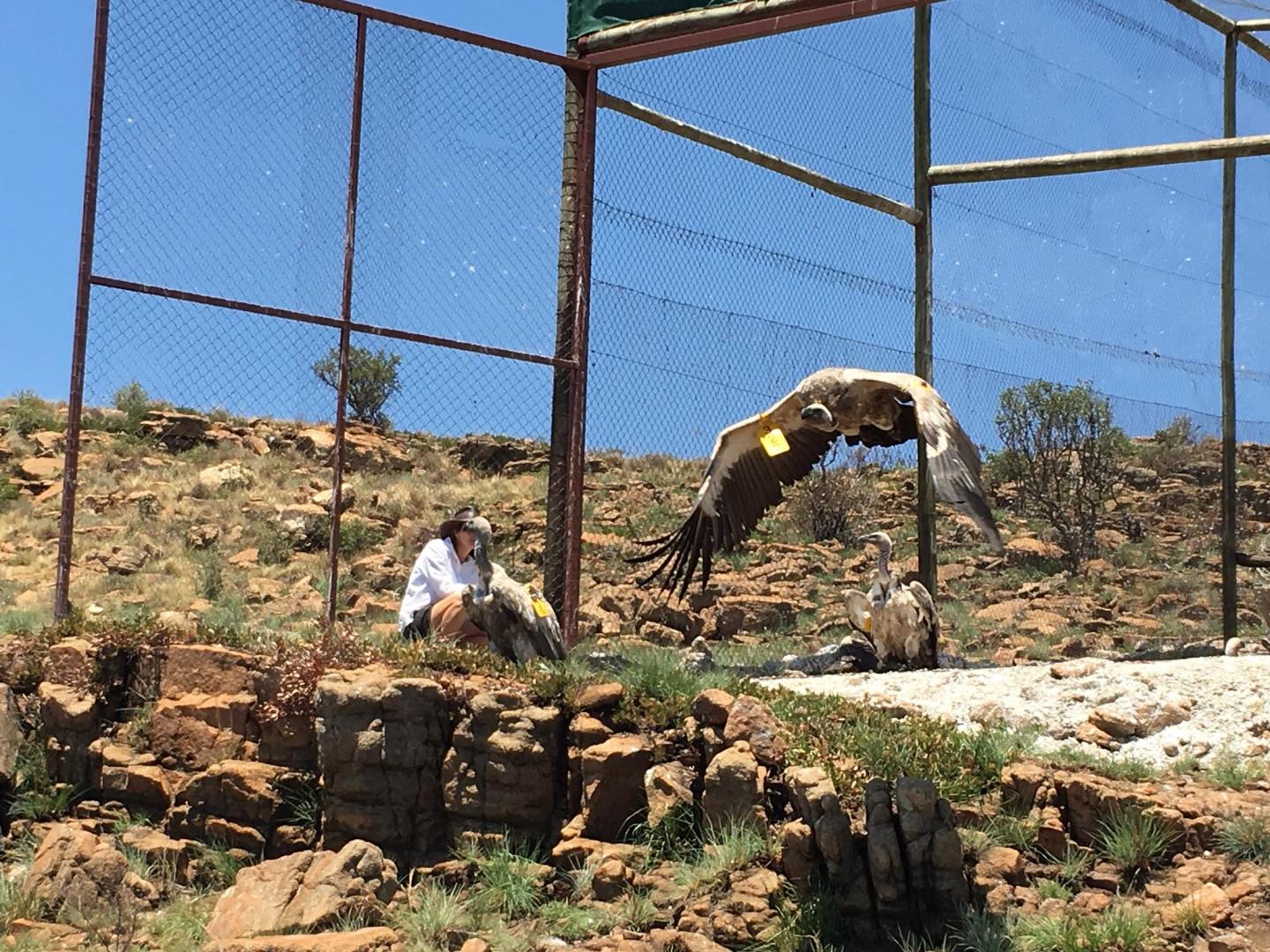
Conservationists who apply wing tags for identifying Cape Vultures–a species of African vulture that is vulnerable to extinction–are putting the birds’ lives further at risk, a new movement ecology study has shown. Researchers from the Max Planck Institute of Animal Behavior in Germany and VulPro NPC in South Africa have demonstrated that Cape Vultures fitted with tags on their wings travelled shorter distances and flew slower than those fitted with bands around their legs. The research emphasises the importance of investigating the effects that tagging methods can have on the behaviour and conservation of species, prompting a shift towards the less invasive method of leg bands in the future study of Cape Vultures.
For over a decade, many conservationists and NGOs have been marking vultures by placing a tag on the wing area known as the patagium. Patagial tags have the advantage that they are large and conspicuous enough for individuals to be identified from far away. Leg bands are smaller in size, fitted around the tarsus of the vultures leg and thus, harder to notice and record the unique number.
“After receiving many grounded and injured vultures from incorrect placement of wing tags, we felt there was an immediate need to find out exactly what these tags were doing to the flight of birds and whether this technique was, in fact, hindering the species rather than protecting them,” says senior author Kerri Wolter, CEO of VulPro NPC, a vulture conservation organisation in South Africa.
The study was motivated by recent VulPro NPC research, which highlighted how an incorrect patagial tag could cause injuries and result in the grounding of vultures. To find out how patagial tags affected the birds’ flights, researchers from the Max Planck Institute used GPS devices to track 27 Cape Vultures (Gyps coprotheres) marked with either patagial tags or leg bands.
The GPS devices, which were mounted to the birds’ backs, recorded the birds’ positions as often as every minute for 24 hours a day. These recordings allowed researchers to investigate the birds’ flight performance, including occurrence of flight, proportion of time spent flying in a day, daily distance travelled and ground speed.
Individuals equipped with patagial tags covered a much smaller area in comparison to the leg band group. They were less likely to take flight and, when doing so, flew at lower ground speed compared to individuals wearing leg bands.
“Although we did not measure the effects of patagial tags on body condition or survival, our results strongly suggest that patagial tags have severe adverse effects on vultures’ flight performance,” says first author Teja Curk, a PhD student at the Max Planck Institute of Animal Behavior.
Vultures are scavengers. By feeding on dead animals, they play an important role in the ecosystem due to the services they provide, such as preventing the spread of infectious diseases, recycling organic material into nutrients and stabilising food webs.
“Therefore, restricted flight potential and a reduction in the area covered by these birds, caused by improper tag attachment, can have far-reaching consequences at the ecosystem level,” says co-author Kamran Safi, a group leader at the Max Planck Institute of Animal Behavior.
###
Original publication
Teja Curk, Martina Scacco, Kamran Safi, Martin Wikelski, Wolfgang Fiedler, Ryno Kemp and Kerri Wolter
Wing tags severely impair movement in African Cape Vultures
Animal Biotelemetry 9(11)
09 March 2021
Media Contact
Kamran Safi
[email protected]
Original Source
https:/
Related Journal Article
http://dx.