• HOME
  • NEWS
  • EXPLORE
    • CAREER
      • Companies
      • Jobs
    • EVENTS
    • iGEM
      • News
      • Team
    • PHOTOS
    • VIDEO
    • WIKI
  • BLOG
  • COMMUNITY
    • FACEBOOK
    • INSTAGRAM
    • TWITTER
Wednesday, May 20, 2026
BIOENGINEER.ORG
No Result
View All Result
  • Login
  • HOME
  • NEWS
  • EXPLORE
    • CAREER
      • Companies
      • Jobs
        • Lecturer
        • PhD Studentship
        • Postdoc
        • Research Assistant
    • EVENTS
    • iGEM
      • News
      • Team
    • PHOTOS
    • VIDEO
    • WIKI
  • BLOG
  • COMMUNITY
    • FACEBOOK
    • INSTAGRAM
    • TWITTER
  • HOME
  • NEWS
  • EXPLORE
    • CAREER
      • Companies
      • Jobs
        • Lecturer
        • PhD Studentship
        • Postdoc
        • Research Assistant
    • EVENTS
    • iGEM
      • News
      • Team
    • PHOTOS
    • VIDEO
    • WIKI
  • BLOG
  • COMMUNITY
    • FACEBOOK
    • INSTAGRAM
    • TWITTER
No Result
View All Result
Bioengineer.org
No Result
View All Result
Home NEWS Science News

Biobattery-powered microneedle patch can deliver drugs and procure testing samples

Bioengineer by Bioengineer
February 25, 2021
in Science News
Reading Time: 2 mins read
0
IMAGE
Share on FacebookShare on TwitterShare on LinkedinShare on RedditShare on Telegram

IMAGE

Credit: Matsuhiko Nishizawa

A pain-free, organic and biodegradable drug delivery patch may be on the horizon for home health care patients soon. Researchers from Tohoku University have developed a biobattery-powered device capable of both delivering large molecule pharmaceuticals across the skin barrier and extracting interstitial fluid for diagnostic purposes.

They published their approach online on Jan. 28 in Nature Communications.

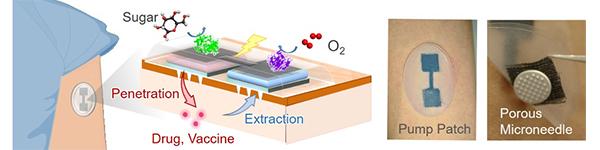
The team, led by corresponding author Matsuhiko Nishizawa, professor in the Department of Finemechanics in the Graduate School of Engineering at Tohoku University, developed a microneedle array smaller than a pinky nail. The microneedles are porous, acting as interconnected conduits to either inject or extract fluid, including the large molecules of vaccines or even insulin.

That’s a step further than the patches already commercialized for small-molecule drug transmission used for post-operative pain relief or migraine treatments, Nishizawa said, without increasing needle size. The porous microneedles are 250 microns long, about the width of three and a half human hairs — deep enough to painlessly penetrate the outermost layer of skin without being long enough to hit blood vessels or nerves.

When a low-grade voltage is applied to the array of porous microneedles coated with hydrogel, the flow of liquid is generated like when a syringe plunger is deployed. Called electroosmotic flow, it can increase the transmission rate of drugs across the skin barrier or the extraction speed of interstitial fluid to be tested for such things as glucose levels.

“This research is a first demonstration that the electroosmotic flow generated by a porous microneedle array accelerates the transdermal penetration of drug molecules and the extraction of interstitial fluid,” Nishizawa said.

The researchers powered the array with a biobattery. The battery consists of four coupled electrodes and converts chemical energy, taken from enzymes processing sugar and atmospheric oxygen, into electrical energy. The biobattery and porous microneedle array are secured to the skin with an adhesive patch smaller than a business card.

The researchers are now developing a porous microneedle array with a biodegradable polymer.

“The successful demonstration shown here using a built-in biobattery proves the future possibility of a totally organic electroosmosis flow-based skin patch that is safe and truly disposable,” Nishizawa said.

###

Media Contact
Matsuhiko Nishizawa
[email protected]

Original Source

https://www.tohoku.ac.jp/en/press/biobatter_powered_microneed_deliver_drugs.html

Related Journal Article

http://dx.doi.org/10.1038/s41467-021-20948-4

Tags: Medicine/HealthTechnology/Engineering/Computer Science
Share12Tweet8Share2ShareShareShare2

Related Posts

Faecal Transplants Show Promise for Parkinson’s Safety, Efficacy

May 20, 2026

Kynurenic Acid Links Epicardial Fat to Atrial Dysfunction

May 20, 2026

ELMO1 Boosts Kidney Repair After Toxic Injury

May 20, 2026

Dual-Raman-Shift Microscopy Enables Label-Free Biomolecular Imaging

May 20, 2026
Please login to join discussion

POPULAR NEWS

  • blank

    New Study Reveals Plants Can Detect the Sound of Rain

    732 shares
    Share 292 Tweet 183
  • Research Indicates Potential Connection Between Prenatal Medication Exposure and Elevated Autism Risk

    846 shares
    Share 338 Tweet 212
  • Breastmilk Balances E. coli and Beneficial Bacteria in Infant Gut Microbiomes

    58 shares
    Share 23 Tweet 15
  • ESMO 2025: mRNA COVID Vaccines Enhance Efficacy of Cancer Immunotherapy

    245 shares
    Share 98 Tweet 61

About

We bring you the latest biotechnology news from best research centers and universities around the world. Check our website.

Follow us

Recent News

Faecal Transplants Show Promise for Parkinson’s Safety, Efficacy

Kynurenic Acid Links Epicardial Fat to Atrial Dysfunction

ELMO1 Boosts Kidney Repair After Toxic Injury

Subscribe to Blog via Email

Enter your email address to subscribe to this blog and receive notifications of new posts by email.

Join 82 other subscribers
  • Contact Us

Bioengineer.org © Copyright 2023 All Rights Reserved.

Welcome Back!

Login to your account below

Forgotten Password?

Retrieve your password

Please enter your username or email address to reset your password.

Log In
No Result
View All Result
  • Homepages
    • Home Page 1
    • Home Page 2
  • News
  • National
  • Business
  • Health
  • Lifestyle
  • Science

Bioengineer.org © Copyright 2023 All Rights Reserved.