• HOME
  • NEWS
  • EXPLORE
    • CAREER
      • Companies
      • Jobs
    • EVENTS
    • iGEM
      • News
      • Team
    • PHOTOS
    • VIDEO
    • WIKI
  • BLOG
  • COMMUNITY
    • FACEBOOK
    • INSTAGRAM
    • TWITTER
Sunday, May 24, 2026
BIOENGINEER.ORG
No Result
View All Result
  • Login
  • HOME
  • NEWS
  • EXPLORE
    • CAREER
      • Companies
      • Jobs
        • Lecturer
        • PhD Studentship
        • Postdoc
        • Research Assistant
    • EVENTS
    • iGEM
      • News
      • Team
    • PHOTOS
    • VIDEO
    • WIKI
  • BLOG
  • COMMUNITY
    • FACEBOOK
    • INSTAGRAM
    • TWITTER
  • HOME
  • NEWS
  • EXPLORE
    • CAREER
      • Companies
      • Jobs
        • Lecturer
        • PhD Studentship
        • Postdoc
        • Research Assistant
    • EVENTS
    • iGEM
      • News
      • Team
    • PHOTOS
    • VIDEO
    • WIKI
  • BLOG
  • COMMUNITY
    • FACEBOOK
    • INSTAGRAM
    • TWITTER
No Result
View All Result
Bioengineer.org
No Result
View All Result
Home NEWS Science News Biology

Signal coupling between neuron-glia super-network may lead to improved memory formation

Bioengineer by Bioengineer
February 24, 2021
in Biology
Reading Time: 2 mins read
0
IMAGE
Share on FacebookShare on TwitterShare on LinkedinShare on RedditShare on Telegram

IMAGE

Credit: Ko Matsui

Tohoku University scientists have shown that neuronal and glial circuits form a loosely coupled super-network within the brain. Activation of the metabotropic glutamate receptors in neurons was shown to be largely influenced by the state of the glial cells. Therefore, artificial control of the glial state could potentially be used to enhance the memory function of the brain.

The findings were detailed in the Journal of Physiology.

Although the glial cells occupy more than half of the brain, they were thought to act as glue–merely filling the gap between neurons. However, recent findings show that the concentration of intracellular ions in glia, such as calcium and proton, can fluctuate over time.

“Glial cells appear to have the capacity of coding information,” says professor Ko Matsui of the Super-network Brain Physiology lab at Tohoku University, who led the research. “However, the role of the added layer of signals encoded in the glial circuit has always been an enigma.”

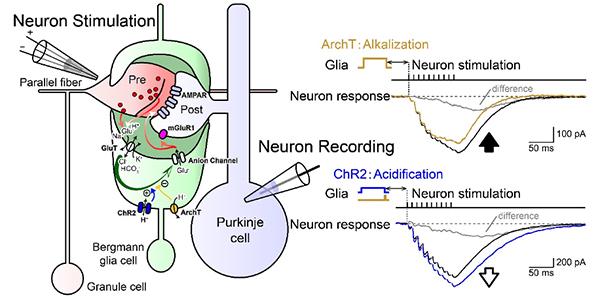
Using patch clamp electrophysiology techniques in acute brain slices from mice, Dr. Kaoru Beppu, Matsui, and their team show that glial cells in the cerebellum react to excitatory transmitter glutamate released from synapses of neurons. The glial cells then release additional glutamate in return. Therefore, these glial cells effectively function as excitatory signal amplifiers.

The additional glutamate released from glial cells efficiently activate metabotropic glutamate receptors on Purkinje neurons–essential for cerebellar motor learning. The amount of feedforward excitation was controlled by the intracellular pH of the glia cells.

“Depending on the state of our mind, the same experience could become a lasting memory or could fade away,” says Matsui. “It is possible that the pH of the glial cells at the time of the experience could have a pivotal role on memory formation.”

In this study, light-sensitive proteins were genetically expressed in glial cells to control their pH at will. Such optogenetics technology would be difficult to apply in human patients. “Although it would take a long time for clinical use, it is possible to imagine a future where a therapeutic strategy is designed to target glial cells to control their pH for memory enhancement to treat dementia,” added Matsui.

###

Media Contact
Ko Matsui
[email protected]

Original Source

https://www.tohoku.ac.jp/en/press/ignal_coupling_neuron_glia_improved_memory.html

Related Journal Article

http://dx.doi.org/10.1113/JP280857

Tags: BiologyMedicine/Health
Share13Tweet8Share2ShareShareShare2

Related Posts

Rising Sightings of Blue and Fin Whales in the South East Atlantic — Biology

Rising Sightings of Blue and Fin Whales in the South East Atlantic

May 23, 2026
New Maps Reveal How European Landscapes Can Simultaneously Promote Climate Action and Biodiversity Conservation — Biology

New Maps Reveal How European Landscapes Can Simultaneously Promote Climate Action and Biodiversity Conservation

May 22, 2026

University of Cincinnati Structural Biologists Achieve World First in Visualizing Crucial Cell Protein

May 22, 2026

Reducing Fertilizer Use Through Strategic Scientific Partnerships

May 22, 2026
Please login to join discussion

POPULAR NEWS

  • ESMO 2025: mRNA COVID Vaccines Enhance Efficacy of Cancer Immunotherapy

    313 shares
    Share 125 Tweet 78
  • New Study Reveals Plants Can Detect the Sound of Rain

    734 shares
    Share 293 Tweet 183
  • Research Indicates Potential Connection Between Prenatal Medication Exposure and Elevated Autism Risk

    847 shares
    Share 339 Tweet 212
  • Common Food Preservatives Associated with Elevated Blood Pressure and Increased Heart Disease Risk

    55 shares
    Share 22 Tweet 14

About

We bring you the latest biotechnology news from best research centers and universities around the world. Check our website.

Follow us

Recent News

Sepsis from C. difficile Infection Has Comparable Mortality

Mortality Trends in Dallas Very Preterm Neonates, 1977–2024

Nanofiber Self-Adhesive Electrode with PEDOT, Polyurethane

Subscribe to Blog via Email

Enter your email address to subscribe to this blog and receive notifications of new posts by email.

Join 83 other subscribers
  • Contact Us

Bioengineer.org © Copyright 2023 All Rights Reserved.

Welcome Back!

Login to your account below

Forgotten Password?

Retrieve your password

Please enter your username or email address to reset your password.

Log In
No Result
View All Result
  • Homepages
    • Home Page 1
    • Home Page 2
  • News
  • National
  • Business
  • Health
  • Lifestyle
  • Science

Bioengineer.org © Copyright 2023 All Rights Reserved.