A chip-based, microfluidic, AI-powered diagnostic platform could make medical diagnostics more affordable, accessible.
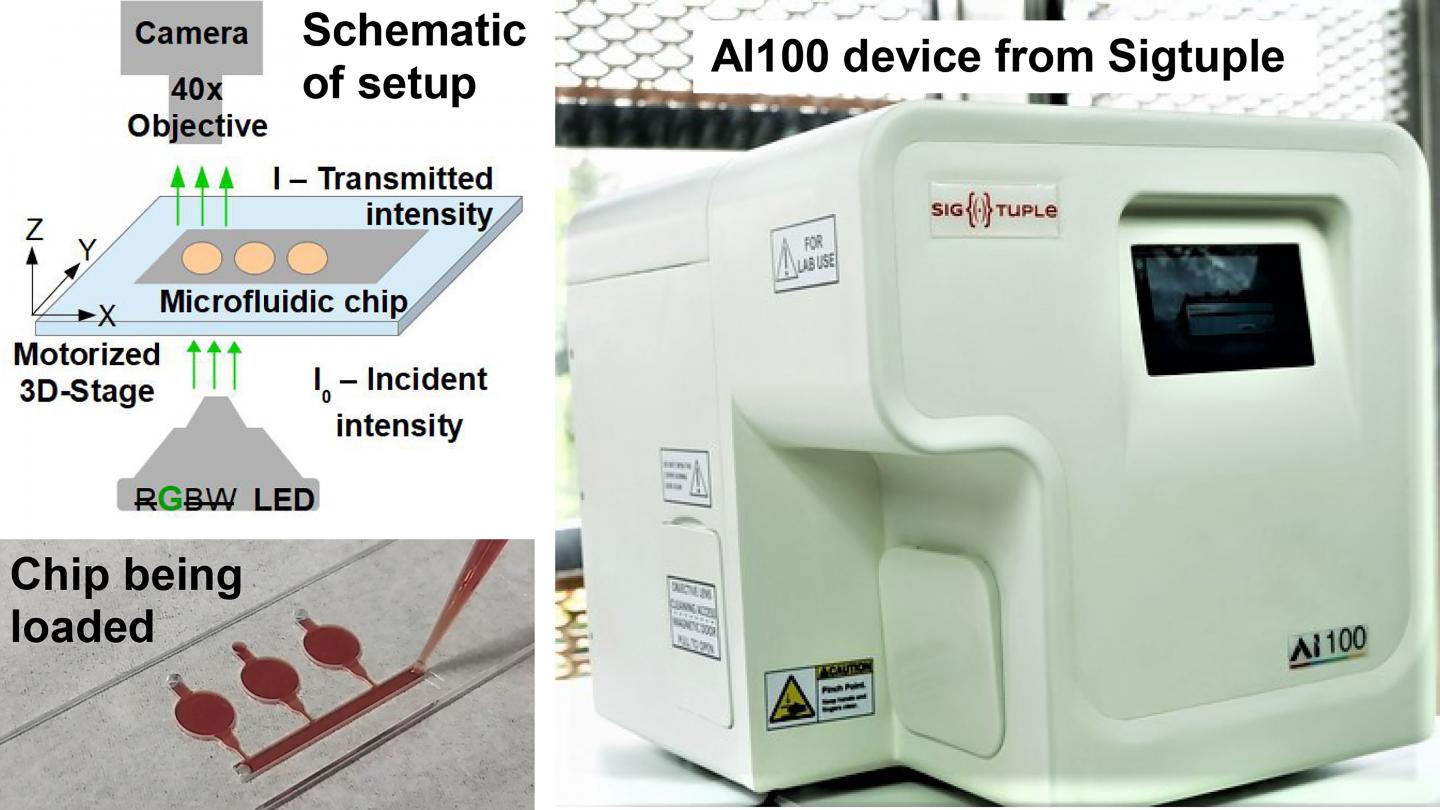
Credit: SigTuple Technologies Pvt. Ltd.
WASHINGTON, February 23, 2021 — One of the most performed medical diagnostic tests to ascertain the health of patients is a complete blood count, which typically includes an estimate of the hemoglobin concentration. The hemoglobin level in the blood is an important biochemical parameter that can indicate a host of medical conditions including anemia, polycythemia, and pulmonary fibrosis.
In AIP Advances, by AIP Publishing, researchers from SigTuple Technologies and the Indian Institute of Science describe a new AI-powered imaging-based tool to estimate hemoglobin levels. The setup was developed in conjunction with a microfluidic chip and an AI-powered automated microscope that was designed for deriving the total as well as differential counts of blood cells.
Often, medical diagnostics equipment capable of multiparameter assessment, such as hematology analyzers, has dedicated subcompartments with separate optical detection systems. This leads to increased sample volume as well as an increase in cost of the entire equipment.
“In this study, we demonstrate that the applicability of a system originally designed for the purposes of imaging can be extended towards the performance of biochemical tests without any additional modifications to the hardware unit, thereby retraining the cost and laboratory footprint of the original device,” said author Srinivasan Kandaswamy.
The hemoglobin testing solution is possible thanks to the design behind the microfluidic chip, a customized biochemical reagent, optimized imaging, and an image analysis procedure specifically tailored to enable the good clinical performance of the medical diagnostic test.
The data obtained from the microfluidic chip in combination with an automated microscope was comparable with the predictions of hematology analyzers (Pearson correlation of 0.99). The validation study showed the method meets regulatory standards, which means doctors and hospitals are likely to accept it.
The automated microscope, which normally uses a combination of red, green, and blue LEDs, used only the green LED during the hemoglobin estimation mode, because the optimized reagent (SDS-HB) complex absorbs light in the green wavelength.
Chip-based, microfluidic, diagnostic platforms are on the verge of revolutionizing the field of health care and colorimetric biochemical assays are widely performed diagnostic tests.
“This paper lays the foundation and will also serve as a guide to future attempts to translate conventional biochemical assays onto a chip, from point of view of both chip design and reagent development,” said Kandaswamy.
Besides measuring hemoglobin in the blood, a similar setup with minor modifications could be used to measure protein content, cholesterol, and glycated hemoglobin.
###
The article “Developing microscopy based microfluidic SLS assay for on-chip hemoglobin estimation” is authored by Lokanathan Arcot, Srinivasan Kandaswamy, Anil Modali, Sai Siva Gorthi, and Tathagato Rai Dastidar. The article will appear in AIP Advances on Feb. 23, 2021 (DOI: 10.1063/5.0036446). After that date, it can be accessed at https:/
ABOUT THE JOURNAL
AIP Advances is an open access journal publishing in all areas of physical sciences–applied, theoretical, and experimental. The inclusive scope of AIP Advances makes it an essential outlet for scientists across the physical sciences. See https:/
Media Contact
Larry Frum
[email protected]
Related Journal Article
http://dx.