Credit: Minnesota Infrastructure Partnership, Mayo Clinic
A University of Minnesota-Mayo Clinic partnership has joined with the Zooniverse citizen scientist platform and the Francis Crick Institute in London to leverage world-leading expertise in microscope imaging with the power of citizen science to study the relationship between structure and function in biology to better understand health and disease.
The Minnesota Microscopy Infrastructure Partnership, led by the Mayo Clinic, the University of Minnesota, and the University’s Hormel Institute, serves the high-end optical and electron microscope needs of more than 400 research laboratories in Minnesota and surrounding states. The collaboration is supported by the State of Minnesota.
As microscopy has advanced, researchers are facing the problem of analyzing the data contained in ever more numerous and detailed microscope images of cells and their crowded architecture. Minnesota Microscopy Infrastructure Partnership researchers have turned to the Zooniverse citizen science crowdsourcing platform for help. Crowdsourcing allows researchers to efficiently and effectively comb through large amounts of data by using the public’s help to analyze complex images that still confuse computers and require specific human skills.
Building upon earlier successful citizen science projects from the Francis Crick Institute and the
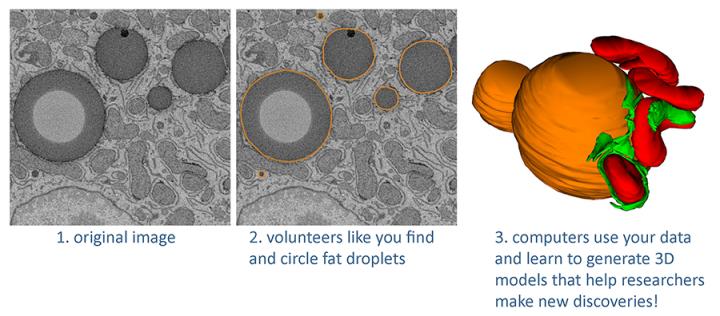
Zooniverse team to advance artificial-intelligence assisted study of cellular architecture, the Minnesota Microscopy Infrastructure Partnership has launched a new Etch A Cell project called “Fat Checker” to specifically investigate lipid droplets within cells. The data generated by Zooniverse citizen scientists will be used to train an artificial intelligence program to recognize and render the three-dimensional architecture of those lipid droplets.
Lipids, also known as fats and oils, play a key role in life, serving as a main structural component of cell membranes, in cell signaling, and as a reservoir for energy storage and release. Too much, too little, or the wrong kind or balance of lipids can lead to chronic diseases such as diabetes, heart disease, muscle weakness, neurodegeneration, and eventually to death. People get lipids by eating vegetables and meat, and a person’s cells also make them.
The aim of the “Fat Checker” citizen scientist project is to help determine the number, size, and location of lipid droplets in cells, and to map their relationship to other parts of the cell that are important for processing and using lipids. The task for the citizen scientist is to draw around the outline of any lipid they see in the images presented to them.
“Decoding biological mechanisms in health and disease lies, in part, on understanding the relationship between structure and function,” said Jeffrey Salisbury, Ph.D., a project leader and co-founder of the Minnesota Microscopy Infrastructure Partnership, and professor and scientific director of the Mayo Clinic Microscopy and Cell Analysis Laboratory.
This information will help biologists to understand the complex roles that lipids play in health and disease.
“A better understanding of lipid droplets in cell structure will reveal clues linking abnormal metabolism to human disease processes, including diabetes, cancer, and neurodegeneration,” said Douglas Mashek, Ph.D., a professor in the Department of Biochemistry, Molecular Biology and Biophysics in the University of Minnesota Medical School whose lab is investigating these relationships in lipids.
“By engaging the public through the Zooniverse citizen scientist platform, we can rapidly advance understanding of the enormous volume of cellular information that can now be generated using modern microscopy techniques,” said University of Minnesota Professor Lucy Fortson, co-founder of Zooniverse and associate head of the University’s School of Physics and Astronomy in the College of Science and Engineering. “It’s only by combining the formidable resources of this new collaboration with the Francis Crick Institute along with the power of the crowd can we really make headway in solving these big data problems in biology.”
###
In addition to Salisbury, Mashek, and Fortson, the Minnesota Microscopy Infrastructure Partnership-Zooniverse project is led by Jeffrey McDonald (University of Minnesota Hormel Institute), Thomas Pengo (University of Minnesota Informatics Institute), and Mark Sanders (University of Minnesota Imaging Center).
To learn more and get involved as a citizen scientist, visit the new Etch-A-Cell – Fat Checker project on the Zooniverse website.
To learn more about other similar projects, visit the Etch A Cell series of citizen science projects on the Zooniverse website.
Media Contact
Rhonda Zurn
[email protected]
Original Source
https:/