• HOME
  • NEWS
  • EXPLORE
    • CAREER
      • Companies
      • Jobs
    • EVENTS
    • iGEM
      • News
      • Team
    • PHOTOS
    • VIDEO
    • WIKI
  • BLOG
  • COMMUNITY
    • FACEBOOK
    • INSTAGRAM
    • TWITTER
Wednesday, December 3, 2025
BIOENGINEER.ORG
No Result
View All Result
  • Login
  • HOME
  • NEWS
  • EXPLORE
    • CAREER
      • Companies
      • Jobs
        • Lecturer
        • PhD Studentship
        • Postdoc
        • Research Assistant
    • EVENTS
    • iGEM
      • News
      • Team
    • PHOTOS
    • VIDEO
    • WIKI
  • BLOG
  • COMMUNITY
    • FACEBOOK
    • INSTAGRAM
    • TWITTER
  • HOME
  • NEWS
  • EXPLORE
    • CAREER
      • Companies
      • Jobs
        • Lecturer
        • PhD Studentship
        • Postdoc
        • Research Assistant
    • EVENTS
    • iGEM
      • News
      • Team
    • PHOTOS
    • VIDEO
    • WIKI
  • BLOG
  • COMMUNITY
    • FACEBOOK
    • INSTAGRAM
    • TWITTER
No Result
View All Result
Bioengineer.org
No Result
View All Result
Home NEWS Science News Health

Stirring up conflicts in tumour cells

Bioengineer by Bioengineer
February 11, 2021
in Health
Reading Time: 2 mins read
0
IMAGE
Share on FacebookShare on TwitterShare on LinkedinShare on RedditShare on Telegram

IMAGE

Credit: Gabriele Buechel / University of Wuerzburg

Neuroblastomas are malignant solid tumours that occur mainly in early childhood. They arise from degenerated immature cells of the sympathetic nervous system.

One prognostic marker to assess the malignancy of the tumour is the MYCN oncogene. High-risk neuroblastoma patients often have amplification of MYCN, i.e. very high levels of this protein, which drives uncontrolled tumour growth. Conversely, inhibiting MYCN or its function could be a promising therapeutic opportunity.

An important step towards this direction was taken by an international research project led by scientists from Julius-Maximilians-Universität Würzburg (JMU) in Bavaria, Germany, which was recently published in the journal Nature Cancer.

News about the role of MYCN in the cell cycle

The co-lead author of the publication is Dr Gabriele Büchel from the Chair of Biochemistry and Molecular Biology at the JMU Biocentre. The principle investigator explains: “Until now, it was known that MYCN controls the function of RNA polymerase. This reads the DNA in the cell nucleus and converts it into mRNA. Through our research, we were able to show that MYCN also plays a specific role during the S phase of the cell cycle, when DNA is also duplicated.”

In this phase, therefore, two processes take place simultaneously: the reading and replication of DNA. Figuratively speaking, according to Gabriele Büchel, “two trains are on the same track”.

Goal: Promote transcription-replication conflicts

Together with the doctoral student Isabelle Roeschert, she found out that MYCN prevents collisions of the two trains – so-called transcription-replication conflicts.

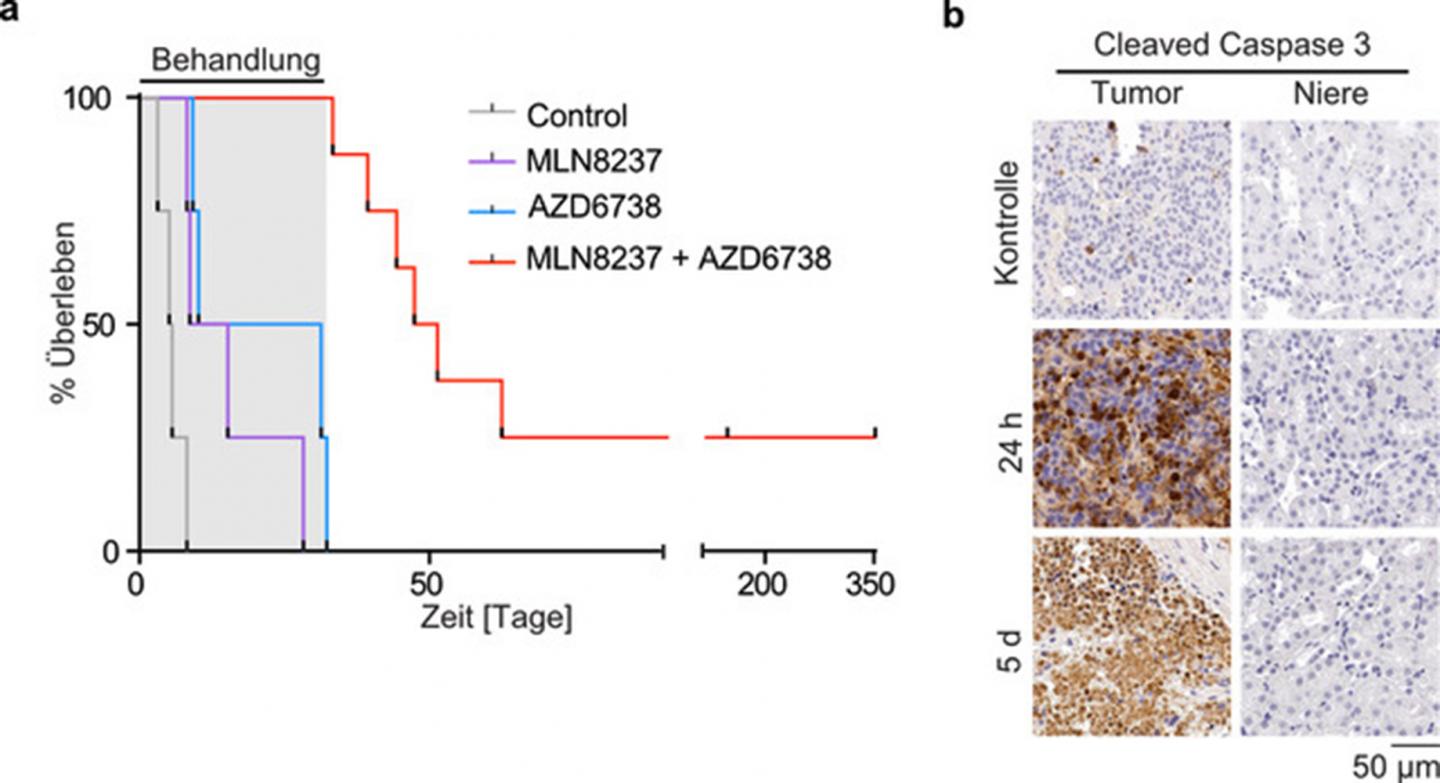
This signalling effect requires the two enzymes Aurora-A and ATR, both of which can be inhibited with existing pharmaceuticals. In this way, targeted “train collisions” can be induced to damage the tumour cell. Or in medical terms: the combination of both drugs leads to DNA damage and cell death – highly specifically in tumours, while other tissues remain unaffected.

“In mouse models of neuroblastoma, we were able to achieve tumour growth regression using this strategy. Some of the experimental animals could be even cured with the combinational treatment”, Gabriele Büchel clarifies the effect of this “therapy”.

Clinical trials already on the horizon

According to her, patients could also benefit from the knowledge gained in the near future. “The substances we use are all already commercially available. Aurora A and ATR inhibitors as well as the combinations we use are currently being tested in a number of practical models which are closer tot he clinic. If they are successful there, clinical trials could start soon,” Büchel announces.

###

In addition to the JMU working group, research teams from the Charité in Berlin, the Universities of Göttingen and Zurich and the Institute of Cancer Research in London were involved in the study. It was funded by the German Cancer Aid and the European Research Council.

Media Contact
Dr Gabriele Buechel
[email protected]

Related Journal Article

http://dx.doi.org/10.1038/s43018-020-00171-8

Tags: cancerCell BiologyMedicine/HealthMolecular Biology
Share13Tweet8Share2ShareShareShare2

Related Posts

Metformin-Alogliptin Combo vs. Monotherapy in Diabetes

December 3, 2025

Botanical Extracts’ Antibacterial Activity Boosted by Enhancers

December 3, 2025

Global Guidelines for Shared Decision-Making in Valvular Heart Disease

December 3, 2025

Hidradenitis Suppurativa Remission Achieved Using Bacteriophage Therapy

December 3, 2025
Please login to join discussion

POPULAR NEWS

  • New Research Unveils the Pathway for CEOs to Achieve Social Media Stardom

    New Research Unveils the Pathway for CEOs to Achieve Social Media Stardom

    204 shares
    Share 82 Tweet 51
  • Scientists Uncover Chameleon’s Telephone-Cord-Like Optic Nerves, A Feature Missed by Aristotle and Newton

    120 shares
    Share 48 Tweet 30
  • Neurological Impacts of COVID and MIS-C in Children

    107 shares
    Share 43 Tweet 27
  • MoCK2 Kinase Shapes Mitochondrial Dynamics in Rice Fungal Pathogen

    68 shares
    Share 27 Tweet 17

About

We bring you the latest biotechnology news from best research centers and universities around the world. Check our website.

Follow us

Recent News

Boosting Cancer Immunotherapy by Targeting DNA Repair

Evaluating eGFR Equations in Chinese Children

Metformin-Alogliptin Combo vs. Monotherapy in Diabetes

Subscribe to Blog via Email

Success! An email was just sent to confirm your subscription. Please find the email now and click 'Confirm' to start subscribing.

Join 69 other subscribers
  • Contact Us

Bioengineer.org © Copyright 2023 All Rights Reserved.

Welcome Back!

Login to your account below

Forgotten Password?

Retrieve your password

Please enter your username or email address to reset your password.

Log In
No Result
View All Result
  • Homepages
    • Home Page 1
    • Home Page 2
  • News
  • National
  • Business
  • Health
  • Lifestyle
  • Science

Bioengineer.org © Copyright 2023 All Rights Reserved.