• HOME
  • NEWS
  • EXPLORE
    • CAREER
      • Companies
      • Jobs
    • EVENTS
    • iGEM
      • News
      • Team
    • PHOTOS
    • VIDEO
    • WIKI
  • BLOG
  • COMMUNITY
    • FACEBOOK
    • INSTAGRAM
    • TWITTER
Thursday, May 14, 2026
BIOENGINEER.ORG
No Result
View All Result
  • Login
  • HOME
  • NEWS
  • EXPLORE
    • CAREER
      • Companies
      • Jobs
        • Lecturer
        • PhD Studentship
        • Postdoc
        • Research Assistant
    • EVENTS
    • iGEM
      • News
      • Team
    • PHOTOS
    • VIDEO
    • WIKI
  • BLOG
  • COMMUNITY
    • FACEBOOK
    • INSTAGRAM
    • TWITTER
  • HOME
  • NEWS
  • EXPLORE
    • CAREER
      • Companies
      • Jobs
        • Lecturer
        • PhD Studentship
        • Postdoc
        • Research Assistant
    • EVENTS
    • iGEM
      • News
      • Team
    • PHOTOS
    • VIDEO
    • WIKI
  • BLOG
  • COMMUNITY
    • FACEBOOK
    • INSTAGRAM
    • TWITTER
No Result
View All Result
Bioengineer.org
No Result
View All Result
Home NEWS Science News Health

New discovery for how the brain ‘tangles’ in Alzheimer’s Disease

Bioengineer by Bioengineer
February 2, 2021
in Health
Reading Time: 2 mins read
0
IMAGE
Share on FacebookShare on TwitterShare on LinkedinShare on RedditShare on Telegram

University of Queensland researchers have discovered a new ‘seeding’ process in brain cells that could be a cause of dementia and Alzheimer’s disease.
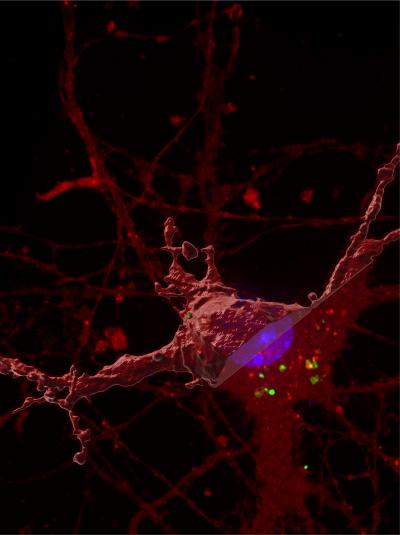
IMAGE

Credit: Dr Juan Polanco et.al, The University of Queensland

University of Queensland researchers have discovered a new ‘seeding’ process in brain cells that could be a cause of dementia and Alzheimer’s disease.

UQ’s Queensland Brain Institute dementia researcher Professor Jürgen Götz said the study revealed that tangled neurons, a hallmark sign of dementia, form in part by a cellular process that has gone astray and allows a toxic protein, tau, to leak into healthy brain cells.

“These leaks create a damaging seeding process that causes tau tangles and ultimately lead to memory loss and other impairments,” Professor Götz said.

Professor Götz said until now researchers did not understand how tau seeds were able to escape after their uptake into healthy cells.

“In people with Alzheimer’s disease, it seems the tiny sacs transporting messages within or outside the cells, called exosomes, trigger a reaction which punches holes in the wall of their own cell membrane and allows the toxic seeds to escape,” he said.

“As more tau builds up in the brain, it eventually forms tangles, and together with abnormally configured proteins known as amyloid plaque, they form the key features of these neurological diseases.”

Queensland Brain Institute researcher Dr Juan Polanco said the findings would help scientists piece together how non-inherited forms of Alzheimer’s disease and other dementias occur.

“The more we understand the underlying mechanisms, the easier it will be to interfere with the process and to slow down or even halt the disease,” Dr Polanco said.

“Along with Alzheimer’s, this cellular process might also play a leading role in other cognitive diseases, from frontal lobe dementia to rare neurological disorders with toxic tau.

“Even in cancer research, there is emerging evidence showing these exosomes can load unique messages that reflect the condition of tumours and enables them to replicate and spread cancer more quickly through the body.

“Improving our understanding of how Alzheimer’s and other diseases spread through exosomes will allow us to create new ways to treat and intervene in these cellular processes in the future.”

Professor Götz directs research at QBI’s Clem Jones Centre for Ageing Dementia Research. A team in his research group, led by Dr Polanco, is looking at the role of exosomes and cell dysfunction as a risk factor in neurodegenerative diseases.

###

This research is published in Acta Neuropathologica (DOI:10.1007/s00401-020-02254-3, PMID: 33417012).

It has also been featured in the US-based AlzForum website.

Media Contact
Georgina Ramin
[email protected]

Original Source

https://www.uq.edu.au/news/article/2021/02/new-discovery-how-brain-tangles%E2%80%99-alzheimer%E2%80%99s-disease

Tags: AlzheimerMedicine/Healthneurobiology
Share12Tweet8Share2ShareShareShare2

Related Posts

UCLA to Head $9M Study Investigating the Connection Between Pesticides, Air Pollutants, and Parkinson’s Disease Risk

May 14, 2026

Analysis of 32 Studies Involving Over 43,000 Participants Reveals Obesity Drugs Significantly Lower Blood Pressure

May 14, 2026

Leading Obesity and Dietitian Societies Jointly Release Consensus Guidelines on Incretin Drug Use for Obesity Treatment

May 14, 2026

Nationwide Study Reveals Decreased Triptan Use for Migraine in Women One Year After Starting Semaglutide for Weight Loss

May 14, 2026
Please login to join discussion

POPULAR NEWS

  • Research Indicates Potential Connection Between Prenatal Medication Exposure and Elevated Autism Risk

    842 shares
    Share 337 Tweet 211
  • New Study Reveals Plants Can Detect the Sound of Rain

    729 shares
    Share 291 Tweet 182
  • Salmonella Haem Blocks Macrophages, Boosts Infection

    62 shares
    Share 25 Tweet 16
  • Breastmilk Balances E. coli and Beneficial Bacteria in Infant Gut Microbiomes

    58 shares
    Share 23 Tweet 15

About

We bring you the latest biotechnology news from best research centers and universities around the world. Check our website.

Follow us

Recent News

UCLA to Head $9M Study Investigating the Connection Between Pesticides, Air Pollutants, and Parkinson’s Disease Risk

Stem Cells: Key Link Between Exercise and Tumors

Analysis of 32 Studies Involving Over 43,000 Participants Reveals Obesity Drugs Significantly Lower Blood Pressure

Subscribe to Blog via Email

Enter your email address to subscribe to this blog and receive notifications of new posts by email.

Join 82 other subscribers
  • Contact Us

Bioengineer.org © Copyright 2023 All Rights Reserved.

Welcome Back!

Login to your account below

Forgotten Password?

Retrieve your password

Please enter your username or email address to reset your password.

Log In
No Result
View All Result
  • Homepages
    • Home Page 1
    • Home Page 2
  • News
  • National
  • Business
  • Health
  • Lifestyle
  • Science

Bioengineer.org © Copyright 2023 All Rights Reserved.