Researchers from RIT and Green Bank Observatory shed new light on nebula formation processes
Credit: STScI, Alyssa Pagan
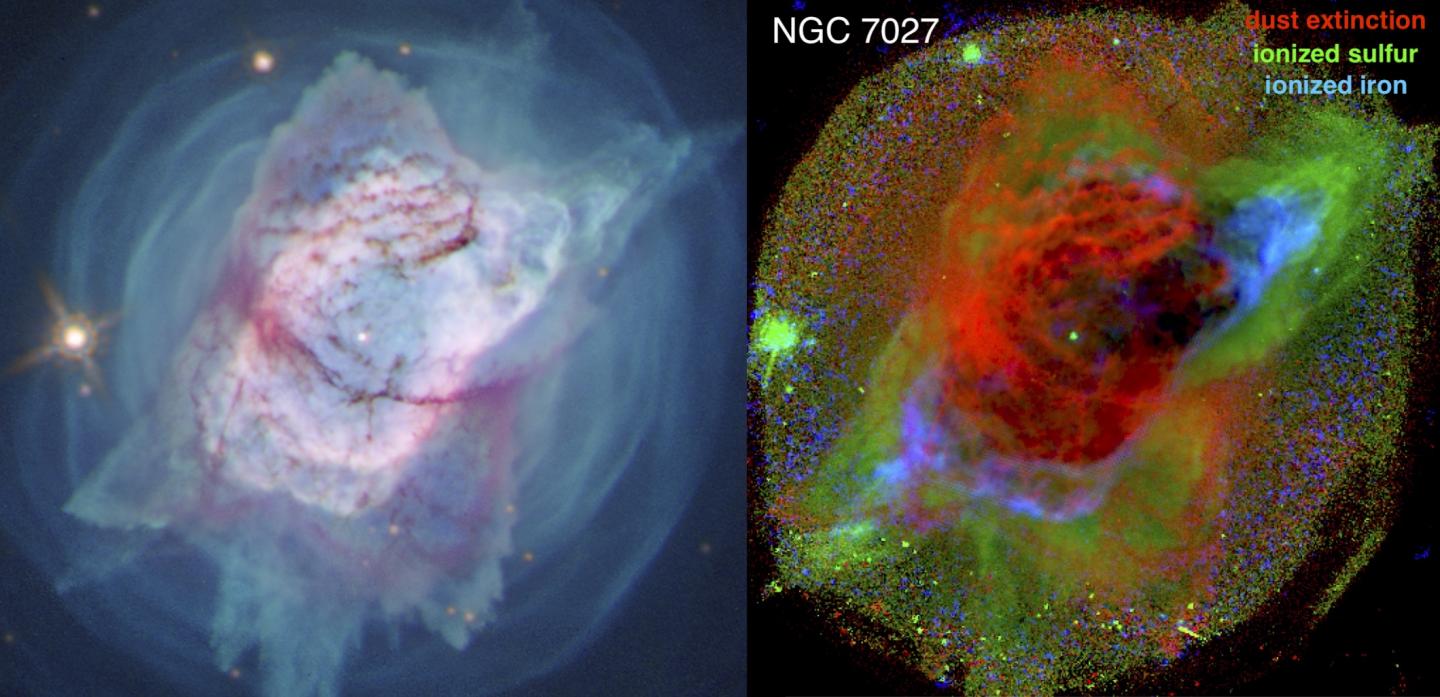
Images of two iconic planetary nebulae taken by the Hubble Space Telescope are revealing new information about how they develop their dramatic features. Researchers from Rochester Institute of Technology and Green Bank Observatory presented new findings about the Butterfly Nebula (NGC 6302) and the Jewel Bug Nebula (NGC 7027) at the 237th meeting of the American Astronomical Society on Friday, Jan. 15.
Hubble’s Wide Field Camera 3 observed the nebulae in 2019 and early 2020 using its full, panchromatic capabilities, and the astronomers involved in the project have been using emission line images from near-ultraviolet to near-infrared light to learn more about their properties. The studies were first-of-their-kind panchromatic imaging surveys designed to understand the formation process and test models of binary-star-driven planetary nebula shaping.
“We’re dissecting them,” said Joel Kastner, a professor in RIT’s Chester F. Carlson Center for Imaging Science and School of Physics and Astronomy. “We’re able to see the effect of the dying central star in how it’s shedding and shredding its ejected material. We’re able to see that material that the central star has tossed away is being dominated by ionized gas, where it’s dominated by cooler dust, and even how the hot gas is being ionized, whether by the star’s UV or by collisions caused by its present, fast winds.”
Kastner said analysis of the new HST images of the Butterfly Nebula is confirming that the nebula was ejected only about 2,000 years ago–an eyeblink by the standards of astronomy – and that the S-shaped iron emission that helps give it the “wings” of gas may be even younger. Surprisingly, they found that while astronomers previously believed they had located the nebula’s central star, it was actually a star not associated with the nebula that is much closer to Earth than the nebula. Kastner said he hopes that future studies with the James Webb Space Telescope could help locate the actual central star.
The team’s ongoing analysis of the Jewel Bug Nebula is built on a 25-year baseline of measurements dating back to early Hubble imaging. Paula Moraga Baez, an astrophysical sciences and technology Ph.D. student from DeKalb, Ill., called the nebula “remarkable for its unusual juxtaposition of circularly symmetric, axisymmetric, and point-symmetric (bipolar) structures.” Moraga noted, “The nebula also retains large masses of molecular gas and dust despite harboring a hot central star and displaying high excitation states.”
Jesse Bublitz ’20 Ph.D. (astrophysical sciences and technology), now a postdoctoral researcher at Green Bank Observatory, has continued analysis of NGC 7027 with radio images from the Northern Extended Millimeter Array (NOEMA) Telescope, where he identified molecular tracers of ultraviolet and X-ray light that continue to shape the nebula. The combined observations from telescopes at other wavelengths, like Hubble, and bright molecules CO+ and HCO+ from NOEMA indicate how different regions of NGC 7027 are affected by the irradiation of its central star.
“We’re very excited about these findings,” said Bublitz. “We had hoped to find structure that clearly showed CO+ and HCO+ spatially coincident or entirely in distinctive regions, which we did. This is the first map of NGC 7027, or any planetary nebula, in the molecule CO+, and only the second CO+ map of any astronomical source.”
###
In addition to Kastner, Moraga, and Bublitz, the research team involved in the HST imaging work includes Rodolfo Montez Jr. ’10 Ph.D. (astrophysical sciences and technology) from Harvard-Smithsonian CfA; Bruce Balick from University of Washington; as well as Adam Frank and Eric Blackman from University of Rochester. Bublitz’s international team of collaborators on radio molecular line imaging of NGC 7027 includes Kastner, Montez Jr., and astrophysicists from Spain, France, and Brazil.
For more information, contact Luke Auburn at 585-490-3198, [email protected], or on Twitter: @lukeauburn.
Media Contact
Luke Auburn
[email protected]
Original Source
https:/