Credit: Masahisa Katsuno
A research team led by Nagoya University in Japan has found that blood pressure, the hematocrit (the percentage of red blood cells in blood), and serum cholesterol levels change in patients with Parkinson’s disease long before the onset of motor symptoms. This finding, which was recently published online in Scientific Reports, may pave the way for early diagnosis and treatment of the disease.
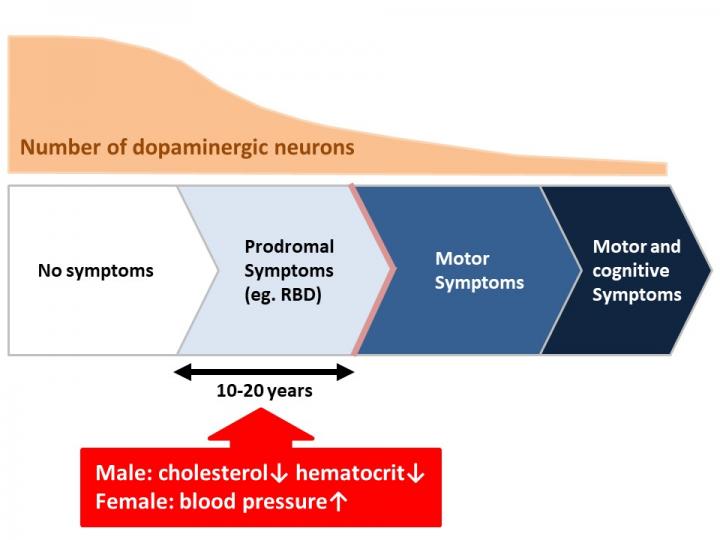
Parkinson’s disease, the second most common disease affecting the nervous system after Alzheimer’s disease, is caused by a deficiency in a neurotransmitter called dopamine. It is known that more than half of all dopaminergic neurons are already lost in patients with Parkinson’s disease in the stage wherein they experience motor symptoms such as tremors, stiffness, and slowness of movement. In addition, previous studies have shown that non-motor symptoms, such as constipation, rapid eye movement sleep behavior disorder, impairment of the sense of smell, and depression, emerge in patients with Parkinson’s disease10 to 20 years before the onset of motor symptoms.
These results suggest that Parkinson’s disease develops decades before the onset of motor symptoms. “If we can detect biological changes in the patients’ bodies well before the onset of the motor symptoms, we can start medical treatments in an early stage,” says Professor Masahisa Katsuno of the Graduate School of Medicine at Nagoya University. From this perspective, the research team led by Prof. Katsuno and Katsunori Yokoi, the lead author and graduate student at Nagoya University, focused on the results of general health checkups, which are carried out among individuals yearly in Japan.
The team analyzed multiple years of data from the checkups of 22 male and 23 female patients with Parkinson’s disease whose checkup results before the onset of motor symptoms were available. For comparison, the team also used data from the checkups of 60 male and 60 female healthy individuals who underwent checkups for at least four years.
The researchers first compared the baseline values of each checkup item between patients with Parkinson’s disease and healthy individuals separately by sex. In male patients, the weight, body mass index, hematocrit, total and low-density cholesterol levels, and serum creatinine levels were lower than those in healthy male individuals. In female patients, the levels of blood pressure and an enzyme called aspartate aminotransferase were higher, while other items’ values were lower compared to those in healthy female individuals.
Next, the researchers examined longitudinal changes in the checkup items in patients with Parkinson’s disease before the onset of motor symptoms. As a result, they found that in the premotor stage, blood pressure levels are increased in female patients, whereas total and low-density cholesterol levels and the hematocrit are decreased in male patients. Regarding other checkup items, no significant changes were observed.
“In this study, we found that blood pressure, hematocrit, and serum cholesterol levels are potential biomarkers of Parkinson’s disease before the onset of its motor symptoms,” says Prof. Katsuno. “This finding indicates that general health checkups can help detect early signs of developing Parkinson’s disease.” In this context, his team is now pursuing studies to identify individuals who are at high risk for the disease based on checkup examinees. “We are also conducting clinical trials of medication in the individuals who are considered, based on their checkup data, to be at high risk for Parkinson’s, in an attempt to prevent the development of the disease in them.”
###
The study, “Longitudinal analysis of premotor anthropometric and serological markers of Parkinson’s disease,” was published online in Scientific Reports on November 25, 2020, at DOI: 10.1038/s41598-020-77415-1.
About Nagoya University, Japan
Nagoya University has a history of about 150 years, with its roots in a temporary medical school and hospital established in 1871, and was formally instituted as the last Imperial University of Japan in 1939. Although modest in size compared to the largest universities in Japan, Nagoya University has been pursuing excellence since its founding. Six of the 18 Japanese Nobel Prize-winners since 2000 did all or part of their Nobel Prize-winning work at Nagoya University: four in Physics – Toshihide Maskawa and Makoto Kobayashi in 2008, and Isamu Akasaki and Hiroshi Amano in 2014; and two in Chemistry – Ryoji Noyori in 2001 and Osamu Shimomura in 2008. In mathematics, Shigefumi Mori did his Fields Medal-winning work at the University. A number of other important discoveries have also been made at the University, including the Okazaki DNA Fragments by Reiji and Tsuneko Okazaki in the 1960s; and depletion forces by Sho Asakura and Fumio Oosawa in 1954.
Website: http://en.
Media Contact
Masahisa Katsuno
[email protected]
Original Source
http://en.
Related Journal Article
http://dx.