• HOME
  • NEWS
  • EXPLORE
    • CAREER
      • Companies
      • Jobs
    • EVENTS
    • iGEM
      • News
      • Team
    • PHOTOS
    • VIDEO
    • WIKI
  • BLOG
  • COMMUNITY
    • FACEBOOK
    • INSTAGRAM
    • TWITTER
Friday, December 26, 2025
BIOENGINEER.ORG
No Result
View All Result
  • Login
  • HOME
  • NEWS
  • EXPLORE
    • CAREER
      • Companies
      • Jobs
        • Lecturer
        • PhD Studentship
        • Postdoc
        • Research Assistant
    • EVENTS
    • iGEM
      • News
      • Team
    • PHOTOS
    • VIDEO
    • WIKI
  • BLOG
  • COMMUNITY
    • FACEBOOK
    • INSTAGRAM
    • TWITTER
  • HOME
  • NEWS
  • EXPLORE
    • CAREER
      • Companies
      • Jobs
        • Lecturer
        • PhD Studentship
        • Postdoc
        • Research Assistant
    • EVENTS
    • iGEM
      • News
      • Team
    • PHOTOS
    • VIDEO
    • WIKI
  • BLOG
  • COMMUNITY
    • FACEBOOK
    • INSTAGRAM
    • TWITTER
No Result
View All Result
Bioengineer.org
No Result
View All Result
Home NEWS Science News Immunology

SARS-CoV-2 antibody test helps select donor blood samples for therapeutic use

Bioengineer by Bioengineer
January 14, 2021
in Immunology
Reading Time: 3 mins read
0
IMAGE
Share on FacebookShare on TwitterShare on LinkedinShare on RedditShare on Telegram

IMAGE

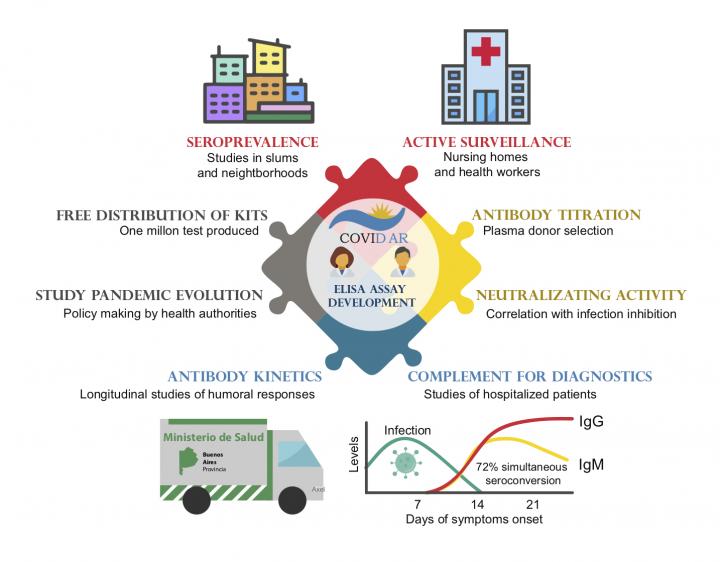
Credit: Ojeda DS et al., 2021, PLOS Pathogens, CC-BY 4.0

Researchers have developed and applied a robust, versatile antibody test to assist health authorities in managing the coronavirus disease 2019 (COVID-19) pandemic, according to a study published January 14 in the open-access journal PLOS Pathogens by Andrea Gamarnik of the Fundación Instituto Leloir-CONICET in Argentina, and colleagues.

As of November 22, there have been more than 57 million COVID-19 cases worldwide since the start of the pandemic, resulting in more than one million deaths globally. Surveillance and testing play an important role in controlling viral spread. In the new study, Gamarnik and colleagues developed and applied a robust, versatile test to detect antibody responses to severe acute respiratory syndrome coronavirus 2 (SARS-CoV-2) – the virus that causes COVID-19. Specifically, the enzyme-linked immunosorbent assay (ELISA) detects immunoglobulin G (IgG) and immunoglobulin M (IgM) antibodies against the whole spike protein and its receptor binding domain. More than half a million tests have been freely distributed to health institutions in Argentina.

Antibodies were detected in at least 34% of patients within seven days, and in 95% of patients within 45 days of symptom onset. Overall, antibody responses in asymptomatic cases varied widely but were generally lower than those of symptomatic patients. The researchers also developed standardized protocols that were used to assess IgG antibody levels to select suitable blood samples from donors who have recovered from COVID-19 for therapeutic use and clinical trials across the country. Using this protocol, approximately 80% of donor blood samples were potentially suitable for therapies. According to the authors, the study offers a powerful tool for detecting asymptomatic cases and finding better control measures for the pandemic.

The authors add, “The COVIDAR program has built bridges among basic virology researchers, clinical investigators, health care workers, non-profit organizations and policy makers in Argentina for coping with the pandemic. Hopefully, this transformative lesson will help establish collaborative models and priorities for improving public health.”

###

Peer-reviewed; Experimental study; People

In your coverage please use this URL to provide access to the freely available article in PLOS Pathogens:
http://journals.plos.org/plospathogens/article?id=10.1371/journal.ppat.1009161

Citation: Ojeda DS, Gonzalez Lopez Ledesma MM, Pallares HM, Costa Navarro GS, Sanchez L, Perazzi B, et al. (2021) Emergency response for evaluating SARS-CoV-2 immune status, seroprevalence and convalescent plasma in Argentina. PLoS Pathog 17(1): e1009161.
https://doi.org/10.1371/journal.ppat.1009161

Funding: The COVIDAR project was funded by the CONICET through the Fondo para la Convergencia Estructural del Mercosur (FOCEM), NIH (NIAID) R01.AI095175 and Agencia Argentina de Promoción Científica y Tecnológica PICT2017-1717 Annex COVID-19 to AVG. Founds were also provided by Fundación Williams and Asociación Civil SAND to AVG for COVIDAR and Serokit production and distribution. The funders had no role in study design, data collection and analysis, decision to publish, or preparation of the manuscript.

Competing Interests: The authors have declared that no competing interests exist.

Media Contact
Andrea Gamarnik
[email protected]

Related Journal Article

http://dx.doi.org/10.1371/journal.ppat.1009161

Tags: Health Care Systems/ServicesHealth ProfessionalsInfectious/Emerging DiseasesInternal MedicineMedicine/HealthPulmonary/Respiratory Medicine
Share12Tweet8Share2ShareShareShare2

Related Posts

IMAGE

UMass Amherst grad student awarded fellowship for food allergy research

July 23, 2021
IMAGE

Less-sensitive COVID-19 tests may still achieve optimal results if enough people tested

July 22, 2021

Public trust in CDC, FDA, and Fauci holds steady, survey shows

July 20, 2021

USC study shows male-female differences in immune cell function

July 19, 2021
Please login to join discussion

POPULAR NEWS

  • Nurses’ Views on Online Learning: Effects on Performance

    Nurses’ Views on Online Learning: Effects on Performance

    70 shares
    Share 28 Tweet 18
  • NSF funds machine-learning research at UNO and UNL to study energy requirements of walking in older adults

    71 shares
    Share 28 Tweet 18
  • Unraveling Levofloxacin’s Impact on Brain Function

    54 shares
    Share 22 Tweet 14
  • Exploring Audiology Accessibility in Johannesburg, South Africa

    51 shares
    Share 20 Tweet 13

About

We bring you the latest biotechnology news from best research centers and universities around the world. Check our website.

Follow us

Recent News

Machine Learning Predicts Childhood Obesity from Maternal Thyroid

PTSD, Depression, Anxiety in Childhood Cancer Survivors, Parents

Targeting Collagen Prolyl 4-Hydroxylase to Fight Cancer

Subscribe to Blog via Email

Enter your email address to subscribe to this blog and receive notifications of new posts by email.

Join 71 other subscribers
  • Contact Us

Bioengineer.org © Copyright 2023 All Rights Reserved.

Welcome Back!

Login to your account below

Forgotten Password?

Retrieve your password

Please enter your username or email address to reset your password.

Log In
No Result
View All Result
  • Homepages
    • Home Page 1
    • Home Page 2
  • News
  • National
  • Business
  • Health
  • Lifestyle
  • Science

Bioengineer.org © Copyright 2023 All Rights Reserved.