Credit: Fanny Moffette / University of Wisconsin-Madison
MADISON, Wis. — Deforestation dropped by 18 percent in two years in African countries where organizations subscribed to receive warnings from a new service using satellites to detect decreases in forest cover in the tropics.
The carbon emissions avoided by reducing deforestation were worth between $149 million and $696 million, based on the ability of lower emissions to reduce the detrimental economic consequences of climate change.
Those findings come from new research into the effect of GLAD, the Global Land Analysis and Discovery system, available on the free and interactive interface Global Forest Watch. Launched in 2016, GLAD provides frequent, high-resolution alerts when it detects a drop in forest cover. Governments and others interested in halting deforestation can subscribe to the alerts on Global Forest Watch and then intervene to limit forest loss.
The research was led by Fanny Moffette, a postdoctoral researcher in applied economics in the Nelson Institute for Environmental Studies and the Department of Agricultural and Applied Economics at the University of Wisconsin-Madison. Moffette collaborated with Jennifer Alix-Garcia at Oregon State University, Katherine Shea at the World Resources Institute and Amy Pickens at the University of Maryland.
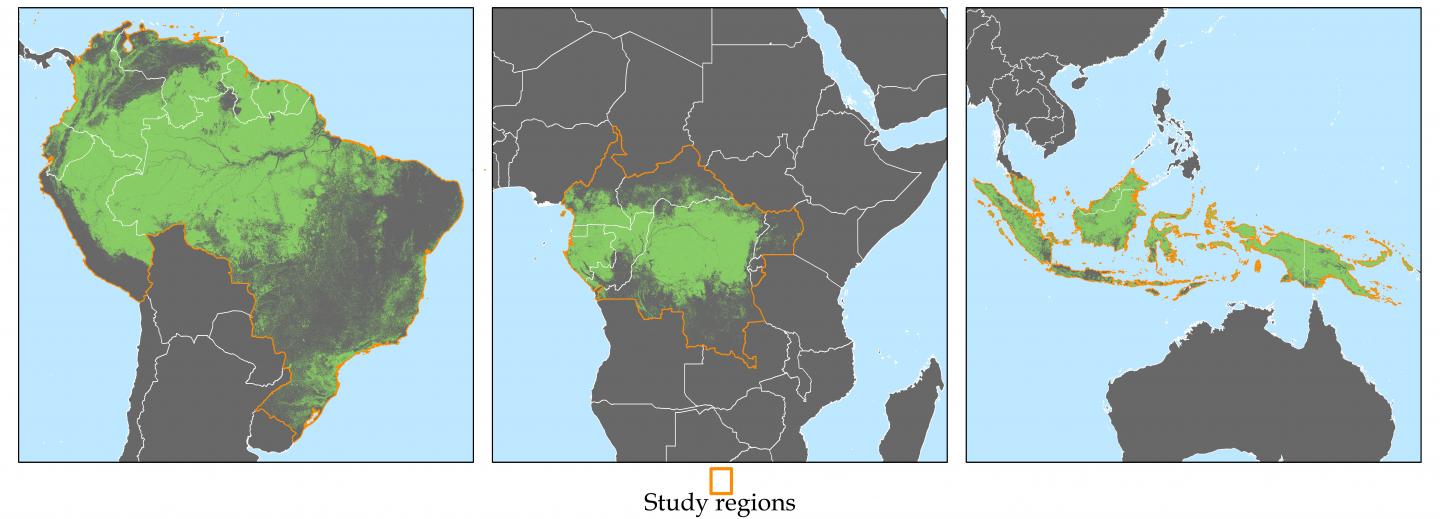
The researchers published their findings Jan. 4 in Nature Climate Change. They studied deforestation in 22 tropical countries across South America, Africa and Asia from 2011 to 2018.
Moffette and her co-authors set out to understand whether these kinds of automated alerts could achieve their goal of reducing forest loss, which has global climate implications. Land-use changes like deforestation account for 6 percent to 17 percent of global carbon emissions. And avoiding deforestation is several times more effective at reducing carbon emissions than regrowing forests.
“The first question was to look at whether there was any impact from having access to this free alert system. Then we were looking at the effect of users subscribing to this data to receive alerts for a specific area,” says Moffette.
Simply being covered by GLAD did not help a country combat deforestation. Only those African countries in which organizations had actually subscribed to receive alerts saw a decrease in deforestation. Intuitively, this finding makes sense, says Moffette. Having access to information is good. But what you need to change the course of deforestation are people committed to using that information and acting.
However, deforestation did not decrease in South American or Asian countries, even where organizations subscribed to receive warnings. There are multiple potential causes for this continental discrepancy.
“We think that we see an effect mainly in Africa due to two main reasons,” says Moffette. “One is because GLAD added more to efforts in Africa than on other continents, in the sense that there was already some evidence of countries using monitoring systems in countries like Indonesia and Peru. And Colombia and Venezuela, which are a large part of our sample, had significant political unrest during this period.”
The GLAD program is still young, and as more governments and organizations sign on to receive warnings, and decide how to intervene at sites of deforestation, the system’s influence may grow.
Developed by a team at the University of Maryland that includes one of Moffette’s collaborators, GLAD made several improvements over its predecessors. It has very high spatial resolution, roughly 900 square meters, which is orders of magnitude more precise than older tools. And it can provide alerts up to every eight days if the skies are cloud-free when satellites re-image a section of Earth. Users can define custom areas to monitor. They then receive weekly emails, available in six languages, that contain geographic coordinates of the alerts within the monitored areas.
Going forward, the team is looking to evaluate the effect of new features of the monitoring platform, such as data that can inform forest restoration, while supporting efforts of organizations that try to intervene to halt deforestation.
“Now that we know subscribers of alerts can have an effect on deforestation, there’s potential ways in which our work can improve the training they receive and support their efforts,” says Moffette.
###
–Eric Hamilton, (608) 263-1986, [email protected]
Media Contact
Fanny Moffette
[email protected]