• HOME
  • NEWS
  • EXPLORE
    • CAREER
      • Companies
      • Jobs
    • EVENTS
    • iGEM
      • News
      • Team
    • PHOTOS
    • VIDEO
    • WIKI
  • BLOG
  • COMMUNITY
    • FACEBOOK
    • INSTAGRAM
    • TWITTER
Saturday, February 7, 2026
BIOENGINEER.ORG
No Result
View All Result
  • Login
  • HOME
  • NEWS
  • EXPLORE
    • CAREER
      • Companies
      • Jobs
        • Lecturer
        • PhD Studentship
        • Postdoc
        • Research Assistant
    • EVENTS
    • iGEM
      • News
      • Team
    • PHOTOS
    • VIDEO
    • WIKI
  • BLOG
  • COMMUNITY
    • FACEBOOK
    • INSTAGRAM
    • TWITTER
  • HOME
  • NEWS
  • EXPLORE
    • CAREER
      • Companies
      • Jobs
        • Lecturer
        • PhD Studentship
        • Postdoc
        • Research Assistant
    • EVENTS
    • iGEM
      • News
      • Team
    • PHOTOS
    • VIDEO
    • WIKI
  • BLOG
  • COMMUNITY
    • FACEBOOK
    • INSTAGRAM
    • TWITTER
No Result
View All Result
Bioengineer.org
No Result
View All Result
Home NEWS Science News Chemistry

Traditional Ghanaian medicines show promise against tropical diseases

Bioengineer by Bioengineer
December 31, 2020
in Chemistry
Reading Time: 3 mins read
0
IMAGE
Share on FacebookShare on TwitterShare on LinkedinShare on RedditShare on Telegram

IMAGE

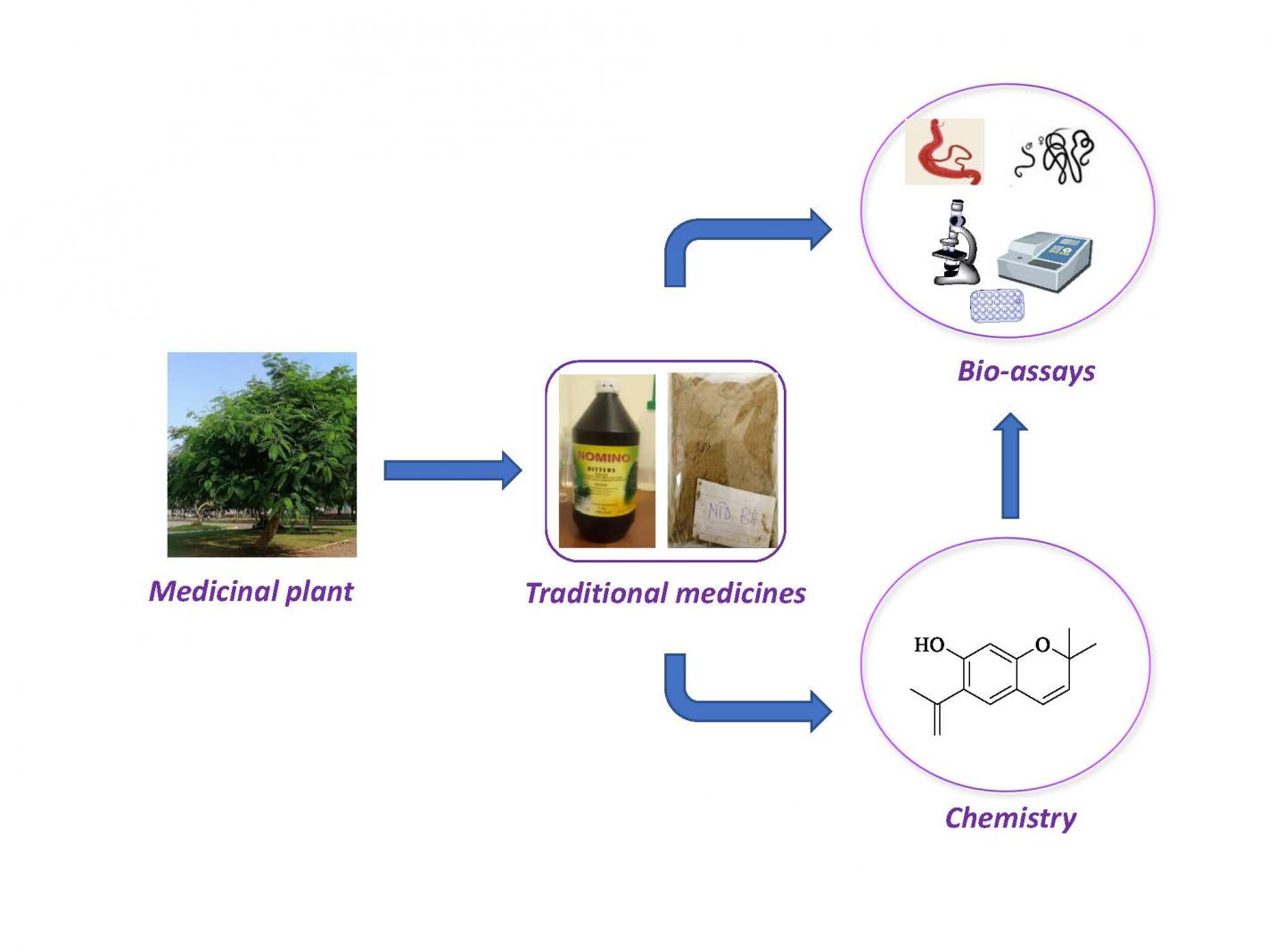
Credit: Osei-Safo 2020 (CC-BY 2.0)

The discovery of new drugs is vital to achieving the eradication of neglected tropical diseases (NTDs) in Africa and around the world. Now, researchers reporting in PLOS Neglected Tropical Diseases have identified traditional Ghanaian medicines which work in the lab against schistosomiasis, onchocerciasis and lymphatic filariasis, three diseases endemic to Ghana.

The major intervention for NTDs in Ghana is currently mass drug administration of a few repeatedly recycled drugs, which can lead to reduced efficacy and the emergence of drug resistance. Chronic infections of schistosomiasis, onchocerciasis and lymphatic filariasis can be fatal. Schistosomiasis is caused by the blood flukes Schistosome haematobium and S. mansoni. Onchocerciasis, or river blindness, is caused by the parasitic worm Onchocerca volvulus. Lymphatic filariasis, also called elephantiasis, is caused by the parasitic filarial worm Wuchereria bancrofti.

In the new work, Dorcas Osei-Safo of the University of Ghana, and colleagues obtained–from the Ghana Federation of Traditional Medicines Practitioners Association–15 traditional medicines used for treating NTDs in local communities. The medicines were available in aqueous herbal preparations or dried powdered herbs. In all cases, crude extracts were prepared from the herbs and screened in the laboratory for their ability to treat various NTDs.

Two extracts, NTD-B4-DCM and NTD-B7-DCM, displayed high activity against S. mansoni adult worms, decreasing the movement of the worms by 78.4% and 84.3% respectively. A different extract, NTD-B2-DCM, was the most active against adult Onchocera onchengi worms, killing 100% of males and more than 60% of females. Eight of 26 crude extracts tested, including NTD-B4-DCM and NTD-B2-DCM, also exhibited good activity against trypanosomes–parasites that cause other human diseases but weren’t the original targets of the traditional medicines.

“By embracing indigenous knowledge systems which have evolved over centuries, we can potentially unlock a wealth of untapped research and shape it by conducting sound scientific investigations to produce safe, efficacious and good quality remedies,” the researchers say.

###

Peer-reviewed; Experimental study; Cells

In your coverage please use this URL to provide access to the freely available article in PLOS Neglected Tropical Diseases:
http://journals.plos.org/plosntds/article?id=10.1371/journal.pntd.0008919

Citation: Twumasi EB, Akazue PI, Kyeremeh K, Gwira TM, Keiser J, Cho-Ngwa F, et al. (2020) Antischistosomal, antionchocercal and antitrypanosomal potentials of some Ghanaian traditional medicines and their constituents. PLoS Negl Trop Dis 14(12): e0008919. https://doi.org/10.1371/journal.pntd.0008919

Funding: DOS, KK, RKA, AF, LEA, RAO are grant recipients of the Worldwide Universities Network Research Development Fund 2017 from the Worldwide Universities Network (UK) and grant number 18-191 RG/CHE/AF/AC_G – FR 3240303659 from The World Academy of Sciences. The funders had no role in study design, data collection and analysis, decision to publish, or preparation of the manuscript.

Competing Interests: The authors have declared that no competing interests exist.

Media Contact
Dorcas Osei-Safo
[email protected]

Related Journal Article

http://dx.doi.org/10.1371/journal.pntd.0008919

Tags: Alternative MedicineImmunology/Allergies/AsthmaInfectious/Emerging DiseasesMedicine/HealthPharmaceutical SciencePublic Health
Share12Tweet8Share2ShareShareShare2

Related Posts

blank

Breakthrough in Environmental Cleanup: Scientists Develop Solar-Activated Biochar for Faster Remediation

February 7, 2026
blank

Cutting Costs: Making Hydrogen Fuel Cells More Affordable

February 6, 2026

Scientists Develop Hand-Held “Levitating” Time Crystals

February 6, 2026

Observing a Key Green-Energy Catalyst Dissolve Atom by Atom

February 6, 2026
Please login to join discussion

POPULAR NEWS

  • Robotic Ureteral Reconstruction: A Novel Approach

    Robotic Ureteral Reconstruction: A Novel Approach

    82 shares
    Share 33 Tweet 21
  • Digital Privacy: Health Data Control in Incarceration

    63 shares
    Share 25 Tweet 16
  • Study Reveals Lipid Accumulation in ME/CFS Cells

    57 shares
    Share 23 Tweet 14
  • Breakthrough in RNA Research Accelerates Medical Innovations Timeline

    53 shares
    Share 21 Tweet 13

About

We bring you the latest biotechnology news from best research centers and universities around the world. Check our website.

Follow us

Recent News

Palmitoylation of Tfr1 Drives Platelet Ferroptosis and Exacerbates Liver Damage in Heat Stroke

Oxygen-Enhanced Dual-Section Microneedle Patch Improves Drug Delivery and Boosts Photodynamic and Anti-Inflammatory Treatment for Psoriasis

Scientists Identify SARS-CoV-2 PLpro and RIPK1 Inhibitors Showing Potent Synergistic Antiviral Effects in Mouse COVID-19 Model

Subscribe to Blog via Email

Enter your email address to subscribe to this blog and receive notifications of new posts by email.

Join 73 other subscribers
  • Contact Us

Bioengineer.org © Copyright 2023 All Rights Reserved.

Welcome Back!

Login to your account below

Forgotten Password?

Retrieve your password

Please enter your username or email address to reset your password.

Log In
No Result
View All Result
  • Homepages
    • Home Page 1
    • Home Page 2
  • News
  • National
  • Business
  • Health
  • Lifestyle
  • Science

Bioengineer.org © Copyright 2023 All Rights Reserved.